Story code: ST-001924
Part 4: The Indefinite Hold
The heavy, suffocating silence in the Oak Creek Community Clubhouse stretched until it felt like the air itself was running out. Gary stood leaning heavily on his aluminum cane, listening to the faint, jagged rhythm of his own breathing. He didn’t look at the rows of folding chairs behind him. He didn’t need to. He could feel the sheer, horrified weight of twenty neighbors staring at the stark black text of the coroner’s seal.
At the front table, Brenda remained completely frozen. Her hands, previously resting with such authority beside her meticulously arranged paint swatches, had instinctively pulled back, hovering an inch above the plastic table as if the heavily stamped court papers were emitting physical heat. The color had drained from her face, leaving her skin a pale, chalky contrast to her crisp white polo shirt. She didn’t speak into the live microphone. She didn’t look back up at Gary. Her eyes remained locked on the typed word *Deceased*.
Gary didn’t offer her a chance to recover. The frantic, cold adrenaline that had carried him down the center aisle was rapidly burning away, leaving only the crushing reality of his shattered spine and the deeper, infinite hollow in his chest.
With a slow, agonizing reach, Gary extended his bandaged hand. He picked up the emergency custody order. He picked up the toxicology report. He deliberately scraped them across the table, knocking the ‘Navajo White’ and ‘Antique Cream’ sample cards off the edge. They fluttered to the linoleum floor like dead leaves. He slid the horrific documentation back into the thick cardstock envelope and tucked it under his arm.
He turned around. The sea of neighbors parted before him. No one murmured. No one whispered. Harold Peterson stared firmly at his own shoes. Gary walked out, the rhythmic *click, drag, click, drag* of his cane echoing loudly in the sterile room until he pushed through the double glass doors and out into the humid night air.
Three days later, Gary sat on a faded plastic lawn chair on his front porch. The morning sun was already warm, casting familiar, harsh shadows across his overgrown fescue grass. Beside him, sitting directly on the rough concrete of the porch, was three-year-old Lily. She wore a mismatched outfit-a pink tutu over a faded blue Paw Patrol t-shirt-because Gary hadn’t yet figured out how to organize the chaotic plastic bags of clothes the county social worker had dropped off. Lily was violently coloring a piece of printer paper with a purple crayon, oblivious to the deafening silence of the neighborhood, oblivious to the fact that she would never see her mother again.
Gary shifted his weight in the plastic chair. His sciatic nerve flared, sending a dull, throbbing ache down into his calf, but he didn’t reach for his painkillers. He needed to stay sharp. The physical agony was just a baseline hum now, a permanent roommate he had to learn to live with.
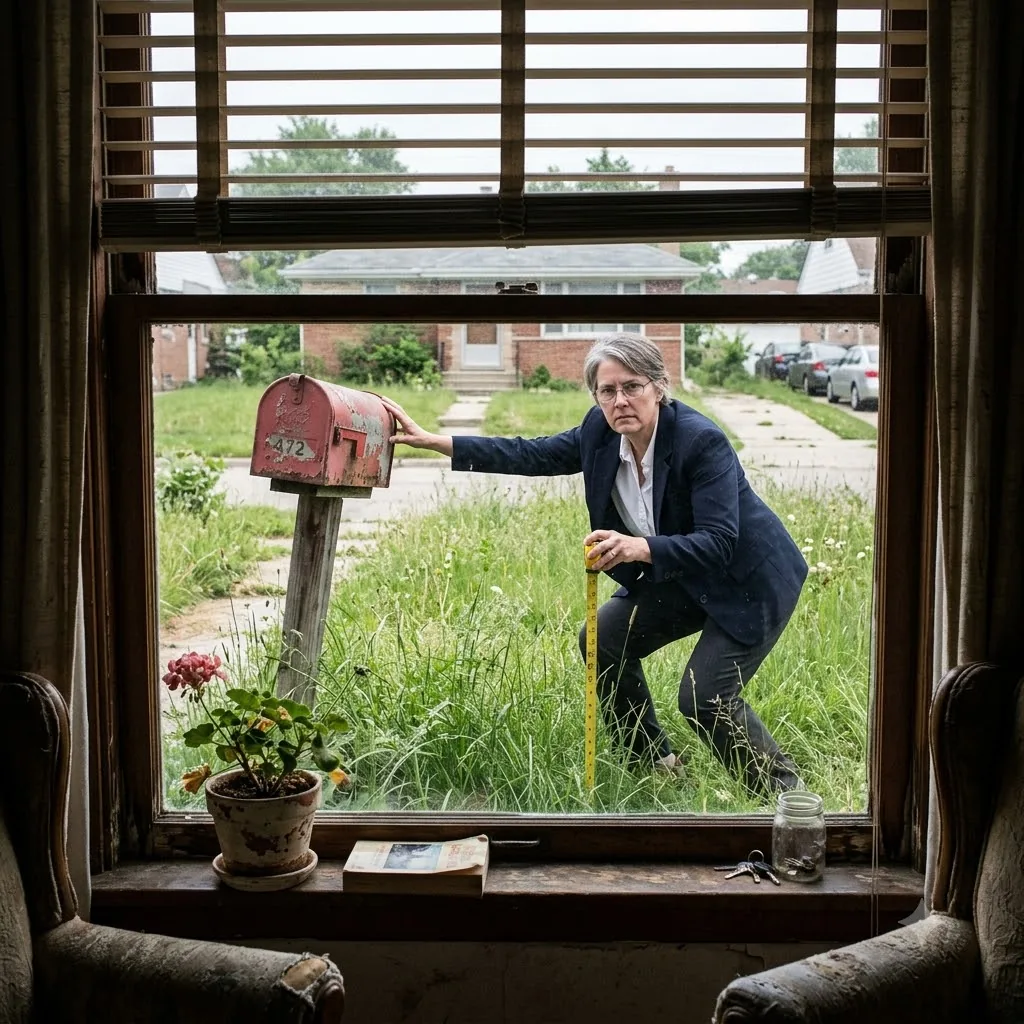
He looked out at the street. The heavy metal mailbox still sat atop its leaning wooden post. The broad sheets of black paint continued to curl and flake, the rusted metal underneath glaring defiantly in the sunlight. It was a structural compromise. It was a violation of neighborhood aesthetic guidelines. And it was going to stay exactly that way.
Yesterday afternoon, Gary had checked the box. Inside, he had found a standard white envelope bearing the HOA return address. It wasn’t a citation. It wasn’t a fine. It was a brief, formally typed letter from the board, signed with a noticeably tiny version of Brenda’s signature. It stated that due to “extenuating personal circumstances,” all exterior maintenance citations for 42 Maple Drive were placed on an indefinite administrative hold. There was no mention of the confrontation, no apology for the public shaming, and no acknowledgment of his daughter’s death. Just a quiet, cowardly retreat into bureaucratic language.
Gary watched a dark gray SUV roll slowly past his house. The driver’s side window was rolled up, but he could see Brenda’s khaki visor through the tinted glass. She didn’t slow down. She didn’t look toward his overgrown lawn, his sagging gutters, or his rusted mailbox. She kept her eyes locked rigidly straight ahead, accelerating slightly as she passed his property line.
The pristine illusion of Oak Creek was dead to him now. He looked at the perfectly manicured lawns across the street, the neutral earth-tone trims, and the hoses coiled obediently on their approved plastic reels. It all looked like a hollow, fragile movie set. It was a desperate attempt to paint over the terrifying, uncontrollable chaos of actual life. They thought if they measured the dandelions, the darkness wouldn’t find them.
Gary reached down. His scraped palm, the thick white bandages now removed to reveal healing pink skin, rested gently on the top of Lily’s head. She paused her coloring, leaning her weight into his leg, her small fingers clutching the purple crayon.
He was sixty-two years old, physically broken, and drowning in a grief so profound he still couldn’t find the bottom of it. His daughter was gone. He was starting over with a toddler in a house that was falling apart. It was an ugly, hard-fought, terrifying reality. But as Gary sat on the porch, feeling the warmth of his granddaughter leaning against his bad leg, he accepted it. He didn’t care about the peeling paint anymore. He had survived the worst the world could do to him, and he was still sitting here in the sun.