Story code: ST-000038
Part 4: Nobody Cheered When It Broke
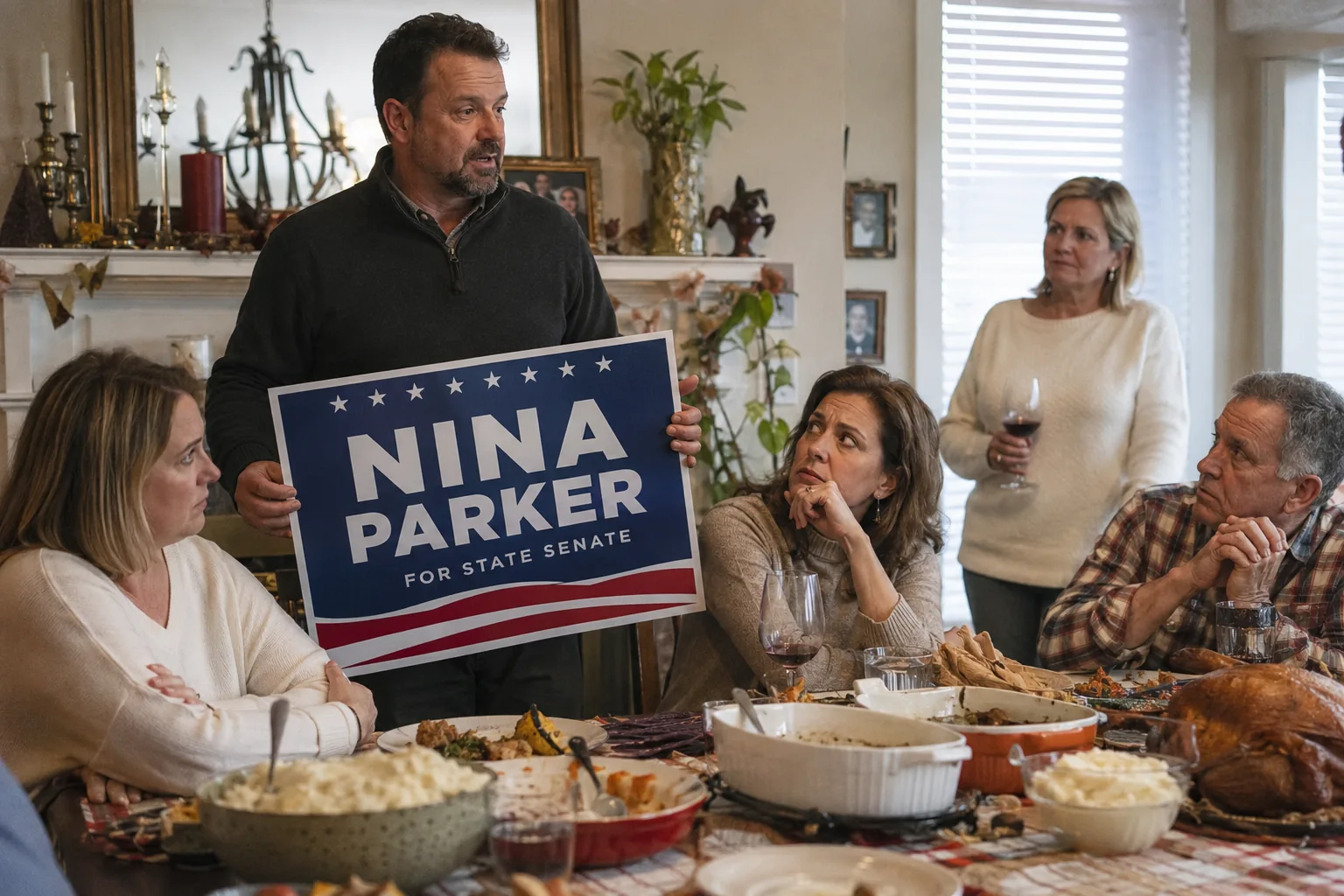
Mark did not answer Nina’s question right away. He looked at the sign where it sat against the sideboard, then down at his plate, then over at Denise like the host might hand him a bridge back into ordinary dinner.
Denise didn’t. She kept both hands in her lap.
Nina remained standing beside her chair. She wasn’t pointing anymore. She wasn’t even looking at anybody else. “Is there a county line on the sign, Mark?” she asked again.
He cleared his throat. “Not printed as a line, no.”
Nobody moved.
He tried again, voice thinner now because he had to build a new version in front of people who had just watched the first one fail. “But that doesn’t mean the inversion principle isn’t real. It means this particular display functions through implied boundary logic, which is what I was simplifying for the table.”
Ron picked up his fork, set it back down, and said, “You said textbook.”
That was all.
Mark gave a small shrug with one shoulder. “People use shorthand.”
Nina finally sat down. She folded her napkin once and laid it to the left of her plate, very neat. “No,” she said. “You used a made-up term to call me ignorant in front of everyone. Then you kept changing what the term meant every time I asked you to show one real thing on the sign.”
He started to cut in with “I didn’t call you-”
She lifted one finger, not dramatic, just enough to hold the line. “You said people who don’t know the vocabulary shouldn’t posture. You said my sign placement was embarrassing. You said I was too behind to understand my own sign.” She looked down the table once, then back at him. “That happened here.”
No one contradicted her because no one could. I had heard every one of those lines from the kitchen doorway. So had everybody else.
Mark pulled his napkin off his lap and refolded it into a tight rectangle. “This family does this every holiday,” he said. “Somebody says something political, I respond, and suddenly I’m the bad guy because I know more than other people want me to know.”
Nina didn’t chase that. She just reached for the sign.
For one second I thought she was going to carry it out to the porch after all. Instead she brought it to Denise and laid it flat beside the serving dishes, face up, where everybody could see there was no county line, no district number, no precinct mark, nothing except the candidate name, the slogan, and the printer’s mark in the corner.
“I’m leaving,” she said.
Denise looked up fast. “Nina-”
“I am leaving,” Nina said again, still controlled. “Not because of the sign. Because I’m not doing dinner in a room where somebody gets to invent terms and use them on me like a leash.”
She took her phone from beside her plate and slipped it into her bag. No chair scrape, no slammed hand, no raised voice. That quiet made the whole thing heavier.
Mark looked down the table and said, “So that’s it? You get to accuse me of lying and storm out?”
“This isn’t a storm,” Nina said.
She turned to Denise then, and this was the part that changed the room for good.
“Please take me off Christmas brunch next month,” she said. “Don’t put me on the shopping split, don’t assign me dessert, and don’t plan the photo at my apartment this year. Mail Grandma’s platter back whenever you want it. I’m not hosting this family in my place after tonight.”
That landed harder than the proof had. The brunch list lived on Denise’s fridge every season. Nina always did the cinnamon rolls and opened her apartment early because it had the biggest table besides Denise’s. Everybody knew the pattern. Pulling herself out of it was not theatrical. It was logistical. Immediate. Expensive in the plain family ways that count.
Denise pushed her chair back an inch. “Nina, don’t do that tonight.”
Nina zipped her bag. “I’m doing it tonight because tonight is when he did this.”
Mark gave one short, disbelieving laugh, but it died without company. Nobody smiled with him. Nobody picked the thread up.
Ron reached for his water and spoke to Denise, not to Mark. “Take her off the list,” he said.
Denise looked from Ron to Nina to the sign lying between the plates. Then she stood, crossed to the refrigerator by the kitchen doorway, and pulled down the holiday magnet pad where she kept the brunch assignments. From where I was standing, I could see the thick black line when she crossed out NINA – BRUNCH HOST and NINA – DESSERT DROP. She tore the page off, folded it once, and set it under the salt bowl like she didn’t want it blowing around.
That was the real sound of the ending. Not a yell. A pen. Paper. A name losing its place.
Nina thanked Denise in a voice so even it almost hurt to hear. Then she looked at me and said, “Mara, could you open the front door?”
I went ahead of her through the hall. Her coat was already on the bench under the family photos. I handed it over, then the sign. She took both. Rain ticked lightly on the porch roof when I opened the door.
Behind us, the dining room stayed quiet enough that I could hear a spoon touch china once and stop.
Nina stepped onto the porch with the sign tucked under her arm and the coat over the other. She didn’t look back into the room. She just said, “Good night,” and walked to her car under the wet yellow porch light.
When I came back to the doorway, Mark was still in his chair. The place where the sign had been was empty. The page with Nina’s name crossed out was still under the salt bowl. Denise was standing beside the fridge with the marker in her hand. Ron had gone back to his plate but had not started eating again.
Nobody cheered. Nobody wrapped it up with a lesson. Dinner stayed on the table, and Nina’s place in the season did not.
That was the freedom she got.