Story code: ST-000038
Part 3: He Asked for a Test and Got One
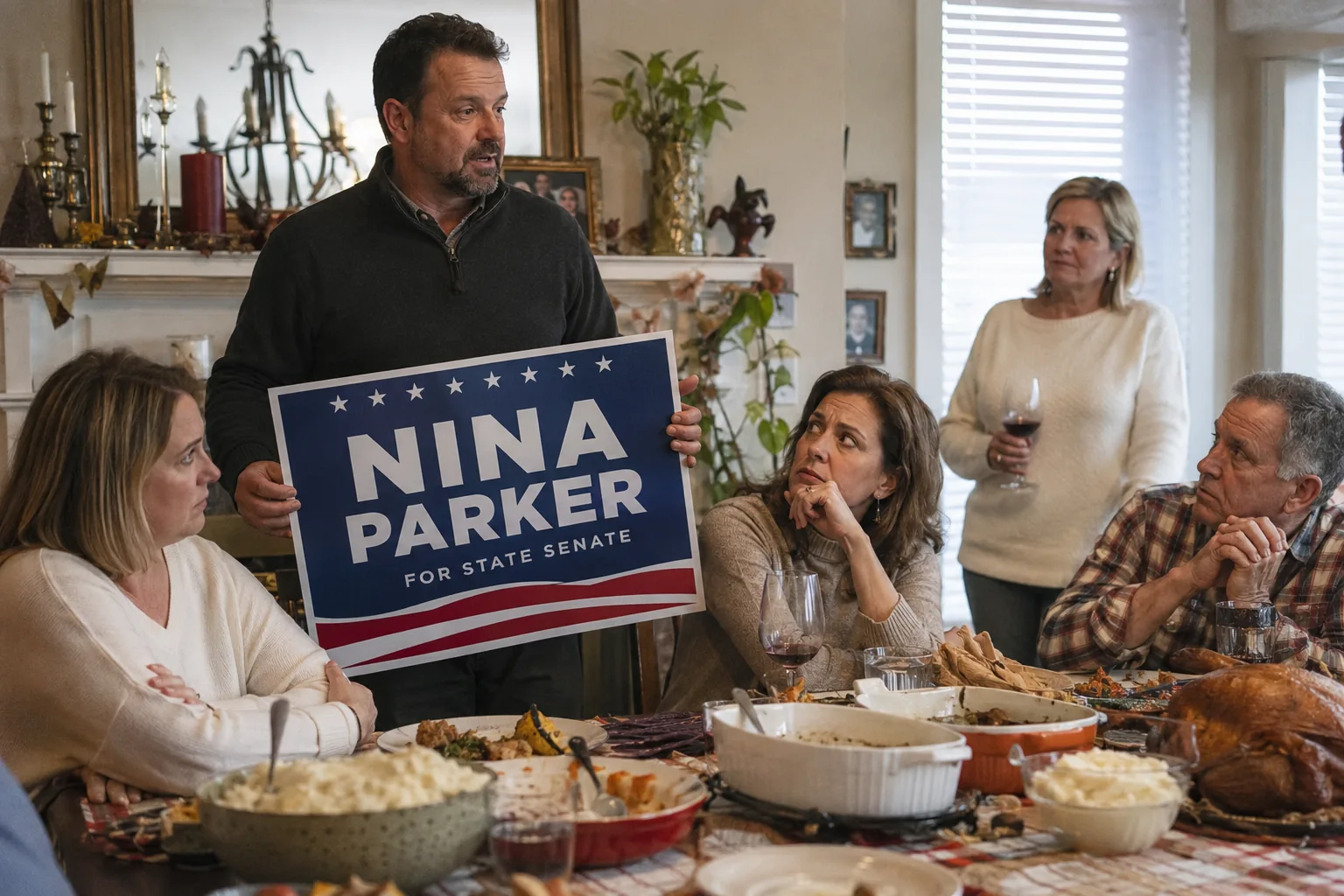
I was closest to the sideboard, so I picked up the sign when Mark said to bring it over. The metal stake clicked once against the wood on the way up. He had told everybody not to touch the orientation, so I held it exactly as it had been leaning, candidate name level, printer’s mark at the lower right.
“Set it by my plate,” he said.
I placed it against the table edge between his chair and Grandpa Ron’s, where everybody could see it. Denise opened her mouth like she might object to a yard sign sitting beside the sweet potatoes, but she didn’t. Mark put two fingers on the top corner to steady it and looked around the table before he spoke.
“Now,” he said, “if you understand inversion events, the first thing you track is the county line.”
Nina didn’t jump in. She just said, “Show us.”
Mark hovered his fork handle over the center of the sign, then the bottom, then the side, as if one of those places might turn into an answer if he gave it time. “It runs through the visual split,” he said at last.
Nina asked, “What visual split?”
“Between the domestic field and the campaign field.”
She looked at the board. “That’s not on the sign. That’s your room again.”
He made a tight smile and tapped the slogan. “No. Right here. Candidate name above, sentiment below. That creates a county line effect.”
From the far end of the table one of the cousins said, very quietly, “That’s a slogan.”
Nobody looked at him, but everybody had heard it.
Mark kept going like he hadn’t. “Once that line exists, the sign reverses the precinct cue inward. That’s what I’ve been saying all night.”
Nina put her hand flat beside her plate. “Okay. Let’s do exactly what you said. Plain, visible, right here. Point to the county line with one finger. Then point to the precinct cue with the other.”
He gave a short laugh. “That’s not how analysis works.”
“A minute ago it was simple enough to prove right now.”
Denise said, “Mark, just show the part you’re talking about.”
He looked at her then, quick and sharp, and back to the sign. He switched from the fork to his index finger. First he pressed the air above the candidate name. Then he dragged the finger down the center without touching the board. Then he circled the lower corner near the printer’s mark.
“It’s relational,” he said. “If I have to reduce it this much, obviously some of the terminology is going to sound flattened.”
Nina leaned forward a little for the first time all night. “You named three different places in six seconds. Which one is the county line?”
He took his hand away. “You’re being literal on purpose.”
“Yes,” she said. “Because it’s a literal sign.”
That landed harder than anything loud would have. Ron lifted his napkin from his lap and laid it beside his plate. Denise sat back in her chair and stopped pretending to serve people. I was still standing there with both hands free, looking at the board from less than a foot away. Blue letters. White border. Slogan. Printer’s mark. Nothing else.
Mark straightened the sign as if the problem was the angle. “Fine. Turn it around.”
Nina said, “Why?”
“Because inversion only shows correctly when you reverse the domestic display field.”
She answered right away. “You told Mara not to touch the orientation.”
He paused.
Nobody helped him out of that pause.
Then he reached for the sign himself, spun it halfway, stopped, and turned it back. “Actually no,” he said, talking faster now. “No, because in this case the threshold geometry already substitutes for reversal. That’s why it confused you.”
“What threshold?” Nina asked.
He pointed toward the kitchen doorway. Toward me. “The entrance axis. The guest approach changes the read.”
I was standing in the guest approach, close enough to see his fingertip shake once before he curled it back around the fork.
Nina turned in her chair and looked at the doorway, then back at the sign. “So if the approach changes the read, we can test that.”
She stood up, not fast, just clean. She took two steps to the side so she could look straight at me. “Mara, take the sign back to the sideboard exactly how it was. Then stand where you were before.”
I did it. The stake clicked again. The sign went back against the sideboard, same angle, same side facing out. I returned to the kitchen doorway with the roll basket still on the counter behind me.
Nina stayed standing beside her chair and held one hand out toward the room. “Now say the county line again from there, Mark. Show us what changes.”
He did not stand.
He looked at the sign, then at the table, then reached for his glass. This time he got it, but he left it in the air too long before drinking.
“That’s not a serious demonstration,” he said.
“It is your demonstration,” Nina said. “Your term. Your rule. Your entrance axis.”
The whole table was still. No forks. No ice in glasses. No side talk from the cousins.
Then Grandpa Ron spoke for the first time that night.
“Son,” he said, looking at the sign instead of Mark, “if the proof keeps moving, it isn’t proof.”
Mark set his glass down. He opened his mouth, closed it, and put his hand on the tablecloth beside his plate.
Nina was still standing when she asked the question that ended the argument before Part 4 had even started.
“So there is no county line on this sign at all, is there?”