Story code: ST-000527
Part 3: The Addendum Opened in Front of Everybody
Nadia did not open the addendum right away. She looked at Mom first.
“Evelyn,” she said, in the same short tone she had used for meds and sleep, “do you want this discussion to continue with everyone present?”
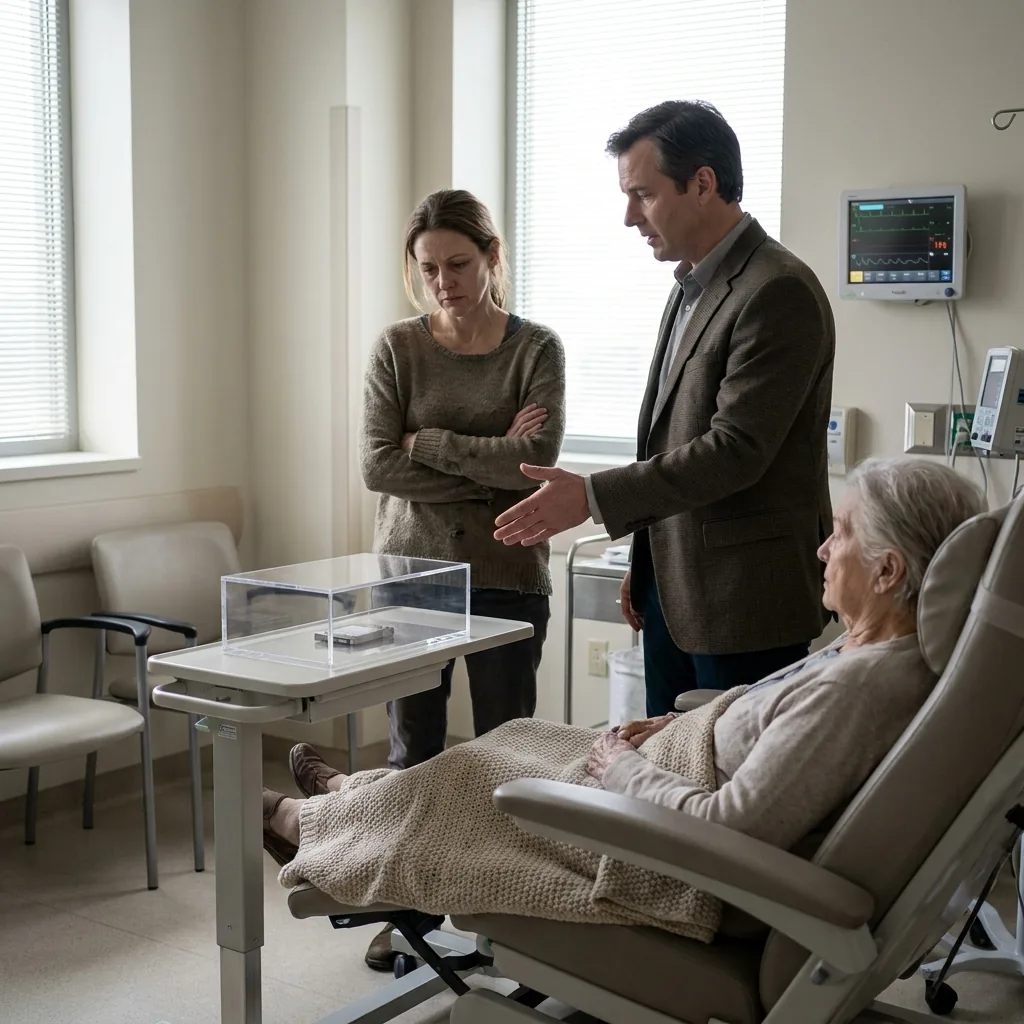
Mom’s eyes moved across the room too slowly for how fast everybody else wanted her to decide. They landed on me. Then on Trevor. Then on the clear clinic case holding the drive.
“Not if they’re going to fight over me,” she said.
Trevor stepped in before the sentence had fully settled. “No one is fighting over you, Mom. We’re trying to help Mara stop making this harder than it has to be.”
Nadia’s thumb stayed over the screen. “I asked the patient.”
That was the first time anyone in that room had cut him off that cleanly.
Dr. Vale shifted in his chair and folded his hands again, rebuilding his face into something calm. “Perhaps the addendum should be interpreted in context,” he said. “Early observations can reflect temporary family stress, not long-term best interests.”
“Open it,” I said.
My voice came out flatter than I expected. Not loud. Just done.
Nadia tapped the screen.
I could not see the words, but I could hear every syllable when she read.
“Addendum by intake nurse R. Mendoza, timestamp nine fourteen a.m. Patient entered corridor with daughter Mara Delaney providing ambulation support and redirection. Son Trevor Delaney arrived later. During pre-room wait, patient asked daughter if she had brought the blue pills, crackers, and spare underwear. Daughter produced all items immediately. Son asked where the restroom was and whether patient still needed overnight toileting assistance. Daughter answered. Son did not. Recommendation: before any accelerated upload consent discussion, confirm decision-making conditions without family pressure and verify direct care reliance.”
The corridor outside seemed to go still, even though I could still hear a cart wheel clicking over a seam in the floor.
Trevor gave one hard blink. “That’s absurd. One nurse making assumptions from five minutes of observation doesn’t define this family.”
Nadia scrolled lower. “There are linked stabilization prompts attached to the same concern flag. Seven overnight episodes in the last two weeks required intervention for confusion, swelling, missed sleep, or bathroom assistance. Respondent: Mara Delaney. Escalation contact offered to secondary family contact three times. No completed response. Secondary family contact on file is Trevor Delaney.”
Nobody looked at me when she said my name. They all looked at Trevor.
Dr. Vale tried to pull the room back. “Daily task completion still does not answer the ethical question of whether prolonging biological decline is the kindest path.”
“No,” Nadia said. “But it does answer who has standing to describe present care burden accurately.”
He gave her a thin smile. “Standing is not the same as wisdom.”
“Then answer something wise,” I said.
He turned to me.
I pointed at Mom’s chair. “If she gets overloaded and starts rubbing that seam on her cardigan like she’s doing right now, what do you do first? Not philosophically. First.”
He looked at Evelyn. He looked at me. He looked at the drive case.
Trevor said, “You lower stimulation. Anyone knows that.”
“How?” I asked him.
He lifted a shoulder. “You calm her down.”
“How?”
He did not answer.
Mom saved neither of them. She tugged once at my hand and said, very quietly, “Hallway. Then cold cloth.”
“Yes,” I said. “Hallway first because if too many people touch her she jerks away, and then a cold cloth on the back of her neck.”
Nadia entered another note.
Dr. Vale’s voice lost some of its polish. “This is becoming adversarial in a way that doesn’t serve the patient.”
“You made it adversarial when you called her care possession,” Nadia said.
That one landed harder than anything I had said, maybe because it came from someone wearing a clinic badge.
Trevor straightened fast. “So now we’re punishing family members for not doing enough diaper changes? Is that the metric for whether someone can advocate for a better future?”
The nurse at the doorway finally spoke. “It’s not punishment to know who keeps a patient safe.”
Trevor turned toward the door. “You don’t know us.”
The nurse did not move. “I know what was observed.”
Mom’s fingers were still on the cardigan seam. Back and forth. Back and forth. The monitor gave another neat pulse. The drive case sat on the table with its blue strip glowing like it had been waiting all morning to be treated as more important than the woman in front of it.
I could have kept going then. I could have read every missed callback in Trevor’s face and pushed until Dr. Vale had nowhere left to stand. Instead I said, “Mom needs this room cleared down before anybody says upload again.”
Nadia nodded once, then looked at her screen and said, “Given the concern flag and contradictory advocacy claims, I am placing an immediate hold on accelerated upload intake pending direct patient rest, separate consent check, and caregiver-welfare review.”
Trevor took a step toward her. “You can’t do that because my sister put on a good show with a binder.”
Nadia turned the tablet so he could see it. “It’s already entered.”
He stopped.
Then she added, “And because the drive release token on this case is linked to the hold, that unit cannot be advanced out of family support until review clears it.”