Story code: ST-000527
Part 2: The Wrong Person Started Answering
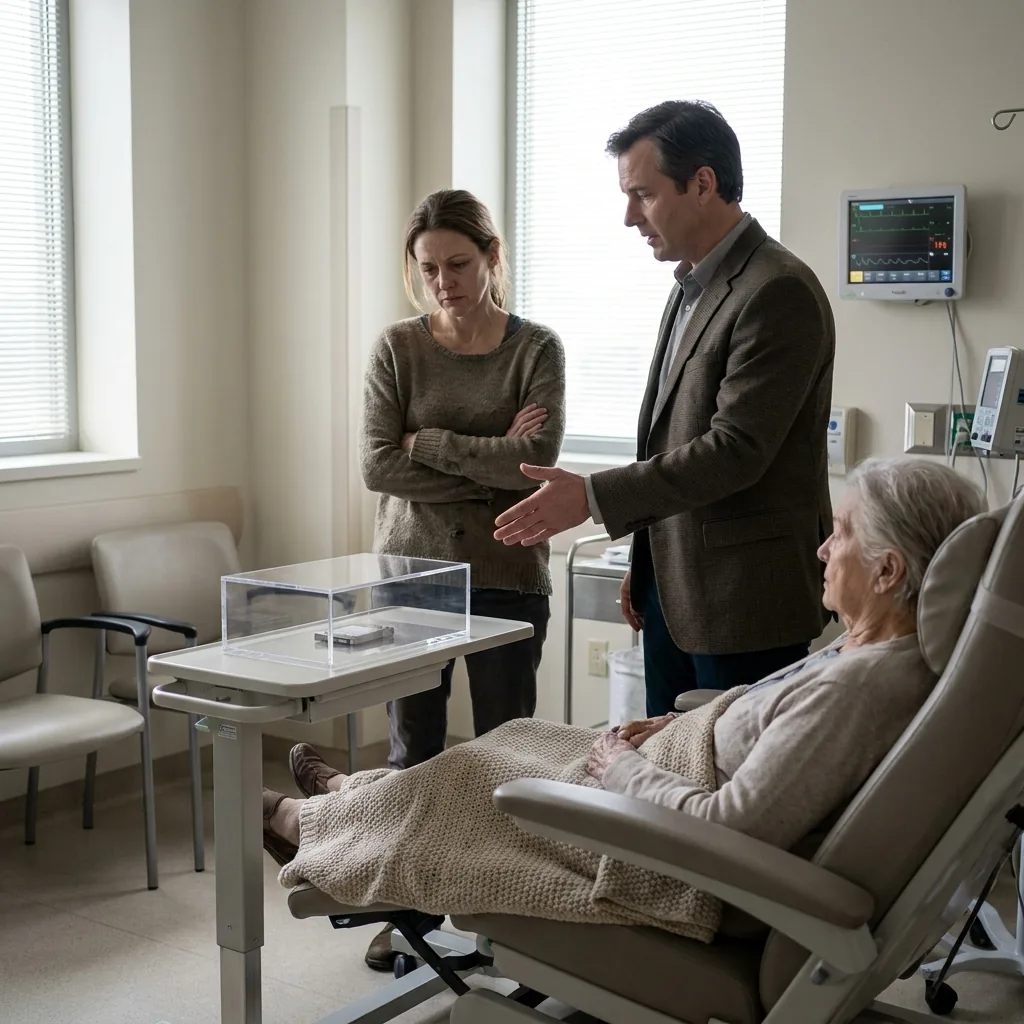
When Nadia said, “That’s not what this log shows,” Trevor laughed too fast and spread his hands like the clinic had made a cute little admin mistake. Dr. Vale turned toward her with his practiced calm, but he stopped touching the consciousness drive case. I still couldn’t see the tablet screen from where I stood beside Mom’s chair, and that made the silence feel longer.
Nadia asked, “Who has been responding to the overnight symptom prompts attached to Evelyn Delaney’s case?”
“I have,” I said.
Trevor cut in. “That’s because Mara has made herself the gatekeeper. Which is what we’ve been trying to address.”
Nadia didn’t nod. “This system records time, device source, and follow-up notes.”
Dr. Vale gave a small smile. “Care platforms often reflect the habits of whoever is most anxious. We should be careful not to confuse frequency with quality.”
I almost laughed at that, but Mom moved in her chair and pressed her knuckles to her mouth, which meant the room was already too loud for her. I crouched beside her.
“Do you want water?” I asked.
She nodded once.
I opened her cup, tilted the straw, and waited while she took two careful sips. Trevor kept talking over me.
“This is exactly what I mean,” he said. “She anticipates every need before Mom can speak for herself.”
Mom lowered the cup and said, clear enough for everybody to hear, “I did speak.”
Trevor’s mouth closed.
Nadia asked him, “What is Evelyn’s current evening medication order?”
He looked at Dr. Vale first. “That’s not why we’re here.”
Nadia repeated it. “What is the current evening medication order?”
“She takes what Mara gives her,” he said.
I stood up. “Half tab clonazepam only if she starts the hand tremor after eight. Full blood pressure dose at seven. No sleep aid unless she’s already eaten.”
Nadia entered something. “And what changed last Tuesday?”
“The compression socks came off before dinner because her ankles were chafing,” I said. “And I shifted the second blood pressure reading later because she’d just gotten out of the shower the first time and it was throwing it off.”
Trevor gave me a disgusted look, like precision itself offended him. “You hear how she talks? Like Mom is a project.”
“No,” I said. “Like Mom is a person whose body keeps making demands whether you’re around or not.”
Dr. Vale leaned in, voice warm, controlled, almost tender. “Mara, nobody is denying your labor. The question is whether that labor has become a reason to resist her next form of care.”
I said, “You keep calling it care, but you can’t answer one practical question about the care she needs right now.”
He opened one hand toward the drive case. “Because the point of this technology is to move beyond the failing logistics of flesh.”
Nadia looked up again. “Today’s intake requires observed condition and caregiving history tied to present welfare.”
He turned to her with that same soft authority. “Of course. But if we let one overwhelmed relative define welfare only in terms of maintenance, we can do harm by delay.”
Mom’s fingers started rubbing the seam of her cardigan. Back and forth. Back and forth. That was one of her tells before she shut down completely.
I said, “Mom, do you want a break from this room?”
Before she answered, Trevor said, “Please don’t coach her.”
My whole body went still.
“Coach her?” I said. “I asked if she needed a break.”
“You always redirect when things get difficult,” he said. “You step in, you soothe, you make yourself necessary, and then somehow no decision can happen without you.”
He said it in front of a nurse passing the open door, in front of Nadia, in front of Dr. Vale, in front of our mother sitting under clinic leads with her cardigan half off one shoulder because I had been busy defending the fact that I kept her alive between appointments.
I picked up the cardigan and set it right again. “Do you know how to fasten her left sleeve without hurting her wrist?” I asked.
Trevor’s face tightened. “That’s not relevant.”
“It is if you think love is a speech.”
Nadia turned the tablet so it faced Trevor. I could only see the glow against his shirt and the way his eyes moved, fast at first and then slower.
“These are the six-week stabilization notes,” she said. “One consistent respondent. One physical caregiver listed in the symptom escalations. One family member present at the pre-intake training demo. That family member was not you.”
Trevor didn’t answer.
Dr. Vale stepped in smoothly. “Again, practical participation should not be weaponized to shame relatives who support higher-order decisions.”
Nadia said, “I’m not shaming anyone. I’m clarifying the case record because the discussion in this room is treating the active caregiver as an obstacle.”
The nurse at the door did not move on. Another staffer slowed in the corridor. No one said a word, but the shape of the room changed a little. Not in my favor yet. Just away from Trevor’s performance.
Mom lifted her hand toward me again. I took it.
Nadia scrolled. “There’s also a note attached to this morning’s assisted intake.”
Trevor straightened. “What note?”
She read without drama. “Patient arrived clean, hydrated, appropriately layered, with updated meds, incontinence supplies, food accommodations, and a complete symptom binder prepared by caregiver Mara Delaney. Patient repeatedly looked to Mara for direct comfort regulation. Upload readiness discussion may be compromised by family pressure inconsistent with observed care history.”
Nobody spoke for a full beat after that.
Then Dr. Vale said, very carefully, “Who entered that observation?”
Nadia’s thumb rested on the screen. “It wasn’t me,” she said. “It was logged before I entered the room, and it includes a flagged addendum I have not opened yet.”