Story code: ST-000527
Part 4: They Had to Take the Drive Off the Table
For one second nobody in the room reacted, like the words had not reached them in the right order.
Then Trevor said, “No.”
Not loud at first. Just sharp and automatic.
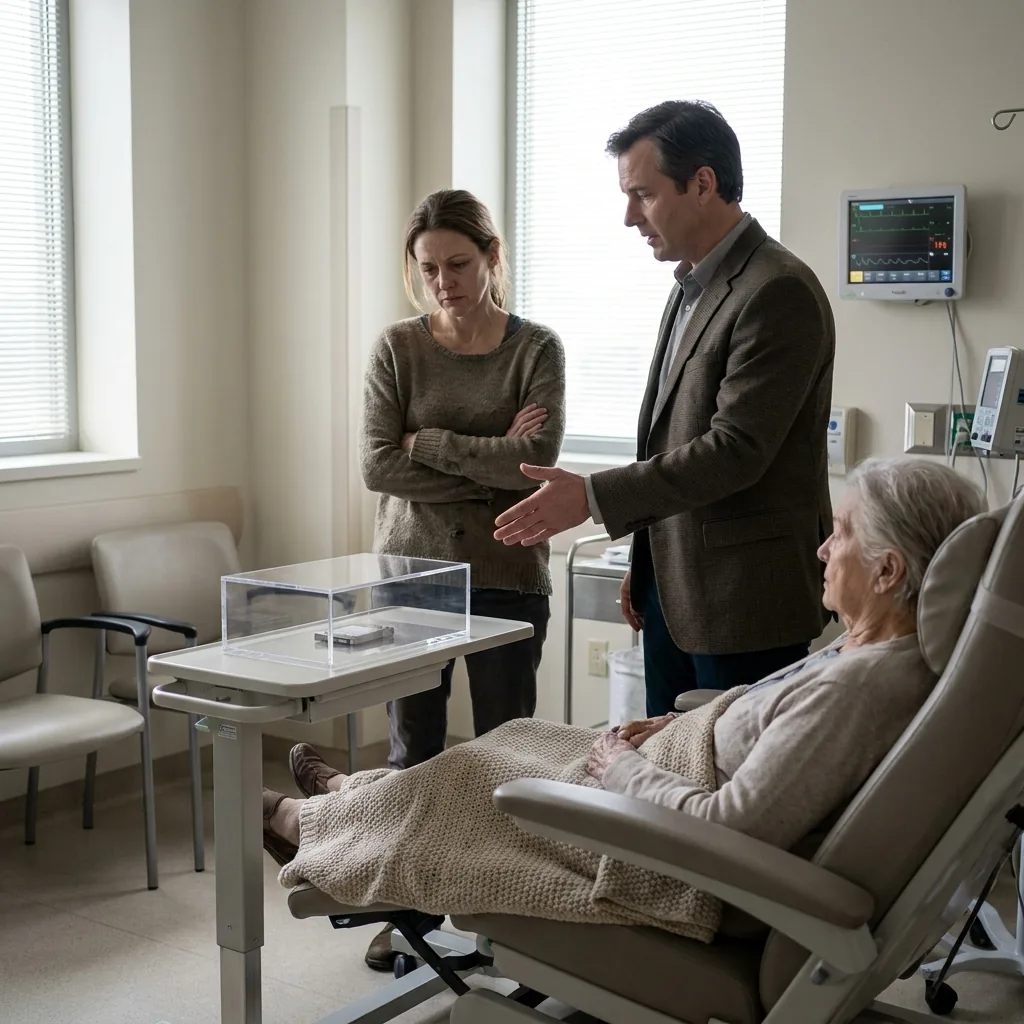
He turned toward the clear case as if he could fix the problem by getting closer to it. The blue strip under the foam insert kept pulsing. Dr. Vale stood up so quickly his chair legs scraped the floor.
“A temporary hold should not freeze a family’s chosen treatment pathway,” he said. “Not on the basis of interpretive bias.”
Nadia stayed seated. “It’s not temporary language. It’s an intake lock tied to observed patient welfare and disputed care authority.”
He held out his hand. “Let me see the record.”
“You can review it through case procedure,” she said. “Not by taking over this room.”
Trevor looked at Mom then, finally, but not in a way that helped her. “Tell them,” he said. “Tell them this is what Mara wanted. Another delay. Another excuse.”
Mom did not answer right away. She was staring at the drive case.
I knew that look. Too much brightness. Too many voices. Too many people asking her to prove something while her body was still strapped to wires.
I leaned down beside her. “Mom, do you want the hallway now?”
She nodded.
Dr. Vale spoke over her. “Evelyn, before you leave, I think it’s important to affirm whether your daughter’s fear is speaking for you.”
That did it.
Nadia stood. The nurse at the door stepped fully into the room. Another staffer in gray scrubs appeared behind her in the corridor.
“Do not question the patient while she’s showing overload after a hold has been placed,” Nadia said. Her voice did not rise. It didn’t need to. “And do not frame this as the daughter’s fear when the chart in my hand documents her as the active caregiver and your claims as materially incomplete.”
Nobody apologized. Nobody rushed to me with shame on their face. The change was uglier and more real than that.
Trevor’s mouth stayed open a second too long before he shut it. Dr. Vale’s hand dropped from midair. The two staffers in the hall did not leave. Even the nurse who had only been passing by now watched Trevor instead of me.
I started disconnecting what I could reach without touching the leads I wasn’t supposed to remove. I took Mom’s water, my binder, the cardigan sleeve that had slipped again.
Trevor moved toward the chair. “I’ll take her.”
Mom pulled her hand back from him so fast the pulse lead twitched.
“No,” she said.
It was the clearest thing she had said all morning.
The room heard it.
I looked at Nadia. “Can we move her to the intake corridor bench until she’s steadier?”
“Yes,” she said. Then, to the nurse: “Please assist Mara, and remove the drive unit from the consultation table while the hold is active.”
That was the visible thing. More than the tablet. More than Trevor going pale around the mouth. The nurse crossed to the table, picked up the clear clinic case with both hands, and carried it to the wall cabinet by the sink. She scanned her badge, opened the cabinet, placed the case inside, and locked it again.
The little blue strip disappeared behind frosted glass.
Trevor made a choking sound in the back of his throat. “You are humiliating us in front of staff over a family disagreement.”
“No,” Nadia said. “I’m documenting that a patient under pressure needs protection and that the current advocacy claims do not match the care record.”
Dr. Vale tried one last time. “Then document that I object to this characterization and that the daughter has repeatedly obstructed progress.”
Nadia looked at him for a beat. “I will document that you attempted to continue a high-pressure consent discussion after the patient asked for less conflict and after overload signs were observed.”
He went still.
That was when I understood I could keep swinging. I could say every small thing Trevor had skipped for months. I could ask him about the nights Mom sat on the edge of the bed crying because she could not get her socks off and he had sent a heart emoji instead of calling. I could make him answer in front of all of them.
Instead I slid one arm behind Mom’s shoulders and the other under her elbow.
“Eyes on me,” I said. “We’re just going to the bench. Slow step. Then cold cloth.”
She nodded once.
The nurse helped with the leads. Nadia opened the support room door wider. Staff in the corridor moved back to make space, but none of them pretended they had not heard what they heard.
As I guided Mom into the hall, Trevor said my name.
I did not stop.
He said it again, louder. “Mara.”
I turned enough to face Nadia, not him. “Please note that no one discusses upload with her unless she’s rested and spoken to without me being blamed for answering care questions.”
Nadia lifted her tablet. “Already added. Separate consent check only. Active caregiver participation required for welfare review.”
That was the cost. Not a speech. Not a reconciliation. A formal restriction entered while witnesses watched.
Trevor looked at Dr. Vale. Dr. Vale looked at the locked cabinet. The nurse stood between them and the table that no longer held the drive.
I walked my mother to the intake corridor bench and sat beside her while the clinic hummed around us. People passing by glanced in, then glanced away too late. Behind the frosted glass, the drive’s blue glow was only a blur now.
Mom leaned her head against my shoulder for one second and said, “Too much future in that room.”
“I know,” I said.
Inside the support suite, nobody had their old voice anymore.