Story code: ST-000658
Part 2: The Room Started Acting Like His Word Was Procedure
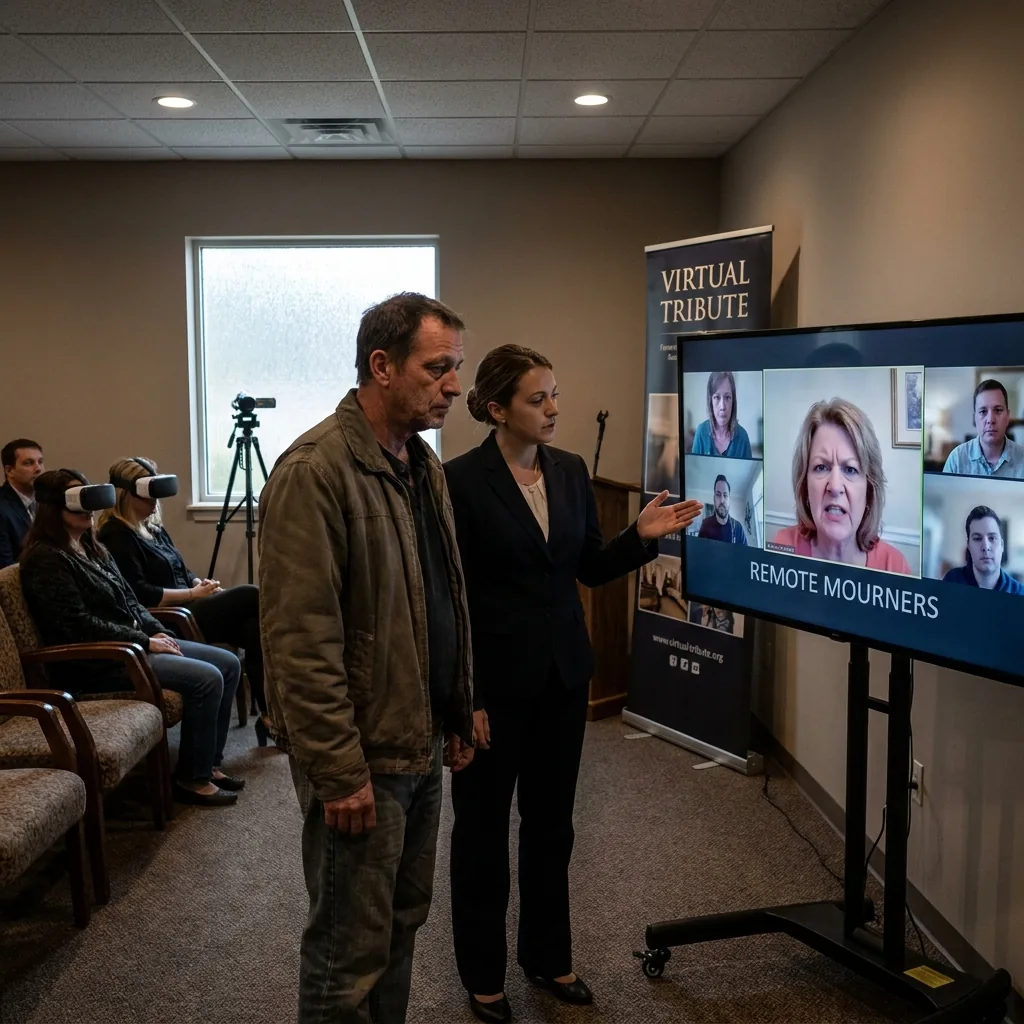
By the time Evan Pike finished explaining his so-called condolence buffer, the problem was bigger than one rude interruption. His words had started acting like procedure in the room, and every second we delayed made him sound more official. I was still at the side table with the laptop open and the headset dock light blinking, and the family was waiting for me to touch a button that I suddenly was not supposed to touch without his approval. Noah kept his voice low and formal. “Mr. Pike, for clarity, what exactly is the condolence buffer?” Evan answered without a pause. “It’s the emotional latency partition between passive viewers and immersive entrants. If Mara launches the tribute while the partition is unstable, you’ll get cross-channel memorial bleed. That is why I stepped in.” He said my name like we were colleagues in the same system instead of a man on a screen talking over a family memorial. Leah stayed where she was near the front row, one hand on the back of a chair. Her eyes moved from Evan’s tile to me to the headset station. Dana did not say anything. She had gone very still except for her thumb rubbing the folded edge of the printed program. I said, “The page doesn’t show anything called a condolence buffer. It gives me viewer access, headset access, and audio mirror.” Evan tilted his head just enough to make disagreement look patient. “End-user pages don’t expose the partitioning layer. They simplify it so people don’t misfire the sequence.” There it was again. He had an answer ready for every plain label in front of me. Noah stepped toward the side table. He did not crowd me, but he was close enough to see the laptop screen. “Can we run the tribute the standard way without causing a problem?” Before I could answer, Evan cut in. “Not if someone already challenged the handshake conditions out loud. Once the room starts second-guessing the immersive path, you need a clean reset window.” Dana looked up at that. “I asked a question,” she said, very softly. Evan spread one hand toward his camera as if he were calming her from inside the monitor. “And that’s fine. I’m just trying to protect the integrity of the memorial.” That sentence did more damage than the jargon. It made his interruption sound generous. I moved the cursor over the viewer option, then off it again. Noah saw me looking. He said, “Mara?” I kept my voice even. “I can tell you what the link does on this screen. I can’t confirm terms he’s adding that aren’t on the system.” The speakers gave a faint hiss before Evan came back in. “That is exactly the kind of narrow operational thinking that causes tribute fragmentation. With respect, room techs often only know the visible layer.” He had found the hierarchy he wanted: family beneath him, me beneath him, and Noah pushed to choose between keeping the service moving or challenging a man who sounded specialized. Noah glanced toward Leah. In rooms like that, the smallest family decision changes the whole temperature. Leah took two steps down the aisle until she was closer to the side table. She did not raise her voice. “Can my mother watch without the headset, yes or no?” I answered her directly. “Yes. From what is on this page, yes.” Evan came in over me. “Not safely if the condolence buffer has already been disturbed.” Leah looked at the display screen for a long second, then at the laptop, then at the black headset with its strap laid neatly beside it. “How would anyone in this room know that?” That question sat there. Even Noah did not fill it right away. Evan smiled, small and composed. “By understanding memorial threading. I know this language sounds foreign if you haven’t worked with immersive grief environments, but there are reasons these systems are not crowd-managed.” He was not loud. He did not need to be. The effect was the same as a door closing. Noah cleared his throat. “Leah, we can skip the VR segment if you’d prefer.” Dana’s head came up fast at that. She looked from Noah to the headset station to the screen. The family had spent the week talking about that tribute. I had heard it during setup, heard people mention the places the deceased loved and the remote relatives who wanted to step through that digital room together. Skipping it would keep the peace, but it would also hand the whole choice to the man on the monitor. Leah asked me, “If you had to prove what it does, can you do that from here?” I looked at the laptop, then the mirrored display, then the headset station. Everything we needed was already in the room. I did not have to call anybody or pull records or leave the floor. A viewer link could be opened on the side display. The headset feed could be started separately. The room could watch what happened. “Yes,” I said. Noah’s jaw shifted once. “During the memorial?” “It would take less than a minute if we’re only checking what appears on launch,” I said. Evan leaned closer to his camera for the first time. “That would be reckless. Live testing during a memorial is how you trigger archive shear after a compromised buffer. If Mara does that now, any failure will be on her, not the platform.” The phrase landed hard because it was built to. Archive shear. Compromised buffer. Failure on her. He had stacked the blame before anything happened. But the screen in front of me was still plain, almost blunt in its simplicity. Viewer access. Headset access. Audio mirror. No warning banner. No locked sequence. No hidden status line spinning through a sacred technical mystery. Leah put her hand flat on the edge of the side table and looked at Noah, not Evan. “I don’t want him deciding what my family gets to see because he.