Story code: ST-000658
Part 3: I Let the Screen Answer Him
Leah did not finish the sentence right away. She kept her hand on the side table and looked at Noah until he answered her instead of the screen.
Noah folded his run sheet once, sharply, and slipped it under his arm. “One minute,” he said. “Mara, show only what the system does when you open it. No commentary beyond that.”
Evan’s voice came back quick through the speakers. “Noah, I need to be very clear that a live launch under compromised conditions is not a neutral demonstration. If the condolence buffer has already taken noise, your result will be invalid on sight.”
Noah did not look at him. “Mara.”
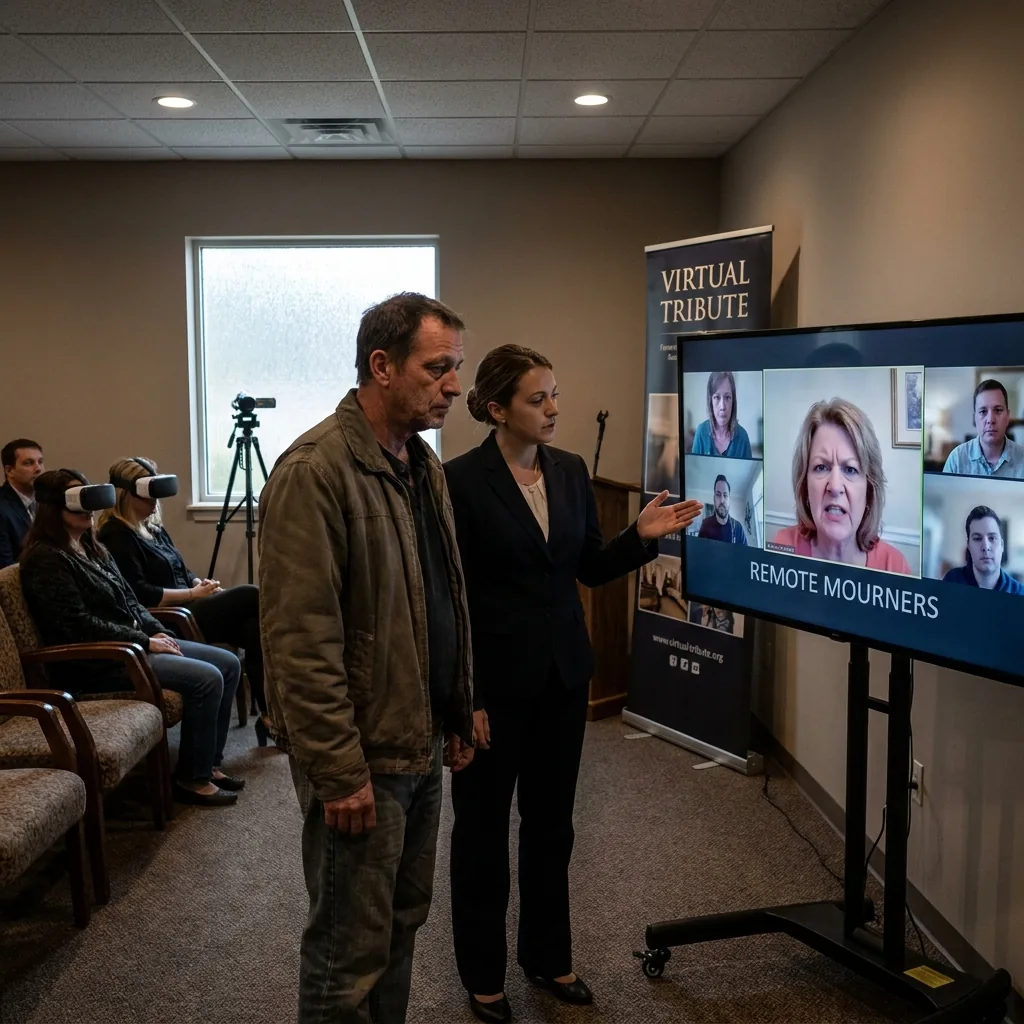
I moved the laptop a few inches so Leah and Noah could see the screen without leaning over me. On the wall display, Evan’s call tile stayed large in one corner. I dragged the browser window onto the main screen beside it so the room could watch my cursor.
“This is the memorial link page,” I said. “These are the options it gives me here. Viewer access. Headset access. Audio mirror.”
I read each label exactly as it appeared.
Dana had stepped closer without anyone noticing. She still had the service notes in her hand. The paper was bent in the middle where her fingers had been pressing it.
Evan gave a thin smile toward his camera. “Visible labels are not the architecture. Please do not confuse a family-facing menu with the underlying handshake state.”
I clicked viewer access.
The browser opened a plain waiting screen with the memorial title and a button that said Enter as Viewer. No alert appeared. No lockout. No warning about sequence. I clicked the button.
The tribute room loaded on the display: the digital memorial space we had built, the still photographs set along the virtual wall, the soft entry music coming through the room speakers at low volume. No error banner crossed the screen. No delay box asked for an immersion handshake. The page simply loaded as a viewer page.
Nobody said anything for a beat.
Then Evan talked over the music. “That proves almost nothing. Passive shells can render before the partition stabilizes. The issue is whether the immersive side has been contaminated by the premature viewer call.”
His pace had changed. The polished pauses were gone. The words came faster now, stacked tight.
I closed the viewer tab and went back to the link page. “Now headset access,” I said.
Noah gave one small nod.
I clicked the headset option. The headset station beside me woke with a soft tone. On the laptop, the launch window opened with the usual pairing prompt and the same two lines I had seen in setup all week. Connect headset. Start tribute session.
I turned the laptop slightly so Noah and Leah could read it. Then I touched Start tribute session.
The headset feed appeared in the preview window. Same memorial room. Same photographs. Same entry music. No interruption. No warning. No mention of condolence buffer, memorial threading, grief-continuity layer, or archive shear.
Evan spoke immediately. “You can’t validate that without checking the emotional latency partition. You’re showing the shell, not the threaded environment.”
Dana looked up at the wall display. “Where would that be written?”
He answered her too fast. “It wouldn’t be exposed there.”
I said, “Then tell me one visible thing in this setup that should happen if the buffer is real. One thing we can watch from this room.”
For the first time since he came on screen, Evan stopped long enough for the speaker hiss to show through.
Leah turned from the display to the headset on the draped table. “Mara, if I put that on right now, what happens?”
“You enter the same tribute room,” I said.
Evan cut back in. “Not safely. The partition can still be carrying the earlier objection.” He said objection like it had become a technical event.
Noah’s eyes stayed on the launch window. “Earlier you said opening viewer access first would disturb the handshake. We opened it first. The headset session still launched.”
Evan straightened in his frame. “Because contamination can present later. That’s exactly what I’m trying to explain. These failures are deferred.”
Noah asked, very evenly, “Deferred where?”
Another pause.
On the laptop preview, the tribute room kept running without a flicker. Entry music. Photos. Navigation marker. Nothing else.
Leah picked up the headset strap and let it fall back against the cloth. “So every time something works, there’s another invisible layer we’re supposed to trust you about.”
Evan’s jaw shifted once on screen. “I’m the only one here speaking from experience with immersive grief systems.”
Dana took one more step toward the side table. Her voice was still quiet, but it carried. “Then say one term that’s actually on that page.”
Evan looked straight into his camera and answered with the same smooth cadence he had used from the start, but now it had a hard edge to it.
“The platform does not use consumer labels for memorial threading. That’s why people who don’t know the backend keep making these mistakes.”
Nobody moved.
The headset preview continued running in the corner of the laptop like a small, stubborn fact. Noah reached past me, touched the trackpad once, and opened the settings drawer attached to the session window. It was short enough for everyone nearest the table to read.
Session mode: Viewer.
Audio mirror: Off.
Headset connected: No.
Leah said, “The headset isn’t even on yet.”
On the wall display, Evan’s face stayed centered and neat, but he did not answer her for three full seconds. That silence did more than any argument I could have made.
Then Noah said, “Let’s finish this after the memorial,” and clicked Evan’s microphone tile to mute the room feed from our side.