Story code: ST-000836
Part 2: The Pattern Started Looking Built
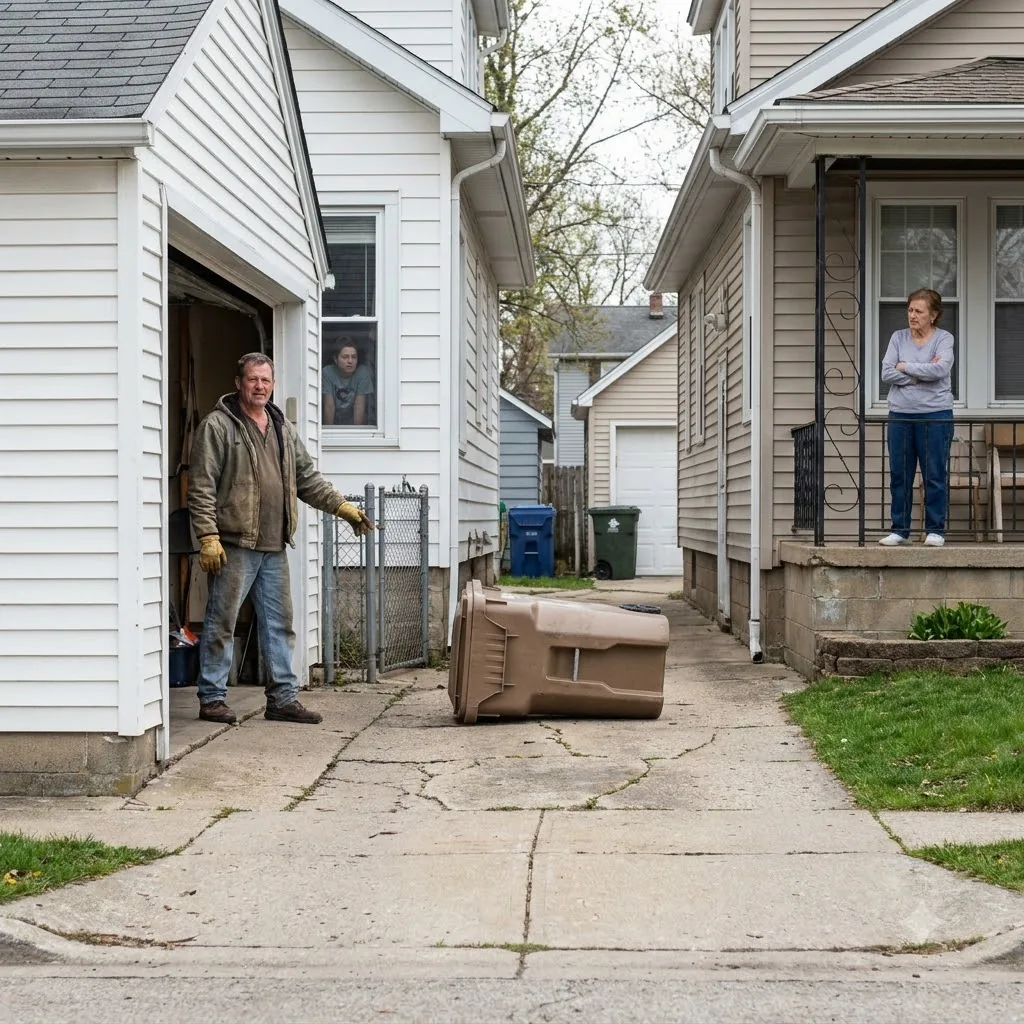
After I watched Diane swing that bin around like she’d been doing it for years, I stopped arguing with her explanations and started watching her timing. That was the part that changed the whole thing. The messes still looked small from a distance, but up close they had the same shape every time: she fumbled only when the fumble would leave the work sitting with us. I didn’t say much that afternoon. Luis did. He stood at the garage opening with a roll of contractor bags in his hand and said, “So the wheels work fine after all.” Diane had the casserole-dish woman beside her. She laughed once, too quickly, and said, “I just got lucky with the angle.” Luis nodded like he heard her. “Funny how the lucky angle only shows up when you’re not asking Mara to finish it.” The woman in scrubs looked from him to the curb, then back to Diane. Nobody raised a voice. Diane picked up the foil-covered dish with both hands and said she had to get inside before it got cold. The next week, I paid attention to details I had been pushing aside because they seemed too petty to list out. Which way the lid was facing when she claimed she didn’t know how to set it. Where the wheels sat when she said the driveway slope pulled it wrong. How often she called for help only after the bag had already split or the can had already tipped. She never asked before the part that made more work. Always after. Monday night, Caleb came out with our kitchen bag and had to stop because Diane’s recycling bin was angled into the center again. He looked at it, then at me. “I’m not moving her stuff anymore.” He said it flat, not loud. He set our bag back inside our bin and waited until I squeezed past to straighten hers just enough to clear space. From her porch Diane called, “Sorry, I thought I tucked it in.” Caleb didn’t answer. He just got in the car and backed out slow. On Wednesday, the lid on Diane’s trash bin was propped open with a pizza box corner, and rainwater had pooled inside. Thursday morning she dragged the bag up, the bottom gave out, and half the wet garbage slid onto the concrete near the side strip. She saw me in the garage and called, “Mara? Can you give me a hand? I don’t know how that keeps happening.” I stayed where I was and said, “Tie the next bag before you lift it.” She stared at the mess for a second, then said, “I can’t hold the lid and the bag and the handle all at once.” Luis was replacing a shelf bracket near the wall. Without looking up, he said, “Then do it in steps. Lid first. Bag second. Handle last.” Diane made a little sound through her nose, as if the whole situation had worn her out. Then she stood there until I came over with a fresh bag and gloves, because I did not want that pile sitting all day between our houses in June. She thanked me, and while I was cinching the replacement bag she said, “You’re just better at these practical things.” That line sat with me all afternoon because it wasn’t about the trash. It was a way of naming me as the one who would finish whatever she started badly. By then even Caleb could predict the sequence. If pickup day was early, Diane would appear late with one wheel off the concrete seam. If the bags were heavy, she would drag instead of roll. If someone else was nearby, she got clumsy. If no one was close enough to be useful, her bin somehow made it where it needed to go. Luis noticed the same split in real time the following Tuesday. He had come by before work to drop off a tool, and we were both in the garage when Diane edged her trash bin out from the storage spot. She saw us immediately and gave the handle two weak tugs. The bin knocked against the wall. The lid bounced open. “Shoot,” she said. “It’s wedged again.” Luis walked to the edge of the slab but didn’t touch anything. “What’s wedged?” She pointed vaguely at the wheels. He crouched, looked, and said, “Nothing’s touching the wheels.” Diane changed direction without missing a beat. “Then it’s the slope. It always pulls away from me.” The driveway there is flat enough that rainwater sits instead of running, and all three of us knew it. She kept one hand on the bin and one hand lifted a little, like she was presenting an impossible machine. After she went back inside, leaving the bin half turned again, Luis stayed crouched another second, then stood up and wiped his hands on his jeans. “She only needs one audience member,” he said. I looked out toward her porch. “I need something cleaner than saying that.” He nodded once. “Then stop rescuing her where she expects it.” That was easier said than done when the cost sat in the heat and smell on our side. Still, we started talking in the narrow practical way the driveway taught us. Not about catching her in a speech. Not about cornering her in front of anyone. Just about what the task actually required. The hidden part was the pivot. You had to line the wheels, pull the handle back just enough, then swing through the pinch point by the garage without clipping the wall or blocking the center. That was the exact move she kept failing at when we were there, and the exact move I had already seen her do cleanly. By Friday, Luis had a plan that used nothing except the bins, the driveway, and one simple missing chance to ask me for help. If it worked, Diane would either leave her own trash sitting there for the truck to.