Story code: ST-000978
Part 4: She Left With the Cost in Her Hand
That was the moment the room stopped belonging to Graham.
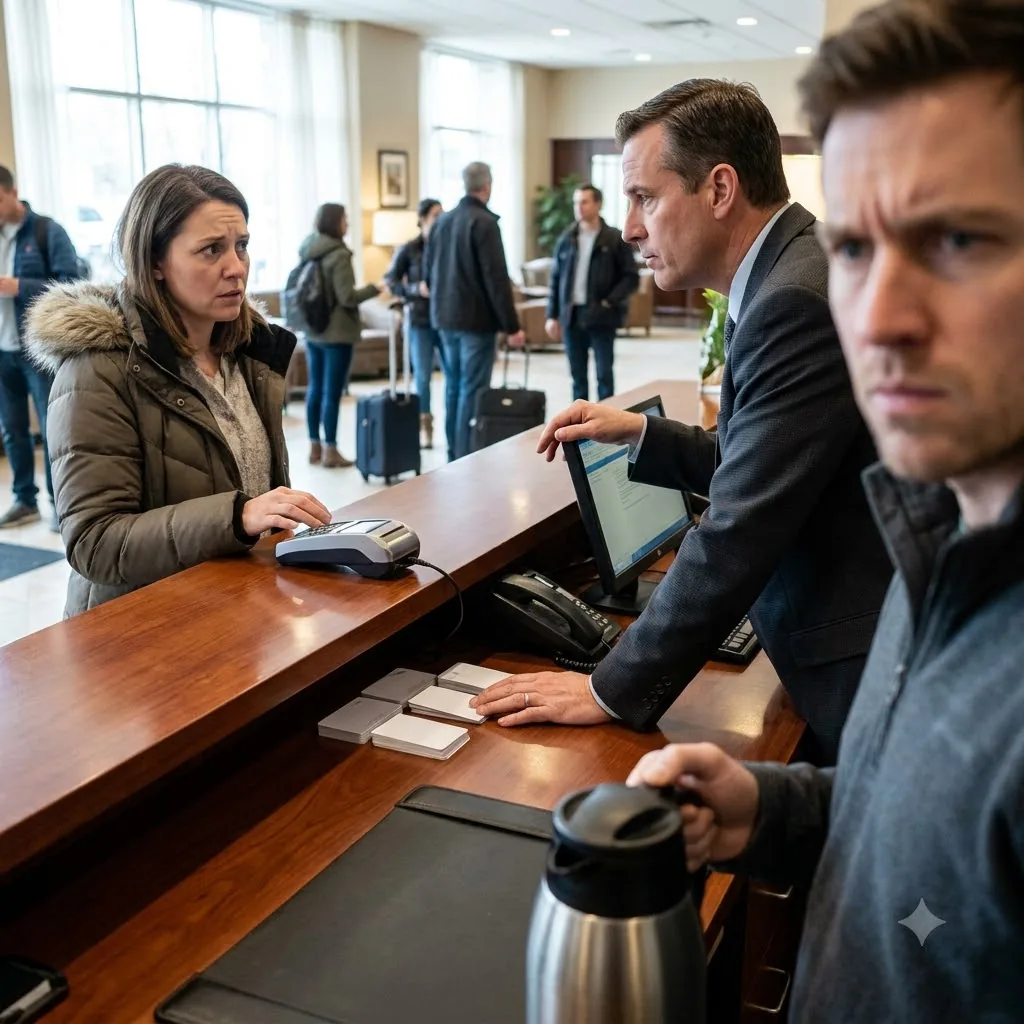
Not because anyone challenged his title. Not because somebody important came out of a back office and overruled him. It was simpler than that. He had built a whole public lesson around “occupancy alignment” and “threshold contamination,” and the card reader had answered him in two plain beeps.
Graham looked at Marisol, then at the terminal. “Your stay is active,” he said.
“I heard that part,” she said. “I also heard everything before it. I’m not going back upstairs like none of that happened. Reverse tonight and check me out.”
The father by the elevators turned away then, finally herding his family inside when the doors opened. The woman behind the rope line stepped forward one place without being called. The lobby noise resumed at the edges, but the quiet around the desk held.
Graham’s hand settled near the keyboard again. This time he used it. He clicked into her reservation, eyes on the screen. No speech about chain-of-possession. No little lecture to the room. Just work.
“There will be an early departure adjustment,” he said.
“Fine,” Marisol said.
He paused. “And because the booking was within the cancellation window, tonight will still bill.”
Her fingers closed around the strap of her bag again. She nodded once. It was a small movement, sharp and final. “Print it.”
That was the bitter part of it. The machine had shown she should have been able to get back into her room without being treated like a security problem, and she was still the one leaving with a charge attached.
Graham printed the folio. The printer behind him started up and kept running longer than before. He tore the pages free, stapled them, and set them on the counter beside the two keycards. Then he reached for the new keycard sleeve as if to include it.
Marisol stopped him with one sentence.
“I don’t want another key.”
He let go of the sleeve.
DeShawn came around the end of the desk then, not into the center of it, just enough to stand near the lobby side where a guest could take papers without leaning in. He put a pen beside the folio because that is what staff do when they need their hands busy.
Marisol looked down at the charges. She did not narrate them out loud. She just traced one line halfway across the page with her finger, then lifted her hand. “So I pay for tonight, and I’m checked out now?”
Graham nodded. “Yes. Once I finalize it, the room keys deactivate.”
There was another quiet there. Not dramatic. Just clean.
She took the folio, her ID, and then, after a second, the original keycard only. She left the freshly encoded one on the desk.
That landed harder than if she had thrown it.
“Finalize it,” she said.
Graham looked at the card she had left behind. It was the one he had made after all the explaining, the one meant to smooth over the proof by moving past it. He turned back to the terminal and worked through the checkout screens. A few keys clicked. The printer did not start again.
When he was done, he placed a small zeroed checkout slip beside the abandoned keycard. “You’re checked out, Ms. Vega.”
She tucked the folio under her arm and held the old card between two fingers for a second, almost the way he had held it earlier. But there was no performance in it. She set it down on top of the final slip.
“Then keep both,” she said.
She pulled the handle up on her overnight bag and turned toward the lobby doors.
No one clapped. No one told Graham off. DeShawn picked up the extra keycard and laid it flat beside the first one, two pieces of plastic suddenly ordinary again. The woman behind the rope line stepped up to start her own check-in, but she looked at Marisol as she passed, then looked back at Graham before saying a word.
Marisol crossed the tile in a straight line, folio in hand, bag rolling behind her. The automatic doors opened. Hot outside air pushed in for a second and lifted one corner of the paper she was carrying. Then she was gone.
Graham gathered the two dead keycards and slid them under the lip of the keyboard tray. He did not face the lobby when he spoke next.
“I can help who’s next,” he said.
His voice was still calm, but the room no longer arranged itself around it.
I went back to the coffee station and stacked fresh lids into the holder because the lobby kept moving, the way it always does. But I kept seeing those two cards on the counter and the printed folio under Marisol’s arm. She got out of there on her own feet. She also paid to do it.
That was what stayed with me. Not the jargon. Not even the silence after the machine proved him wrong. It was the fact that the truth came out in public, and the cost still left with her through the front doors.