Story code: ST-000978
Part 2: He Kept Explaining Instead of Proving
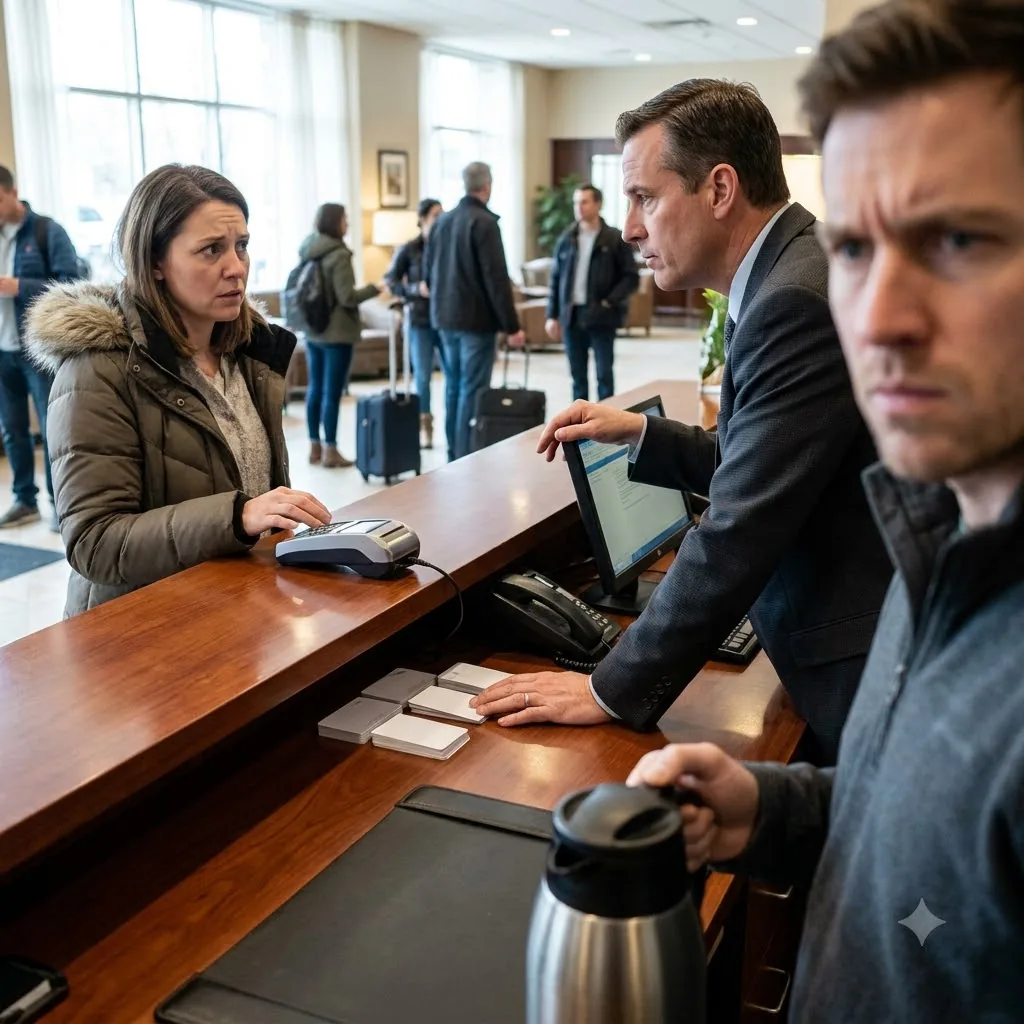
After Marisol asked him to show her, Graham did not touch the encoder. That was the first thing I noticed. Not what he said, but what he didn’t do. The keycard machine sat to his right with its small green light on, ready, and his hand stayed near the keyboard instead. In a busy hotel lobby, that kind of pause gets loud. Graham kept his voice level. “It’s not about the card being different in a way you can see. It’s about the card existing inside a compromised access chain.” Marisol stood still with her bag against her leg. “Then test it.” “Testing it prematurely would bypass desk sequence,” he said. DeShawn had finished pretending to straighten brochures by then. He was close enough to hear every word without stepping into the conversation. The family in baseball shirts had stopped at the elevator bank. The father kept one hand on the handle of a rolling suitcase and watched over the top of it. Graham picked up the card again, turning it once between his fingers. “When a guest removes a credential from an unresolved threshold, it creates a break between field denial and counter validation. That break has to be interpreted before the key can be trusted.” Marisol’s eyes went to the card, then to the encoder, then back to him. “Interpreted by who?” “By trained desk staff,” Graham said. He said it gently, almost kindly. It was the same trick as before. He wasn’t yelling. He was sanding her down in public with language that treated her like someone asking why water was wet. A woman waiting behind the rope line shifted her purse to the other shoulder and glanced at the sign that listed check-in time and breakfast hours, like maybe “counter validation” would be posted there somewhere. It wasn’t. Marisol spoke over the next pause before he could fill it. “You keep saying different versions of the same thing,” she said. “My room key stopped working. You still haven’t tried to fix it.” Graham nodded once, the way people do when they want agreement to look like instruction. “Because the practical fix depends on whether the key failed clean or failed inside threshold. Those are not the same.” I had been in that lobby long enough to know the normal rhythm of broken keycards. A guest comes down. We verify identity. A card gets re-encoded or replaced. Maybe someone checks the room assignment on screen. It takes two minutes, usually less. Graham had stretched this one so long that the printer had started and stopped twice behind him. Marisol set both palms on the desk now. Not slamming, just placing them there with care. “Then tell me what a clean fail is.” Graham did. He was too confident not to. “A clean fail is when access is denied without custody interruption and the credential remains in its original zone of rejection until desk review. Once that chain is broken, you’re no longer dealing with a standard invalidation. You’re dealing with threshold contamination.” That last term changed the room. Not because anybody gasped. It was quieter than that. DeShawn’s head came up all the way. The woman in line stopped shifting her purse. Even the father by the elevators looked from Graham to the card and back again. “Threshold contamination” sounded official enough to freeze people for a second, but it also sounded like the kind of phrase that should come with a sign, a policy sheet, something. Marisol blinked once. Her mouth opened, closed, then reopened. “Contamination. Because I walked downstairs with my own room key.” Graham gave the smallest shrug. “I’m explaining the category, yes.” He finally tapped something on the keyboard, but not much. A short movement. Two keys, maybe three. No card went into the encoder. No test happened. He looked at the screen for a second and then back at her without changing his tone. “At this point, the cleanest option may be to separate from the original credential entirely.” “Meaning what?” Marisol asked. “Meaning the existing key may no longer be usable for standard revalidation.” “So make another one.” He paused again. “That depends on occupancy alignment,” he said. There it was, the first phrase coming back around like he expected repetition to make it stronger. PKG-001 living inside the scene: the jargon he used early was now the only thing holding him up. But every time Marisol brought it back to the card, he moved it into another circle of explanation. She reached into her wallet, pulled out her ID, and set it on the desk beside the card. “My name matches the reservation. The room was assigned to me. I came straight here. If the room is aligned, make the key. If it isn’t, say that. But stop saying contamination like I spilled something on your machine.” Graham did not look at the ID first. He looked at DeShawn. It was quick, but I saw it. A glance sideways, then down. DeShawn didn’t rescue him. He just stood there with a stack of folded city maps under one arm, silent and still. Graham faced Marisol again. “Ms. Vega, if you insist on reducing this to a simple re-encode, you’ll misunderstand the security layer involved.” “Then let me understand it,” she said. He spread two fingers over the card on the counter. “A threshold-contaminated credential cannot be verified by ordinary guest handling.” “Good,” Marisol said. “So don’t let me handle it. You handle it. Right now.” No one laughed. No one spoke. The lobby noise kept going at the edges, suitcase wheels, elevator chimes, ice dropping into a cup somewhere near me. But around the front desk itself, the air had narrowed down to his hand on that card and the machine sitting inches away. Graham’s fingers stayed where they were. Marisol pulled her hands back from the desk and folded them around the strap of her bag again. Her voice got quieter, not louder. “Use your machine,” she said. “Or.