Story code: ST-001018
Part 3: She Picked Flax And The Aisle Did The Rest
Lydia looked down the run of bins like the right answer might be printed on one of the pull handles. Her fingers tapped once against the glass jar. Then she said, “Flax. Finer product shows transfer integrity better.”
Rosa stepped half a pace to the side so the flax station was clear. “All right,” she said. “One demonstration. Same conditions. Same aisle. Mara, bring the scale into view.”
I rolled the tare scale stand a little closer so nobody had to move out of the bulk section to see it. The wheels clicked over a cracked sunflower seed shell on the floor. Noah shifted from the almond bin to the endcap, paper list folded into a narrow strip now, and the older couple by the rice bins stayed where they were with their scoops hanging idle.
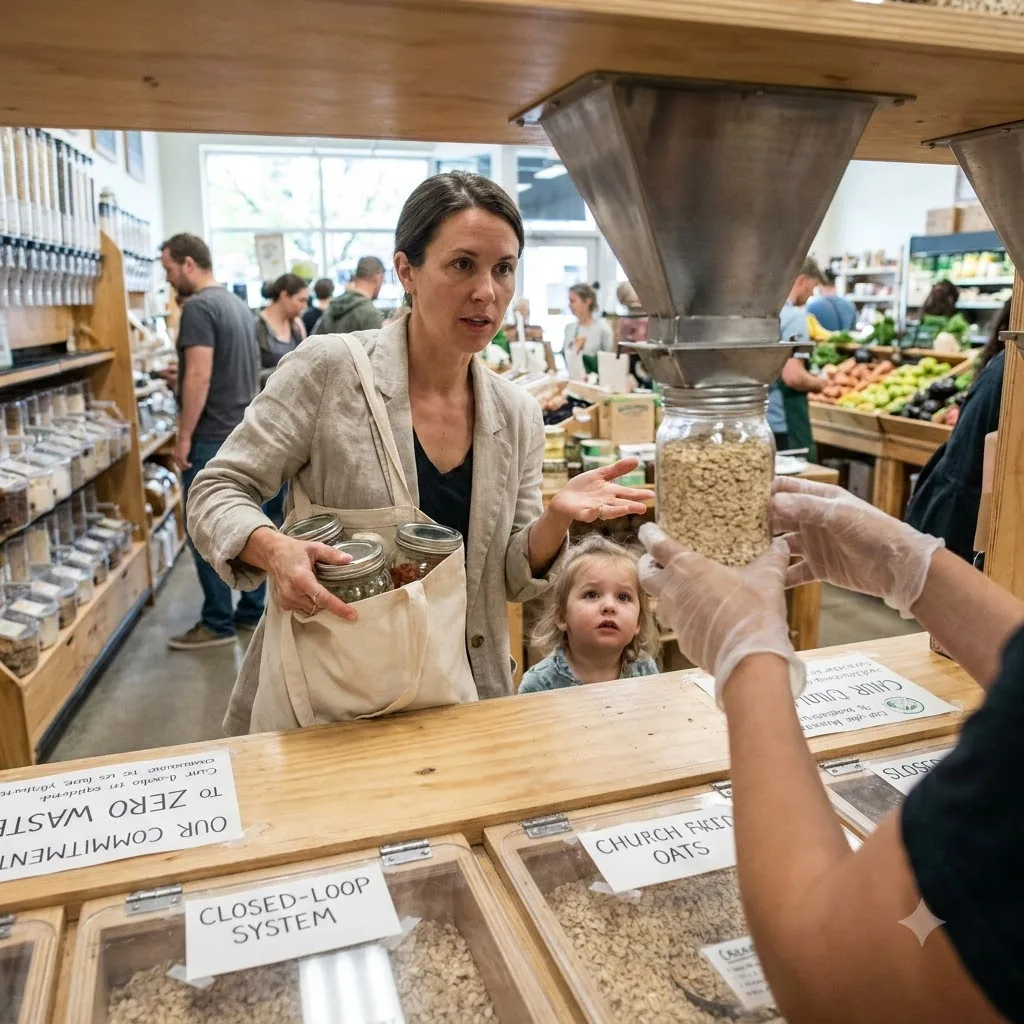
Lydia set the oat jar down and pulled a smaller wide-mouth jar from the canvas tote. The jars knocked together again, less confidently this time. Evan still had the empty jar and marker lid pressed to his shirt. He didn’t say anything. He just watched Lydia’s hands.
Rosa touched the posted handling card again. “State your steps as you do them.”
Lydia gave a quick nod. “Container off the contact plane. Mouth angled for oxygen release. Flow starts before full alignment, so there is no static return to source.”
She unscrewed the lid and this time kept it in her left hand instead of putting it on the ledge. With her right, she raised the jar under the flax chute at a slant, just off center, exactly the way she had shown the oats. The mouth of the jar hovered below the spout instead of sitting square under it.
She cracked the handle.
Flaxseed does not drop like oats. It comes quicker, tighter, with that dry peppery sound. The first stream hit the inside shoulder of the jar, then skipped off the rim in a dark scatter. Seeds ticked against the glass, peppered the shelf, and bounced onto the lip below the bin.
Lydia pulled the jar back a little, then higher. The stream clipped the outer rim again.
Rosa said, “Keep going.”
Lydia said, “This is the release phase.”
Noah looked at the seeds on the ledge and then at Rosa, but he kept his mouth shut.
Lydia tried to roll her wrist to bring the jar more directly under the chute without touching the bin face. That shifted the angle even farther, and the flax began to pile against one side of the jar instead of falling cleanly to the bottom. A thin line of seeds rode the rim and spilled over her knuckles. Some stuck briefly to the glass from static and then dropped outside the jar.
Rosa asked, “What visible sign tells us this is preventing back-feed contamination?”
Lydia answered fast. “The uninterrupted release arc.”
There wasn’t one. The stream kept breaking as she corrected the jar position in tiny jerks. Every correction sent more flax onto the ledge. A few seeds rattled onto the scale platform I had just rolled over.
Rosa said, “Stop there.”
Lydia did not stop right away. She held the handle a second longer, as if a cleaner pour might still appear if she gave it one more breath. Then she let it close.
The bin flap clicked shut. The sound was small, but with everyone else quiet it carried.
Rosa pointed with her pen again. “Product outside the jar. Product on the shelf. Product on your hand.”
Lydia lifted her chin. “Because your dispenser geometry is wrong for suspended decanting. The chute projects too far.”
Rosa did not argue. She looked at me. “Mara, standard fill. Same product. Clean jar.”
I took one of our spare sanitized jars from under the station, showed the empty inside, and set it on the scale for tare so the number flashed to zero where everyone could see it. Then I capped it, moved it to the bin, uncapped it only when it was centered under the chute, and used the handle in one smooth pull. The flax dropped straight into the mouth. No bounce. No scatter. When I closed the handle and capped the jar, the shelf stayed clean except for Lydia’s seeds.
Rosa said, “Again, with the scoop fallback.”
I did it a second time the way we teach when product flow gets fussy: jar stable on the shelf, scoop from the catch tray, pour directly into the jar, lid back on. Nothing hit the ledge.
Nobody said anything for a few beats. The older man by the flax bin finally set his scoop back into its cradle instead of filling his bag.
Noah spoke first, quiet enough that it made everybody else listen harder. “So the jar test was just whether it actually stayed in the jar.”
Rosa answered, “In a store aisle, yes. Observable result.”
Lydia opened her mouth, closed it, then said, “You’re reducing a contamination discipline to a retail demonstration.”
Rosa repeated her own words back to her. “You said I would know exactly why our process failed the jar test.” She tapped the scattered flax with the toe of her shoe. “This is the test we can see.”
Lydia’s tote shifted against the ledge when she reached for another jar too quickly. One of the stacked jars slid sideways, tipped out of the tote mouth, and hit the shelf edge. It did not shatter, but the metal twist lid sprang loose and the jar rolled once against the base of the scale, leaving a ring of flax and oat dust across the white platform.
Evan bent like he was going to grab it. Lydia caught his sleeve without looking away from Rosa.
Rosa’s voice stayed level. “Leave it there. I’m documenting the station exactly as it sits.”