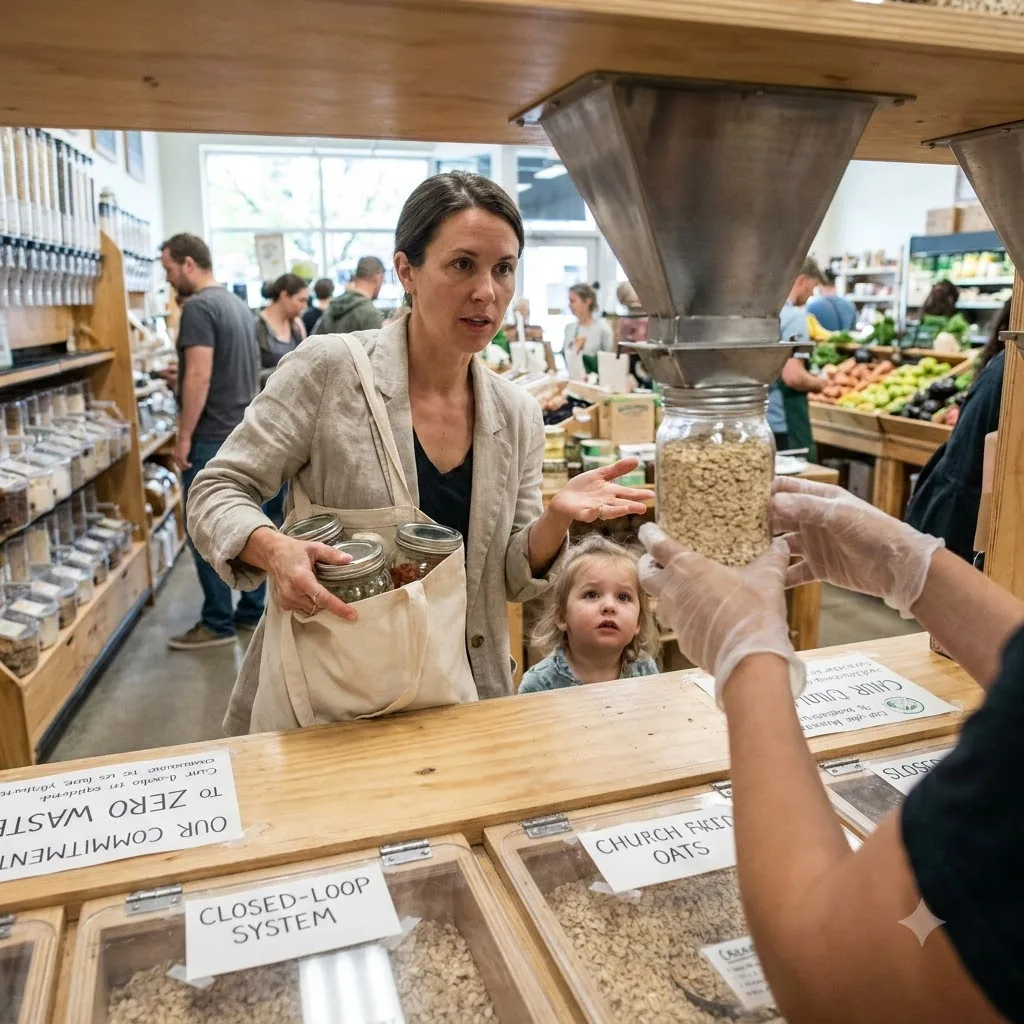
Story code: ST-001018
Part 4: Rosa Wrote It Down While The Seeds Stayed Put
Nobody rushed to pick the jar up.
That was the part that made the whole thing feel final. The loose lid had spun almost to my shoe and stopped. The jar rested against the base of the scale with a dust ring on the platform and a little crescent of flax on the shelf lip. Evan stood with Lydia’s hand still on his sleeve. Noah had his folded list at his side now. Even the bins sounded louder than people did, with little clicks opening farther down the aisle where shoppers kept moving around us.
Rosa crouched just enough to see the scale platform, then straightened and pulled the inventory pen from her apron pocket. She took the small incident pad we use for spills, broken glass, and customer handling problems and braced it against the posted bulk card.
“Customer name?” she asked.
Lydia answered after a beat. “You already have it.”
“I’m confirming it for the report,” Rosa said.
“Lydia Harper.”
Rosa wrote it down. Then she looked at the tote, the open jar in Lydia’s hand, the fallen jar at the scale, and the flax scattered across the ledge. “Observed customer rejecting posted handling steps,” she said as she wrote. “Customer demonstrated requested alternate method. Product exited container and contacted station surfaces. Additional jar became unstable on ledge during demonstration.”
She did not read it dramatically. She said it the way she says produce shrink numbers into her radio. That made it heavier.
Lydia shifted her weight and finally let go of Evan’s sleeve. “You’re making this sound negligent.”
Rosa kept writing. “I’m making it specific.”
Then she looked at me. “Mara, note that standard fill and scoop fallback were demonstrated immediately after with no product loss outside container.”
I said, “Yes.”
She added that too.
Noah glanced at the notepad, then at Lydia. “So this goes in the store log?”
Rosa answered him without taking her eyes off the page. “Yes. Bulk handling incident log. We keep them at customer service and with department records.”
That was when Lydia’s voice changed. Not louder. Thinner. “Over a few seeds?”
Rosa clicked her pen once. “Over a customer stopping station flow, disputing safety handling in front of staff, and insisting on a live demonstration that failed under direct observation.”
The aisle stayed still after that. No speech came in to rescue it. The fake phrase she had used all this time- suspended decanting- just sat there with the flax on the ledge and nowhere clean to go.
I knelt and set the fallen jar upright on the shelf, away from the scale, because Rosa had already seen it where it landed. The glass had not cracked, but the rim had a dusty band around it from the platform. I left it uncapped and untouched after that.
Rosa tore one yellow copy from the pad and held it out. “This is a floor note for today’s incident. Customer service will attach it to your store profile if you shop here again. For bulk, you’ll need staff-assisted fills today if you want to continue in this aisle. No self-serve jars after this station event.”
It was not a speech. It was not a ban from the building. It was narrower than that, which made it fit. In our store, staff-assisted fill means one of us handles the container at the scale and the bin. It is what we do when glass breaks, when someone ignores allergy protocol, or when a station has to be controlled. It goes into the same running record we use for repeat problems.
Lydia did not take the paper right away. Rosa held it there until she did.
Evan looked at the note, then at the tote. He lowered the empty jar he had been holding and set it gently in the cart basket instead of handing it back.
The older couple turned back to the rice bins. Somebody at coffee beans laughed at something unrelated on the next aisle over, and the ordinary store noise came back in pieces. Not relief exactly. Just the room starting up again around something that was already decided.
Lydia folded the yellow slip once, very sharply, and slid it under the lid ring of the jar in her hand. “We’ll do staff-assisted,” she said.
Rosa nodded. “After Mara clears the contaminated product from this station.”
I put on gloves, took the spill brush, and swept the flax from the ledge into the discard tray. The seeds made a dry ticking sound as they gathered. I wiped the scale platform where the jar had left its dust ring. Lydia stood there while I did it, tote looped over one wrist now instead of balanced on the ledge. She kept her eyes on the station tools, not on me.
When I was done, I recapped our demo jar and set the scoop back in its cradle. Rosa tucked the white copy of the report pad into her apron pocket.
Lydia held out two jars without any more terminology. “Can you fill these with flax and oats?”
“Yes,” I said.
That was all I gave her. No lecture. No smile. Just the answer and the process she had spent twenty minutes calling ignorant.
I tared the first jar on the scale while the yellow note stayed visible under its lid ring. Noah picked up his almond bag again and, on his way past, looked once at the paper and once at the clean station.
By then the worst part for me was over. Not because she apologized. She didn’t. Not because anybody clapped. Nobody did. It was over because the aisle had a record now, and the fake science had to sit beside it in plain handwriting while I filled her jars the regular way.