Story code: ST-001018
Part 2: She Asked For A Test In The Aisle
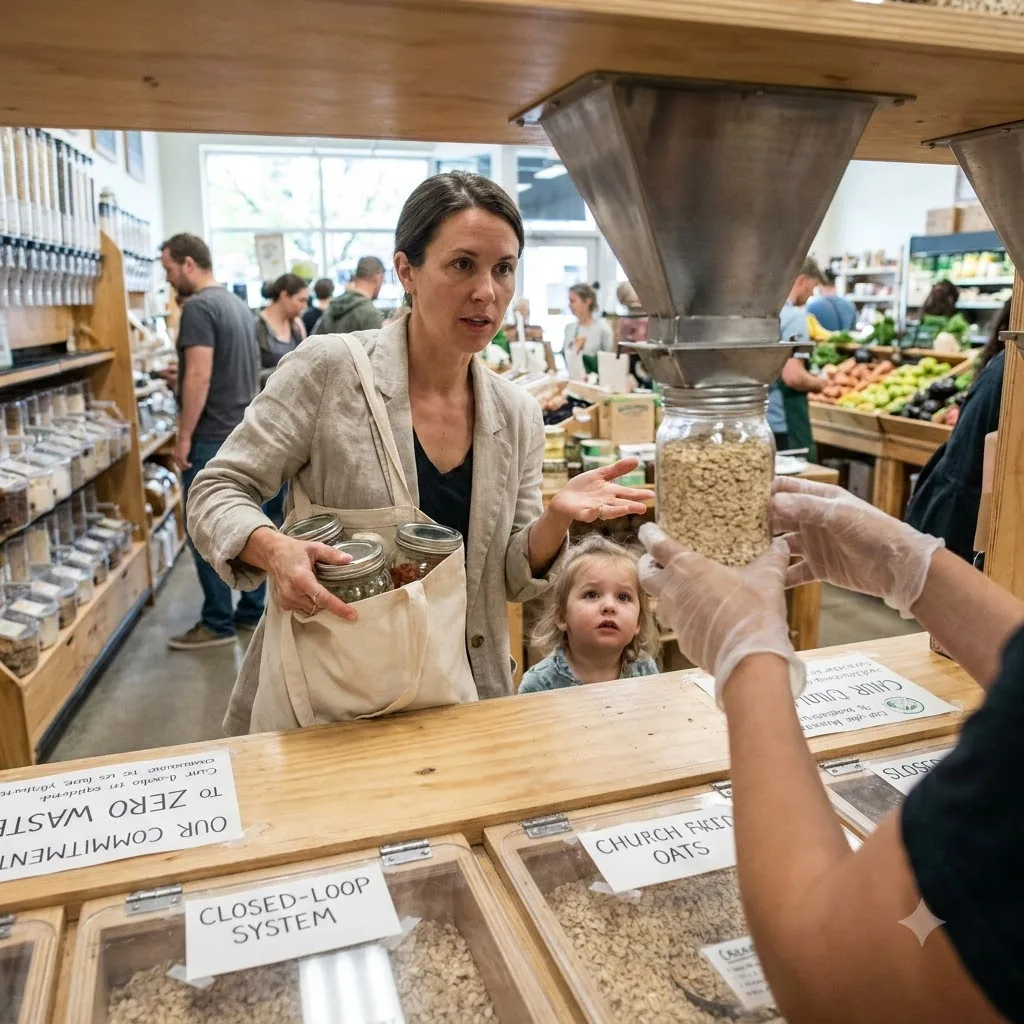
By the time Rosa came into the aisle, Lydia Harper had repeated “suspended decanting” three more times and turned it into something that sounded half environmental standard, half lab procedure. She kept one palm on the oat bin handle, her son close to the cart, and every time I started to explain our actual process she stepped over the end of my sentence like it was a floor mark. Rosa arrived from produce with her radio clipped at her shoulder and one inventory pen still in her apron pocket. She took in the open jars, the tote on the ledge, the oat chute, and the three shoppers pretending not to listen. “What’s the issue?” she asked. I answered first because I was the one on station. “Customer wants to fill using a method she’s calling suspended decanting. I asked her to keep jars capped until filling and off the ledge edge. She says our process breaks the chain.” Rosa looked at Lydia. “Can you define that term for me?” Lydia did not miss a beat. “It’s a no-contact transfer method,” she said. “The container stays off the contact plane, angled to preserve oxygen release and prevent back-feed contamination from jar lip static. It’s standard if you’re serious about zero-waste.” Rosa repeated the phrase exactly, which is one of the ways she keeps people from wriggling out through wording. “No-contact transfer. Oxygen release. Back-feed contamination from jar lip static.” She touched the posted handling card with two fingers. “And you’re saying this can be demonstrated here?” Lydia lifted her chin once. “Obviously.” That one word changed the aisle. Up to then it was still her talking and me trying not to get buried under her vocabulary. Once she said obviously, the whole thing got smaller and more physical. The jars mattered. The chute mattered. The amount of oats in the air mattered. Rosa was no longer asking whose explanation sounded nicer. She was asking whether the thing Lydia named could survive being done with the tools already in front of us. Noah cleared his throat at the almond bin. “So this is like a real procedure?” Lydia answered him without turning. “If people here have never seen it, that doesn’t make it less real.” Rosa said, “Walk me through it using the oat bin.” Lydia shifted her tote and pulled out a wide-mouth jar with a twist lid. The glass knocked softly against another jar in the bag. Her son, Evan, held the marker lid still in one hand and the empty jar in the other, then tucked both to his chest when Rosa stepped closer. I moved the spill brush out of the way with my foot and set a clean scoop back into its cradle. Rosa checked the chute with a quick glance and looked at the scale station beside us. “Before anybody starts,” she said, “we’re staying with visible store procedure. One bin. One jar. No product returned to the source if it spills or contacts outside surfaces.” Lydia gave a tight little smile. “That’s fine. The whole point is that nothing should contact anything.” Rosa nodded once. “Show me.” Lydia took the lid off her jar and balanced it upside down on the ledge. I noticed that right away because it was the exact kind of contact point she had been pretending not to create. She held the jar under the oat chute at an angle, not directly below it, and with her other hand tapped the handle a fraction open. A few oats dropped, then a thin uneven stream started. Because the jar wasn’t centered under the chute, some oats hit the inner shoulder of the jar and skittered against the rim. A few bounced off the outside glass and down to the shelf lip. Nobody said anything yet. Lydia adjusted the angle and said, “You let the oxygen release first.” Rosa asked, “What visible sign tells you that happened?” Lydia kept the jar hovering. “The flow stabilizes.” It didn’t. The oats came in a stop-start rattle because the jar mouth was partly off line and her wrist kept shifting to avoid touching the bin face. A small spray of flakes dusted the ledge. One landed on the upside-down lid. Rosa pointed with the capped end of her pen. “That’s outside the jar.” “It’s incidental,” Lydia said quickly. “The contamination control is at the source.” Rosa’s voice stayed even. “You also said no contact plane. Your lid is on the shelf, open side up against the ledge.” Lydia picked the lid up immediately and held it in two fingers. “Only because I was interrupted.” Noah spoke before I could. “You weren’t interrupted.” His voice wasn’t loud. That was what made it carry. Lydia ignored him and tried to reset the jar under the chute, higher this time, almost touching the dispenser face without quite touching it. The tote shifted on the ledge as she moved her elbow. One of the stacked jars inside knocked hard against another and tipped sideways with a glass thud that made Evan freeze where he stood. Rosa looked at the tote, then back to the bin. “Let’s keep this simple. Your claim is that this method reduces contamination compared to standard fill. So far I see product outside the jar, an open lid on the ledge, and unstable flow. What part should work better if we continue?” Lydia held the jar still for a second too long before answering. “The jar test is really clearer with finer product,” she said. “Oats aren’t ideal for suspended decanting.” That was the first time the term bent in public. She had said Rosa would know exactly why our process failed the jar test. Now she was saying the bin she chose was wrong for her own rule. Rosa glanced at me, then at the lentils, quinoa, and flax in the same run of bins. “All right,” she said. “Pick the product that proves your method. We’ll do it here, once, and everybody can watch.