Story code: ST-001055
Part 3: The Query Command
My index finger remained pressed against the left mouse button, the cursor frozen over the confirmation box for the live calibration test. On the wall, the digital clock ticked to 21:18. The red warning light on the console continued its steady, silent rotation, painting the metallic surfaces of the room in rhythmic intervals of crimson and gray.
“Don’t click that, Elena,” Leo said. His hand dropped from the intercom switch, but his arm remained tense, his fingers twitching against his thigh. He took a step toward the diagnostics desk, his eyes darting between my monitor and the primary console. “A live calibration test will force a full system query. It sends a high-frequency pulse through the array. If the containment is already failing, that pulse will shatter the remaining coherence. You’ll trigger the collapse yourself.”
Sarah did not look at her brother. She kept her eyes on the raw data stream from the sensor bracelet. “The array operates at a threshold of three hundred micro-kelvins, Leo. A calibration pulse uses less than ten nano-watts. It cannot collapse a real decay event.”
“We don’t know that for sure,” Leo said, his voice rising an octave. He reached out, his hand hovering over the edge of my keyboard. “We haven’t run a live pulse during a Class-4 warning since the system upgrade last autumn. The risk parameters are undocumented.”
“The risk parameters are documented in Section 8 of the safety charter,” I said, pointing to the printed binder resting on the shelf above the terminal. “A live test is the mandatory verification step before any manual override signature can be accepted by the registry.”
Leo shifted his weight, his boots scraping loudly against the floor. He turned his body slightly, blocking Sarah’s view of the terminal keyboard. “Let’s just perform a manual reset of the console display first. Sometimes the display driver corrupts the local telemetry. If we reset the display, we can verify the warning before we run a diagnostic that gets logged to the university server.”
“A display reset takes four minutes,” Sarah said. Her voice was flat, devoid of the urgency that had filled the room ten minutes prior. She reached into her lab coat pocket, pulled out her gray keycard, and slid it into the secondary authorization slot on my console. “A live calibration test takes thirty seconds. If the array is decaying, the test will confirm it immediately and notify the safety board.”
“Sarah, wait,” Leo said. He reached down and touched the edge of the keycard, preventing her from sliding it fully into the lock. His hand was trembling slightly, the movement visible under the bright fluorescent tube overhead. “We don’t need to involve the registry yet. Let me check the cable connections on the junction box behind the cleanroom glass. It could be a simple grounding issue.”
Sarah stood motionless. She looked down at Leo’s hand on her keycard, then up at his face. “You just said the containment was collapsing in three minutes. Now you want to spend four minutes resetting a display and checking grounding cables?”
Leo withdrew his hand from the card. He walked back toward the primary terminal, his shoulders hunched. “I am trying to protect our research registry. A false alarm flag on our record will freeze our funding for next quarter.”
“I am executing the command,” I said.
I clicked the confirmation box. The screen blinked once, transitioning from the simulated red warning interface to the blue progress bar of the live query. The system sent the diagnostic pulse.
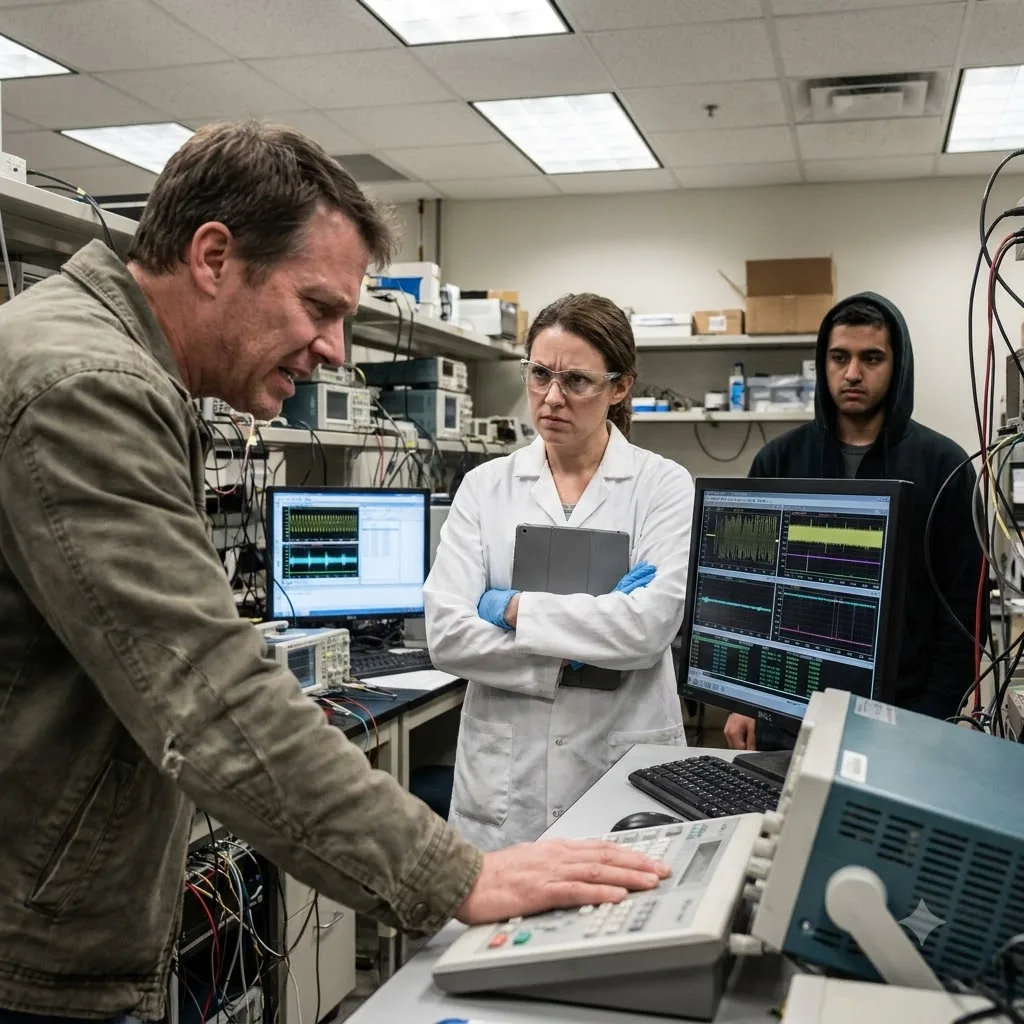
On the secondary monitor, the data buffer from Leo’s sensor bracelet began to dump its historical logs into the local spreadsheet. A yellow flag appeared at the top of the columns, indicating a system mismatch. The system log printer next to my elbow whirred to life, its internal rollers feeding a strip of paper onto the tray as the registry recorded the query.