Story code: ST-001340
Part 2: The Threat of the Rollback
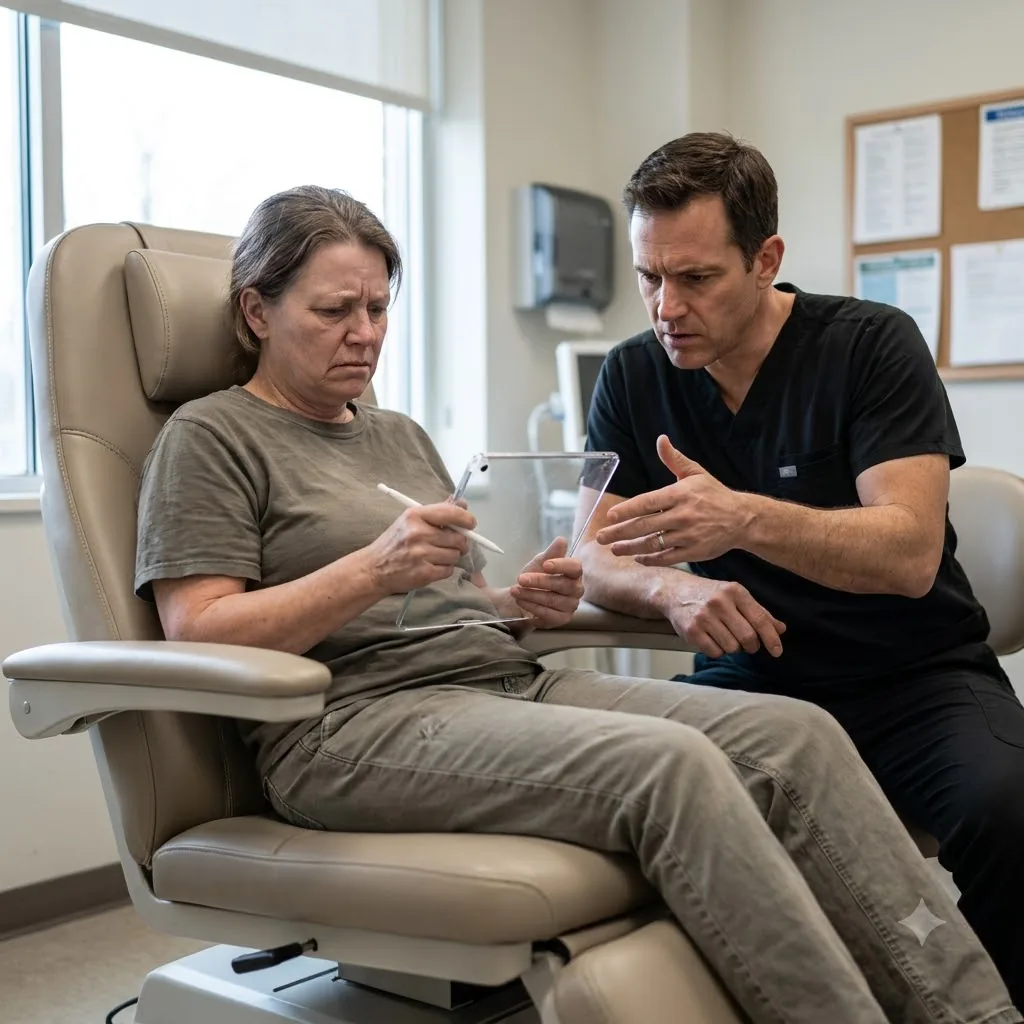
Marcus noticed my fingers scrolling through the diagnostic history. The clinical warmth completely vanished from his face, replaced by a rigid, defensive posture. He stepped closer, casting a shadow over the recliner, and tapped the screen to pull the consent form back to the foreground.
“You don’t need to worry about the background logs, Julian,” Marcus said, his voice dropping its friendly tone. “Those are just raw system diagnostics. What matters is that your implant is running smoothly right now because of the work I did. But if we don’t lock in this protocol override today, the clinic’s server will run an automatic rollback tonight.”
I looked up at him, noting the tightness in his jaw. “And what happens if there’s a rollback?”
“You’ll experience severe cognitive drift,” he said, his tone turning sharp and clinical. “The slight focus lapses and headaches you’ve been having this week? That’s just the beginning. Without my patch keeping the partition stable, the rollback will revert your implant to a buggy, uncalibrated baseline. You won’t be able to hold a train of thought for more than a few minutes, let alone perform your job as a quality analyst.”
The threat was clear, even if he couched it in medical terminology. He was directly linking my current stability issues-the minor visual lag I had felt earlier that morning-to the cover-up patch he had installed. He had deliberately left my system in a state where only his continued, unauthorized adjustments could keep me functioning, using my own cognitive health as leverage.
“So the upgrade you gave me wasn’t a permanent fix,” I said.
“It’s a temporary patch that requires regular, manual authorization,” Marcus replied, his eyes locked on mine. “And this consent tablet is the only way I can legally perform those adjustments. If you don’t sign this biometric release now, I cannot touch your implant again. I will be forced to let the system roll back tonight, and I won’t be responsible for the cognitive instability that follows.”
He was trying to make me feel like the author of my own ruin if I refused. The pressure in the quiet room was suffocating. Outside the glass door, other patients walked calmly down the corridor, entirely unaware of the high-stakes coercion happening in Neuro-mod Room 4.
I looked down at the tablet again. The biometric signature box glowed with a faint blue light, waiting for my thumbprint. If I pressed my thumb to the glass, I would hand Marcus total control over my cognitive partition, letting him run whatever untested patches he needed to hide his tracks forever. If I walked out, my mind would begin to unravel within hours as the system rolled back. I needed to find a way to turn his own cover-up against him, but as Marcus leaned in, his shadow cutting off the light, the window to make a decision was rapidly closing.