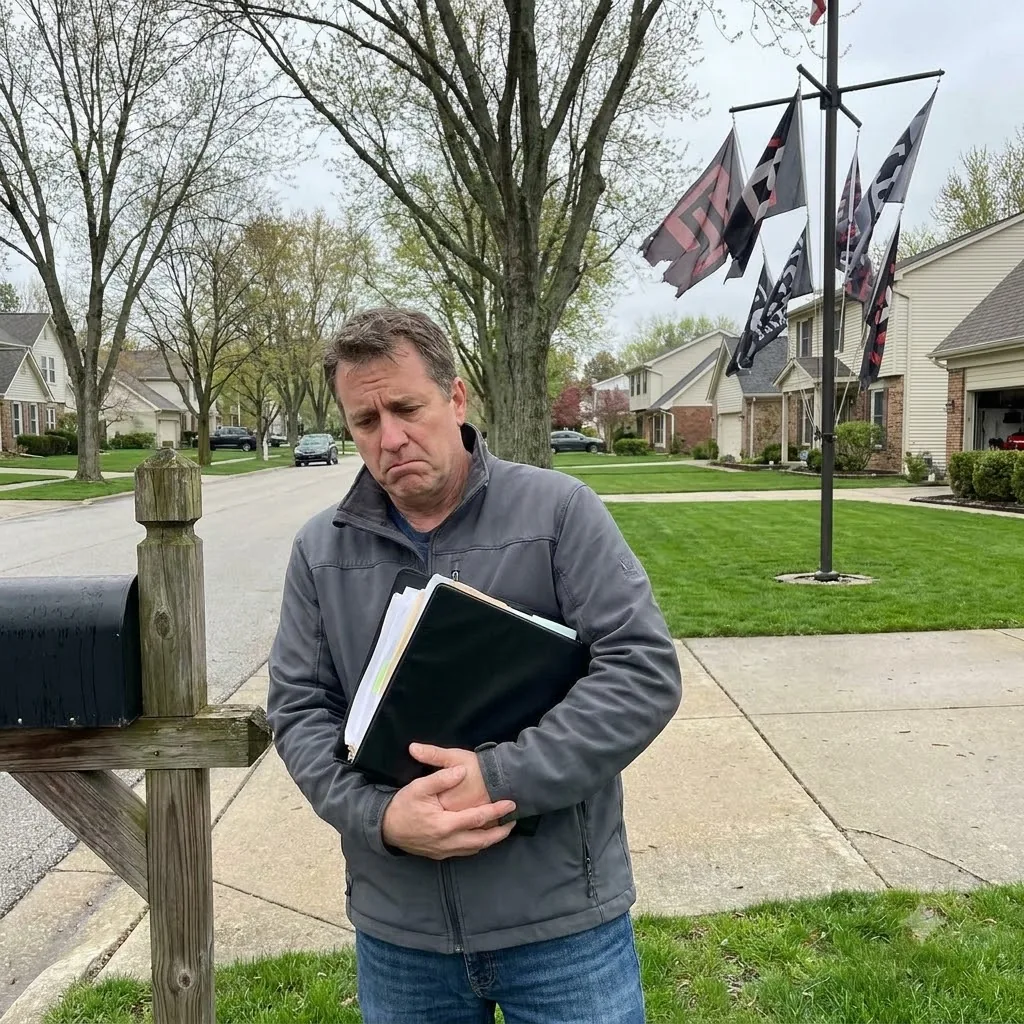
Story code: ST-000001
Part 2: The Tripwire
The sharp electronic click of the dead line echoed in Greg’s ear, followed instantly by the heavy, suffocating silence of his empty kitchen. For a full three seconds, his brain refused to process Arthur’s frantic warning. Then, a primal surge of adrenaline forced his body into motion.
Greg dropped to a crouch, sliding down the smooth face of the oak cabinetry until his knees hit the hardwood floor. He stayed well beneath the sightline of the front windows. His hands were shaking so violently that he nearly dropped his smartphone as he scrambled to open his home security application. The loading wheel spun on the screen for what felt like an eternity before the high-definition feed from his driveway camera flickered to life.
Arthur hadn’t been exaggerating. A massive, matte-black SUV with heavily tinted windows was idling perfectly parallel to the edge of Greg’s lawn.
Two men stepped out of the vehicle. They were not wearing the casual clothes of neighborhood pranksters or the uniforms of delivery drivers. Both were dressed in immaculate, dark, tailored suits. They moved with a chilling, synchronized efficiency. One man produced a silver clipboard and a thick stack of manila folders, his eyes locked onto Greg’s front door. The other man raised a professional-grade DSLR camera with a massive telephoto lens and began rapidly photographing the house. The shutter snapped in a rapid-fire burst, capturing the front windows, the license plate of Greg’s sedan in the driveway, and the exact placement of his property lines.
Greg’s thumb hovered over his phone screen. He dialed Arthur’s number again, praying the board president had simply dropped his phone in his panic. It went straight to a generic, automated voicemail.
Desperate, Greg navigated to his contacts and dialed the emergency line for Vanguard Property Management, the sprawling corporate agency that had managed the neighborhood’s finances and legal disputes for over a decade. The line rang twice before a receptionist answered.
“Vanguard Management, this is Sarah.”
“Sarah, this is Greg Vance, chair of the compliance committee at Oak Creek,” Greg whispered, keeping his eyes glued to the security feed. “I need to speak to the legal department immediately. Our board president just told me-”
“Mr. Vance,” the receptionist interrupted, her voice entirely devoid of its usual cheerful customer-service cadence. She sounded strained, as if someone were standing directly over her shoulder. “I am reading from a prepared script. As of nine-thirty this morning, Vanguard Property Management has formally terminated its contract with the Oak Creek Homeowners Association. We no longer represent your community. We have been instructed to sever all contact regarding this account. Do not call this number again.”
“Wait!” Greg pleaded, his voice cracking. “Why? What did the new owner threaten you with?”
“Direct all further inquiries to your personal legal counsel,” she recited flatly. The line went dead.
Greg lowered the phone, the cold reality of his isolation settling heavily in his chest. Vanguard was a multimillion-dollar management firm with its own army of corporate lawyers. They didn’t just abandon lucrative neighborhood contracts over a noise complaint or a zoning dispute. They had been terrified into instant submission.
Reaching up blindly, Greg snagged the edge of the black leather binder resting on the kitchen island and pulled it down to the floor with him. He needed to understand the weapon the new neighbor was wielding. He flipped past the terrifying exhibits of his personal tax records and property lines, searching for the core of the legal argument.
He found it in a section tabbed in bright yellow, titled *Notice of Predicate Offenses*.
The documents didn’t list a simple countersuit over HOA bylaws. The wealthy owner of the corner estate wasn’t an individual; the property had been purchased by a labyrinthine holding company based out of Delaware. The binder outlined a staggering, weaponized legal theory: by utilizing the United States Postal Service to mail a fifty-dollar citation to the corporate entity, Greg was being personally accused of federal mail fraud and extortion.
The lawsuit was framed under a civil RICO statute, typically reserved for prosecuting organized crime syndicates. Because Greg had signed the compliance letter himself, the holding company was claiming that he had engaged in a conspiracy to defraud and harass a legitimate enterprise. The damages they were claiming weren’t fifty dollars. They were demanding five and a half million dollars in reputational harm, operational disruption, and punitive damages.
Greg felt the bile rise in his throat. It was an entirely fabricated, completely absurd application of the law, but that didn’t matter. The sheer weight of the litigation, the discovery process, and the federal filings would bankrupt him in attorney fees before a judge ever had the chance to laugh it out of court. This was why Vanguard Management had fled. If they stayed, they would have been named as co-conspirators in the RICO suit.
Suddenly, three heavy, concussive blows hammered against Greg’s front door.
Greg flinched, biting his lip to keep from crying out. He stared at his phone screen. The man with the clipboard was standing on the front porch, staring directly up into the lens of the doorbell camera. He didn’t say a word. He simply raised one of the thick manila envelopes, slapped a strip of heavy industrial tape across the back, and secured it directly to the glass of Greg’s front door.
The two men returned to the idling SUV, the doors shutting with a heavy, synchronized thud. The black vehicle slid silently down the street, disappearing around the corner beneath the snapping, violent fabric of the massive flags.
Greg waited two full minutes before he dared to move. He crawled down the hallway, reached up to turn the deadbolt, and cracked the door open just wide enough to peel the envelope off the glass.
He tore the flap open with trembling fingers, expecting another legal summons or a court date. Instead, he pulled out a single sheet of heavy stock paper bearing the official letterhead of his own regional bank. It was an automated notice, generated and printed less than an hour ago.
Due to a pending federal lien application filed against his social security number, all of his personal checking and savings accounts had been placed on an indefinite, immediate freeze.