Story code: ST-000140
Part 3: She Could Not Name the Debt
I looked at the screen again, at HONORING HER COMMITMENT under my name, and another detail clicked into place from her own list. The things she kept calling favors were not random kindnesses. They were all tied to nights when she needed bodies, full tables, printed flyers, or one more parent willing to smooth over a mess before other people saw it.
I said, “You keep saying you helped me. But every example you gave is about something you needed fixed.”
Dana lifted the mic higher. “That is a very cynical way to describe support.”
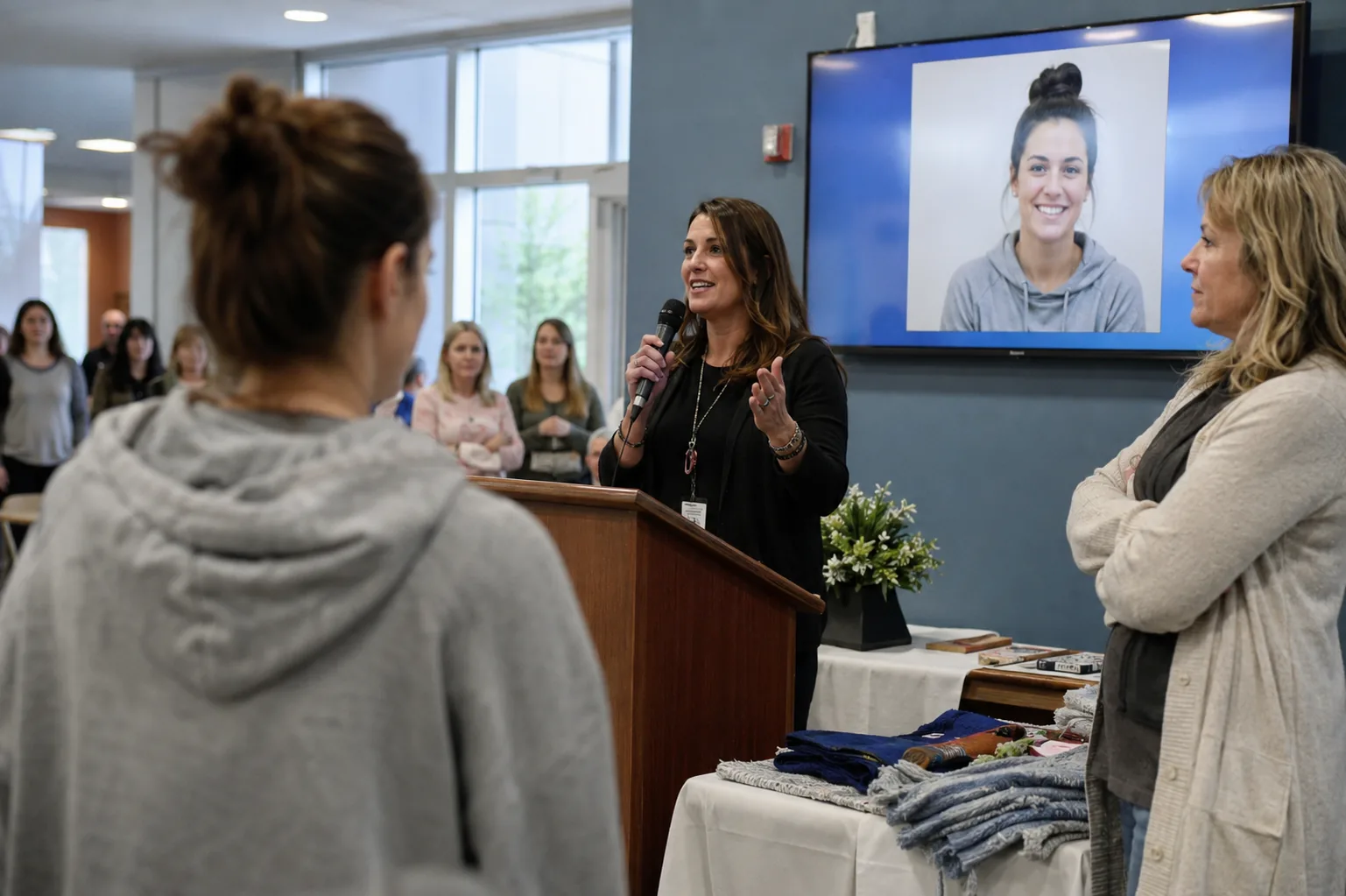
“Then let’s do it plainly,” I said. I pointed toward the screen because I wanted the room looking at the same thing I was. “You wrote that I’m honoring a commitment tonight. Say what that commitment was. Exact words.”
She shifted her weight and gave the kind of smile that asks the room to help carry a weak answer. “A commitment to this community.”
“No,” I said. “That is not a commitment. That is a slogan. What did I agree to do?”
Her fingers tightened around the microphone. She glanced toward the volunteer laptop near Ruth, then back to me. “Marisa, you said yourself you wanted to help more.”
“I said I could bring napkins with notice.”
That got a few quick looks around the check-in table, because it sounded exactly as small as it was.
Dana said, “It was part of a broader conversation.”
“About what amount?” I asked.
She did not answer.
“What shift? What date? What number of hours?” I kept my voice level. “If you’re calling this repayment, tell the room what I agreed to repay and when I agreed to it.”
The silence after that was different from the earlier ones. Before, people were waiting for me to stop resisting. Now they were waiting for her to supply the missing piece.
She said, “People know what community means without everything being written down.”
Ruth looked at the screen and then at Dana. “But you put it up like it was already settled,” she said.
Dana answered her without looking away from me. “Because I trusted Marisa to do the right thing.”
I said, “You trusted me to be easier to pressure in public than in private.”
Her jaw set for a second. Then she started listing again, faster this time, as if speed could cover the gap. “I made room for your family when schedules were tight. I stayed flexible when money was short. I made sure Eli was not left out. I have gone out of my way for you more than once.”
I let her finish. Then I said, “And every one of those things also kept your program running smoothly. The flyers made your event look organized. The saved table kept your spring fair full when vendors dropped out. The fee issue happened after you changed the deadline. You are calling your own event management my personal debt.”
A man near the flyer rack gave a short exhale through his nose. Eli stayed by the wall, still and watchful, his hand on the tote handle. Dana looked at him for half a beat and then back at me.
“That is unfair,” she said.
“What’s unfair is using my son as part of your speech,” I said. “You said you kept him included when things got tight, like you rescued us from something. What happened is you changed a payment date and then acted generous for not enforcing your own new rule.”
Her voice came out sharper. “I did not have to make any exception.”
There it was.
Not the full truth of everything, but enough. Enough for the room to hear the switch. She had moved from saying I had chosen a commitment to saying she had granted favors, and from there to saying access itself was something she could hold over us.
I nodded once toward the screen. “So this was never about a commitment I made. It was about you deciding your routine program decisions meant I owed you loyalty back.”
Dana opened her mouth, closed it, and then said, “You are twisting this.”
“No,” I said. “I’m taking your words seriously. You thanked me for honoring a commitment. You cannot name one. You called it repayment. You cannot name a debt. The only clear thing here is that when your events needed something, I helped, and now you’re trying to collect obedience for it.”
Nobody jumped in. Nobody needed to. The screen was still behind us, bright and simple and wrong. It made her earlier speech look less like gratitude and more like a claim she had posted too soon.
Dana lowered the microphone for the first time since I walked in.
Then she said, low and tight, “Fine. Come with me for one minute.”
She did not ask me to help. She did not say commitment again. She just turned toward the hallway beside the multi-purpose hall entrance and reached for the laptop cart as if she suddenly wanted this conversation out of the room.
That was the first real reversal. She had brought the pressure to the screen. Now she wanted me away from it.