Story code: ST-000158
Part 3: He Could Not Mark the Safe Spot
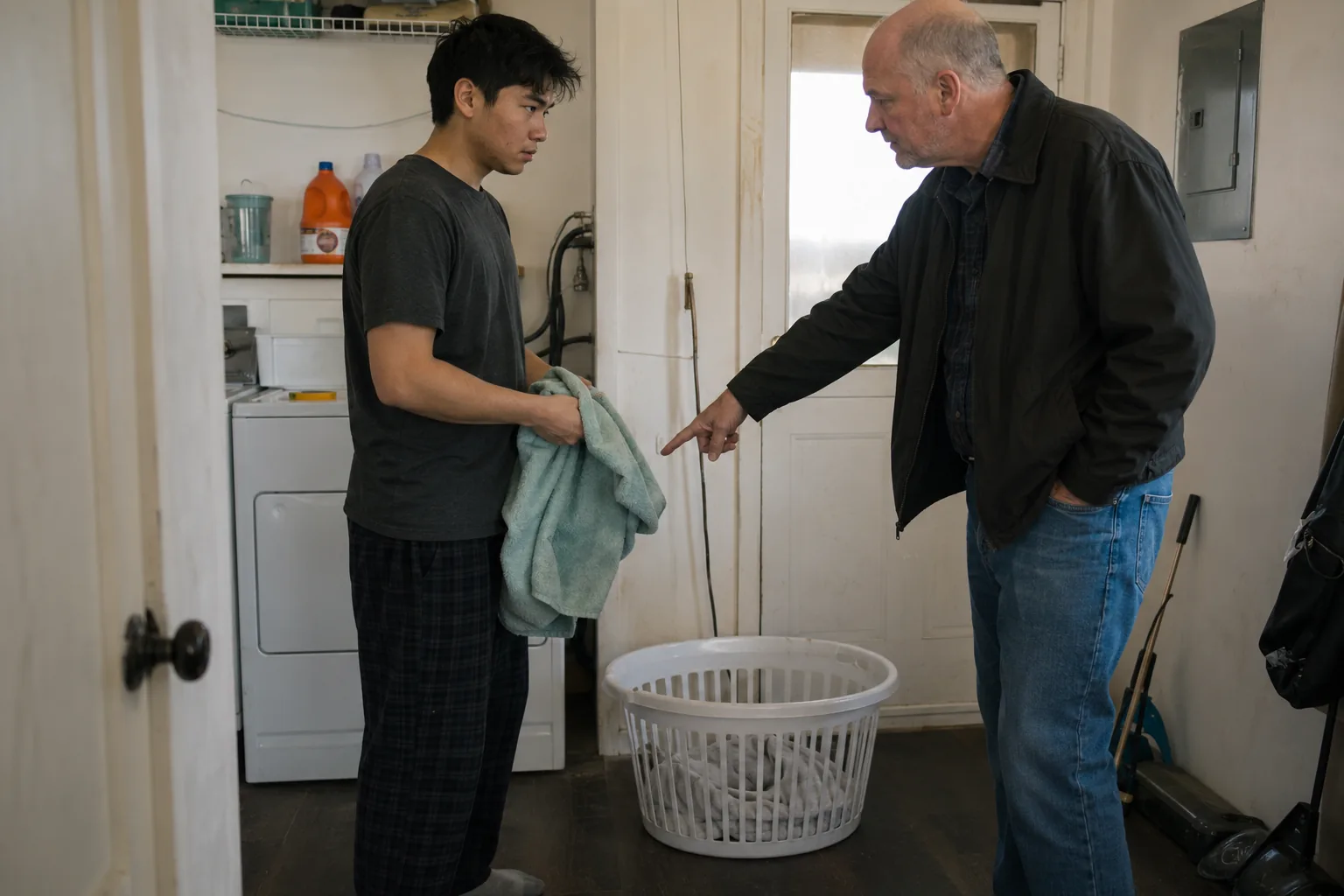
Eli kept the laundry basket lifted an inch off the tile and waited.
Darren looked at the floor first, then at the dryer, then up at the ceiling return, as if the answer might appear if he gave himself enough angles. The basket stayed in Eli’s hands between them like a test he had not planned to take.
“Set it down,” Darren said.
“Where?” Eli asked.
Darren opened one hand toward the sink side of the room. “Away from the exchange path.”
Eli took one step and lowered the basket near the utility sink. It landed with a light plastic knock against the tile. Darren stared at it for a second.
“Too close to the wall,” he said.
Eli picked it up again without a word.
“Here?” I asked, pointing to the strip of floor between the washer and the shelving.
“No,” Darren said quickly. “That narrows the lane.”
Eli moved it to the open spot by the doorjamb, the same threshold Darren had been using to hold the room. “Here, then.”
Darren shook his head. “That creates traffic interference.”
The dryer kept turning behind us. The vent above us kept blowing the same low rush it had been blowing the whole time.
Eli set the basket down in the middle of the room. “Show me one place,” he said.
Darren pointed toward the folding counter, then stopped before his finger fully landed anywhere. “The issue isn’t one place in isolation. It’s the relationship.”
“You’ve said that already,” I said. “You also said orientation matters.”
I crouched, turned the basket so its long side faced the dryer, and looked up at him. “This better or worse?”
“Worse,” he said.
I rotated it again so the narrow end faced the dryer. “Now?”
He took too long. “Still problematic.”
I slid it six inches toward the counter leg. “Now?”
“You are oversimplifying mechanical behavior,” he said.
That was the first time his voice lost some of its clean snap. Not louder. Just less exact.
Eli leaned over and put one hand flat on the top rim of the basket. “No, we’re simplifying your claim. That’s different.”
Darren pulled his phone up in front of his chest like he might read something from it, but he never actually looked down long enough to quote anything. He just held it there and said, “I don’t need to teach a tenant-level seminar to identify unsafe staging.”
I stood back up and looked at his phone. The screen was dark.
“Then say one plain sentence,” I said. “If the basket sits here while the dryer is on, what exactly happens?”
He pointed, but not to one thing. First the dryer. Then the vent. Then the basket. Then the shelf. His hand made that same loose arc from before.
“Contaminant pull,” he said.
Eli said, “What contaminant?”
“Lint. Dust. Textile shed.”
“Into what?” I asked.
“Into the room environment.”
I looked around the room. Towels. Detergent. The sink. The same shelves. The same air he had been standing in for ten straight minutes. “So your warning is that laundry in the laundry room exists in the laundry room?”
Darren’s jaw shifted. “That’s not what I said.”
Eli took the basket and walked it, slowly, to three different spots while Darren kept trying to rename the problem instead of anchoring it. Unsafe proximity. Draw exposure. Exchange interference. Not once did he mark a clear line on the floor. Not once did he give one location and stand by it when we changed only one thing at a time.
I said, “Hold on.”
I pulled my phone from my back pocket and opened the camera.
Darren’s head turned fast. “Don’t record me.”
“I’m recording the basket,” I said.
I aimed at the floor, the dryer, the vent, and the basket in Eli’s hands. Then I said, clear enough to catch every word, “Darren, for the room video: point to one compliant spot for this basket while the dryer is running.”
He did not answer.
Eli held the basket near the sink and waited.
I asked again. “One spot.”
Darren finally pointed to a square of tile near the far wall.
Eli set the basket there.
I left the phone running and said, “Okay. That’s compliant?”
“Under current conditions, yes,” Darren said.
Eli immediately lifted it and moved it less than a foot, to the left, still along the same wall.
“And this?”
“No.”
I looked from one spot to the other. No vent cover between them. No doorway between them. No machine between them. Just a short strip of tile.
“Why?” I asked.
Darren started talking about pressure edges.
I walked the phone down to the floor and held the frame on both spots. “Show me the edge.”
He did not kneel. He did not mark anything. He kept explaining from standing height.
Eli took the basket back to the first square. “This one passed.”
Then he slid it two inches with his shoe.
Darren said nothing.
The dryer turned. The vent pushed air. The room held still around his silence.
I lowered my phone and opened the property management contact thread we had for maintenance scheduling. Marissa Keene’s name was in it from a filter replacement a few months earlier. I hit video call and set the phone against a detergent bottle on the folding counter facing the room.
When her screen connected, all she said was, “What am I looking at?”
And for the first time since Darren stepped into that doorway, he moved his hand away from the frame.