Story code: ST-000158
Part 2: He Kept Explaining Instead of Defining
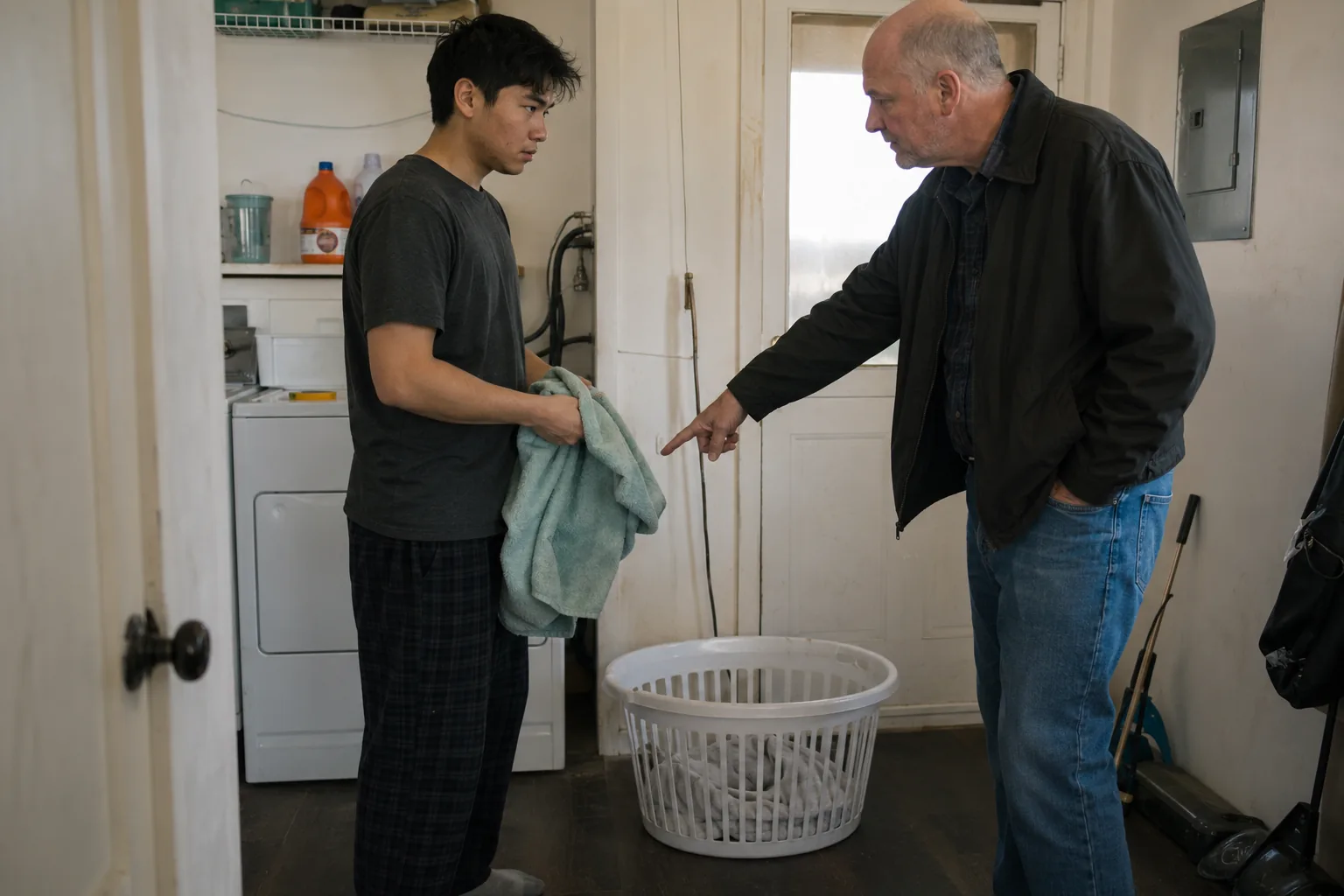
Darren stayed in our utility room and kept talking over the empty space where a plain answer should have been. He had already called the laundry basket a “cross-vent contamination load,” and once he heard himself say it out loud a few times, he started building the whole room around that phrase like it was a code section both of us had somehow missed.
Eli stood with his hip against the dryer and both hands flat on the edge. He did not move toward Darren, and he did not move the basket. He just watched his face and waited for a gap.
I asked, “What does mixed-flow service room mean?”
Darren answered fast. “A utility space with competing pressure behavior.”
“Competing with what?” I said.
He pointed to the dryer again. “Heat exhaust.”
Then he pointed to the ceiling return. “Air intake.”
Then he pointed to the basket. “Porous textile mass.”
He said it in three beats, dry and clipped, like saying it in a sequence turned it into a rule.
Eli tried again. “You keep saying that like it’s a thing everybody knows. What standard are you talking about?”
Darren did not like that question. That much was visible in the way he shifted his feet and squared himself harder into the doorway.
“I am talking about safe room use,” he said. “You don’t need the standard number for the standard to exist.”
Eli looked at the basket, then at the vent, then back at Darren. “So the basket is unsafe because it’s laundry in the laundry room?”
Darren made a short sound through his nose and lifted one finger. “Because of placement. Because of load condition. Because of draw exposure.”
He never used one plain sentence when three polished fragments would do more work for him.
I picked up one of the folded washcloths, set it down again, and asked, “If it’s about placement, where is the safe place for it?”
He glanced at the floor by the sink, then at the opposite wall, then back to the basket. “Outside the live exchange lane.”
Eli’s head turned a little. “The what?”
“The live exchange lane,” Darren repeated, even more confidently. “The movement path where air and lint behavior interact.”
That was the second term. New, smooth, and delivered without pause.
I said, “Can you show me the lane?”
He looked at me for half a second, then traced another shape in the air with two fingers, starting near the dryer door, sweeping up toward the ceiling, then curving down toward the basket by the folding counter.
It looked less like a lane than a magician’s ribbon.
Eli said, “You’re drawing it different every time.”
Darren ignored that and stepped deeper into the room. He nudged the basket with the side of his shoe just enough to rotate it a few inches. “This orientation makes it worse,” he said.
That got my attention more than the words. He had changed the object while still calling it proof.
“Don’t touch our stuff,” Eli said.
Darren held up his hand, palm out, not apologizing, just pausing long enough to keep control. “I’m identifying the issue. If I were writing this formally, I’d note tenant interference with airflow discipline.”
“Airflow discipline,” Eli repeated.
Darren looked at him and gave one small nod, like Eli had finally repeated the correct answer in class.
The room had gotten very quiet except for the dryer tumbling behind Eli and the vent over us pushing its steady low rush. Darren seemed to hear that quiet as permission. He started talking longer, not simpler.
He explained how loose weave items could become suspended, how baskets could sit in a pressure path, how ordinary room habits became technical problems when tenants did not understand mechanical behavior. Every explanation carried the same shape: point at the basket, name a condition, say it like a settled fact, move on before anybody could pin him to one clear definition.
I watched his timing instead of his words. Every time Eli asked for a standard, Darren widened the language. Every time I asked where exactly the problem was, he made a bigger motion with his hand. He had not once crouched down, not once checked a vent cover, not once moved close enough to show where this supposed lane began or ended. He kept using the basket like a prop and the room like a stage.
Then Eli said, very evenly, “Okay. Show me.”
Darren stopped.
Eli pushed off the dryer and pointed to the floor tiles one by one with his finger. “Not another lecture. Show me where the basket can and cannot sit if this is a real thing. Right here, in this room.”
Darren said, “I already have.”
“No,” Eli said. “You’ve named it. That’s different.”
I added, “You said orientation matters too. So which orientation is safe?”
For the first time, Darren looked from me to Eli and back without speaking right away. The dryer kept turning. A zipper inside gave one hard tap against the drum and then another.
Darren cleared his throat and said, “The point is broader than one placement.”
Eli bent, gripped the handles of the laundry basket, and lifted it an inch off the floor without moving it anywhere yet. He looked at Darren and held still like he was waiting for instructions from an expert who had just claimed the room ran on invisible rules.
“Then pick the spot,” Eli said. “Any spot. I’ll put it there and you can explain why that one passes.”
Darren did not answer right away. He looked at the basket in Eli’s hands, at the floor, at the vent, then back at the basket.
And that was the first moment his terminology stopped sounding like a warning and started sounding like something that might not survive being tested in front of the object he had chosen himself.