Story code: ST-000065
Part 2: The Weight of the Canvas Bag
The deadbolt retracted with a loud, fatalistic clack. The heavy glass door of the restaurant swung open, and the humid, stifling summer air rushed inside, smelling of wet asphalt and impending rain. My mother didn’t even look back. She marched out into the empty strip mall parking lot, her worn, non-slip shoes slapping against the pavement with a furious, unyielding rhythm.
“Mom, stop! Please!” I chased after her, the screen door slamming shut behind me. “You can’t do this. They won’t listen. It’s a bureaucracy, they don’t care about-”
“They will care,” she interrupted, her voice slicing through the quiet night. She reached the rusted white family van and aggressively shoved the key into the driver’s side door. “I will make them care. I will sit on their fancy marble floor until they look at me. I will tell them you are a stupid boy who made a mistake, but you are not a bad boy.”
The engine turned over with a violent, choking cough before settling into its familiar, rattling idle. The dashboard lights illuminated her face in a harsh green glow, highlighting the dark, bruised-looking bags under her eyes. She stared at me through the open driver’s window. “You stay here and sweep the floors. Or you come with me and watch how much your mistakes cost. But I am going.”
I couldn’t let her go alone. I couldn’t let her sit in the dark outside the administration building, waiting to offer her pride on a silver platter to Dean Evans-the very man who had coldly handed me that dismissal letter behind locked doors just forty-eight hours ago, smiling a thin, corporate smile while he cornered me into taking the fall.
I ran around the hood of the van and climbed into the passenger seat. I brought my canvas camera bag with me, clutching it to my chest like a life preserver.
We drove in suffocating silence. The streets were abandoned, bathed in the sickly orange glow of sodium streetlights. Every bump in the road made the van’s suspension groan, a sound that mirrored the twisting ache in my stomach. I looked at her hands gripping the steering wheel. Her knuckles were swollen, the skin cracked and burned from years of splashing fry-oil. She had given up everything-her youth, her health, her pride-just so I could wear a white coat and hold a stethoscope. And now, she was preparing to sacrifice whatever dignity she had left.
“I will tell them about the tuition,” she said suddenly, her voice trembling but hard. “I will tell them I can pay double. I will take a loan against the restaurant. I will scrub their cafeterias if they want. They just need to see that we are serious people. Hardworking people. In America, if you show them you are willing to bleed, they give you a second chance.”
“Mom, it doesn’t work like that,” I whispered, my throat tightening. “Not with them. They aren’t looking for hard work. They don’t want me there.”
“Because you did not study!” she shouted, slamming her palm against the steering wheel. The van swerved slightly. “Because you were running around taking pictures of garbage! You gave them a reason to throw you away! Now I have to go fix it!”
I swallowed the bile rising in my throat. I let her scream. I let her blame the photography, because the alternative was telling her that the meritocracy she worshipped was a lie.
The towering wrought-iron gates of the university loomed ahead, casting long, menacing shadows across the entrance. The campus was a fortress of ivy-covered brick and Gothic stone, a monument to wealth and legacy that we had only ever been allowed to visit as paying guests. She bypassed the visitor lot and parked the van illegally, throwing it into park right on the curb outside the Dean of Students’ building. It was nearly 1:30 in the morning. The massive oak doors were locked tight, the windows above them dark and unblinking.
She turned off the engine. The sudden silence in the van was deafening.
“We wait,” she commanded, folding her arms across her stained apron. “Sixteen hours if we have to. When the sun comes up, we will be the first thing the Dean sees.”
“He won’t care, Mom. Please. Let’s just go home. We can figure something else out. I’ll get a job. I’ll help with the restaurant.”
“No.” She turned to me, her eyes dropping to the canvas bag in my lap. A new, desperate light sparked in her gaze. “Give me the bag.”
I froze. “What?”
“The camera bag. Give it to me.” She reached across the center console, her fingers hooking into the thick canvas strap. “When the Dean arrives, I will hand this to him. I will tell him you are giving it up. I will tell him to throw it in the dumpster to prove you will never touch a camera again. We have to offer them a sacrifice.”
“No!” I yanked the bag back violently, my heart hammering against my ribs. “You can’t give this to them!”
“Leo, let go!” she snapped, grabbing the strap with both hands and pulling with a sudden, frantic strength. “It is destroying your life! Let it go!”
“It’s not about the camera!” I yelled, pulling back. The bag was heavy, loaded with lenses and something else-something tucked securely into the internal zippered pocket. The real reason I had been expelled. The undeveloped rolls of film from that night behind the science building. The very evidence Dean Evans had demanded I turn over in exchange for my future, before he realized it was easier to simply label me a failure and throw me out to protect his own career.
“I said give it to me!” she cried, her voice cracking with a hysterical edge. She lunged, her elbow catching me sharply in the ribs.
In the desperate struggle in the dark cabin of the van, the worn brass zipper of the main compartment split open. The contents shifted violently. My camera body tumbled out, hitting the floorboard with a sickening crack, but neither of us looked at it.
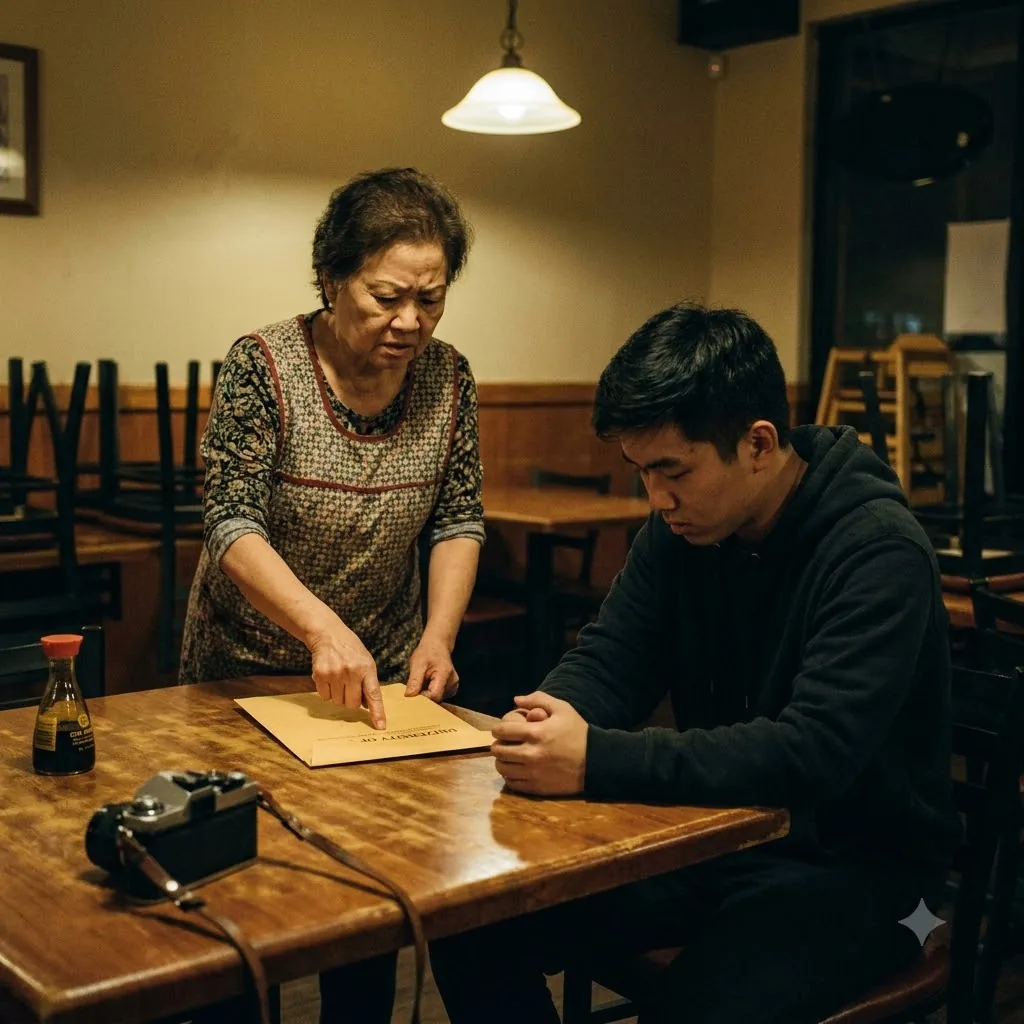
Instead, my mother’s hand instinctively grabbed the thick, manila envelope that had slid halfway out of the internal pocket. The envelope I had smuggled out of Evans’ office during our final, disastrous meeting.
“Don’t look at that,” I gasped, dropping the bag and reaching for it.
But she had already pulled it free. In the dim light of the streetlamp filtering through the windshield, she stared at the bright red stamp on the front of the heavy paper. It didn’t say Academic Warning. It didn’t mention missing assignments or failing grades.
It read: CONFIDENTIAL – Legal Settlement & Non-Disclosure Agreement: Leonard Chen.
She slowly looked up from the envelope, the frantic, determined energy completely draining from her face, replaced by a chilling, bewildered dread.