Story code: ST-000065
Part 4: The Negative
Senator Vance did not blush. He did not stammer, apologize, or offer an explanation. The calculated silence of the administrative lobby simply hardened into something distinctly venomous. The smooth, practiced mask of the politician vanished, replaced by the cold, ruthless glare of a man who was used to crushing inconveniences beneath his polished Italian loafers. He slowly folded the twenty-thousand-dollar check in half, slipped it back into his breast pocket, and turned his back on my mother entirely.
“Handle this, Richard,” Vance said to the Dean, his voice flat and devoid of emotion. He grabbed his son by the shoulder, steering the smirking, reeking boy toward the inner hallway.
Dean Evans scrambled. He didn’t even try to reason with us anymore. The illusion of a fair academic process was dead. He lunged for the telephone on the receptionist’s desk, slamming his palm down on a speed-dial button. “Security. Main lobby. Now. We have hostile trespassers.”
“He is the one who burned the building!” my mother screamed, her voice cracking as she pointed frantically toward the retreating backs of the senator and his son. She lunged forward, desperately trying to bypass the receptionist’s marble counter, but she never made it.
Two campus security officers erupted from the side corridor, their heavy boots thudding against the marble floor. They didn’t ask for our side of the story. They didn’t care about the crushed Non-Disclosure Agreement in my mother’s fist or the twin-serpent ring on Bryce’s finger. They simply saw a frantic, fry-oil-stained woman screaming at the Dean of Students.
One of the officers grabbed my mother by the upper arm, hauling her backward with a violent jerk.
“Don’t touch her!” I yelled, dropping my shoulder and shoving the officer hard in the chest.
Before I could regain my balance, the second officer was on me. He twisted my arm painfully behind my back, his thick forearm pressing heavily against my neck. My canvas camera bag swung wildly, the heavy metal buckles biting into my ribs as he marched me forward. My mother was struggling, crying out in a mixture of rage and broken English, her worn non-slip shoes squealing against the pristine floor.
They shoved us through the heavy oak double doors with brutal efficiency. I stumbled forward, scraping my palms against the concrete steps as I caught my balance. Behind us, the doors slammed shut with a heavy, reverberating thud. The deadbolts clicked into place, echoing like a gavel striking a sound block. We were officially locked out.
The stifling summer humidity from the night before had vanished, blown away by a sudden, bitter cold front that had rolled off the lake before dawn. The campus quad was freezing. The damp morning air sliced right through my thin cotton t-shirt, biting at my skin. I stood up, shivering uncontrollably in the gray, oppressive shadows cast by the towering gothic architecture. The ivy-covered brick buildings suddenly looked exactly like what they were: a fortress designed to keep people like us on the outside.
I brushed the dirt from my knees and looked at my mother. Her apron was twisted, her graying hair wild and unspooled from her bun. She stood shivering on the bottom step, staring up at the locked doors.
I braced myself for the explosion. For four years, every ache in her swollen legs, every humiliating shift over the deep fryer, had been for my medical degree. I waited for her to scream at me. I waited for her to sob about the wasted tuition, the insurmountable loans tied to the restaurant, the lifelong dream of finally having a doctor in the family that was now officially, irrevocably dead. I expected her to collapse under the weight of the realization that my life was ruined, and all her sacrifices had been for absolutely nothing.
But she didn’t cry. She didn’t yell about organic chemistry or the tuition money.
She stared at the mahogany doors for a long time, her breathing slowly evening out in the freezing air. The frantic, desperate immigrant mother who had driven here to beg on her knees was gone. The woman who believed that hard work was a magical shield had died in that lobby.
She turned to face me. Her eyes were dry, sharp, and cold as the frost clinging to the wrought-iron gates.
She pointed a cracked, calloused finger at the canvas bag hanging from my shoulder.
“The pictures you took,” she said, her voice eerily calm, stripped of its usual frantic cadence. “The ones they stole from you in the meeting.”
“Yes,” I said, my teeth chattering. “They confiscated all the film.”
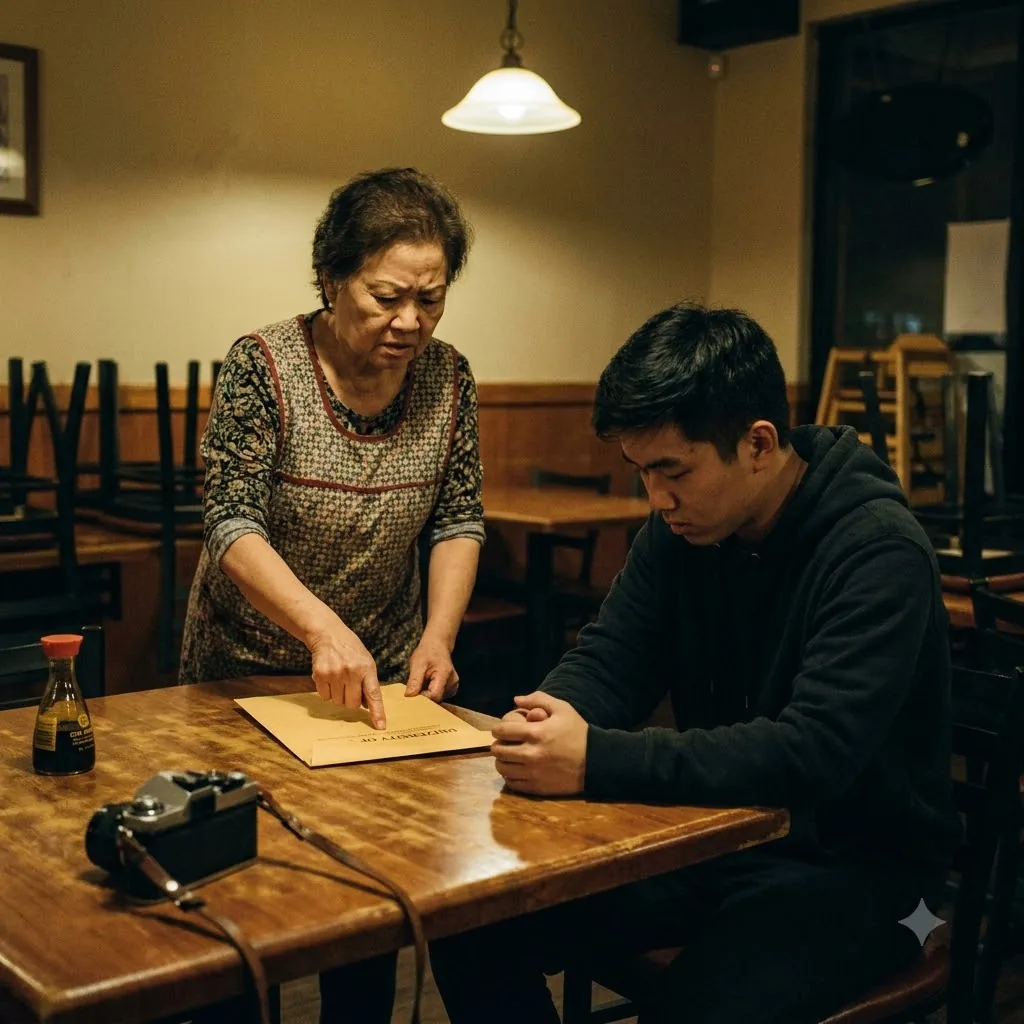
“But you are a photographer,” she said, stating the word not as an insult, but as a cold, hard fact. “You told me once about the darkroom. You said you keep backups of everything. Did you give them the original negatives?”
I stared at her, the freezing wind whipping between us. A slow, heavy realization began to thaw the ice in my chest. “No. I hid the negatives inside the ventilation grate in the darkroom before Evans called me into his office. They only took the developed prints.”
She nodded once. A terrifying, absolute nod. She looked back up at the towering, impenetrable fortress of the administration building, then looked me dead in the eye.
“Is your camera good enough to ruin a senator?”
I looked at the woman who had sacrificed her entire life trying to play by the rules of a rigged game. I saw the exact moment the rules stopped mattering to her. We had lost the medical degree. We had lost our blind faith in the system. But as I gripped the canvas strap of my bag, feeling the heavy, mechanical weight of the camera body inside, I realized we finally had something much more dangerous.