Story code: ST-000165
Part 3: The Administrative Algorithm
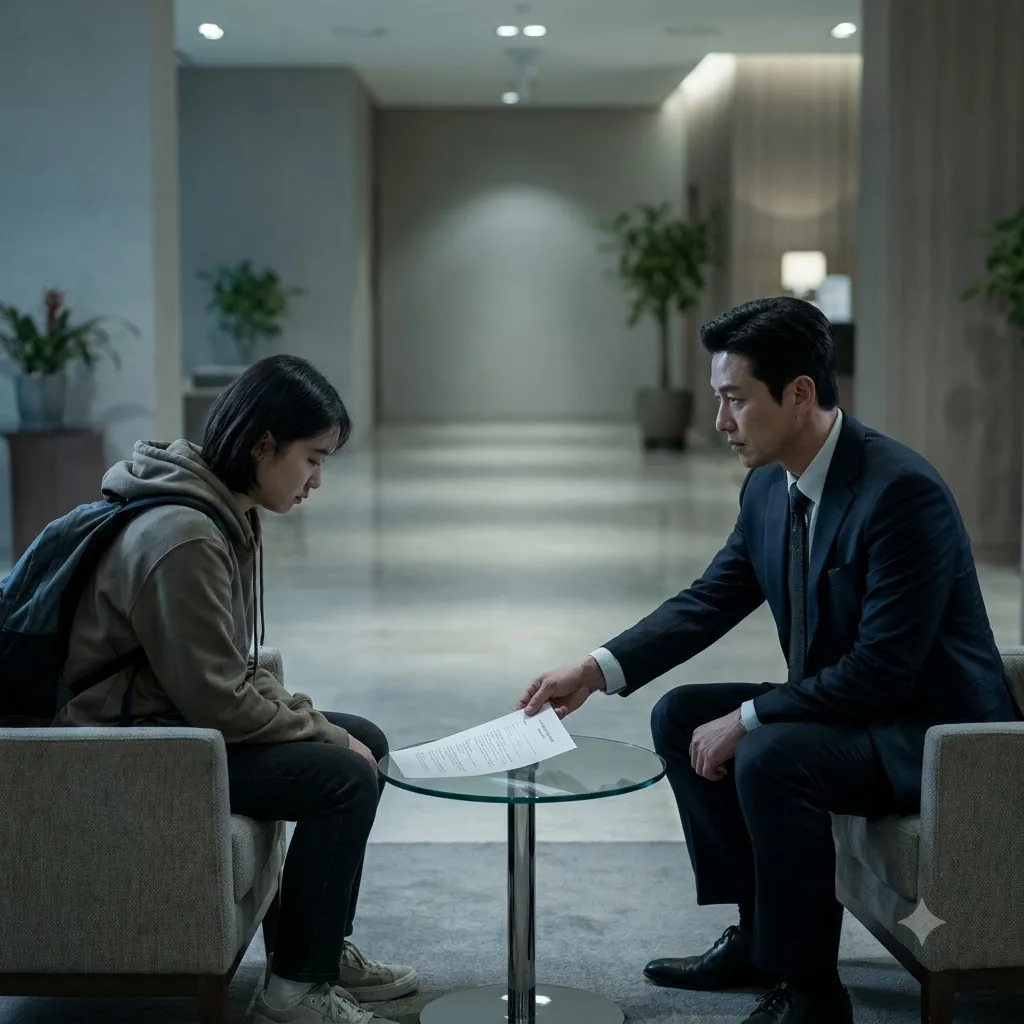
The five minutes stretched into an agonizing eternity. Left alone in the sterile hotel alcove, I stared at the formal withdrawal document and the gleaming gold fountain pen resting on top of it. My name. My applicant ID. The sheer, premeditated cruelty of it made my vision blur.
I closed my eyes and dug my fingernails into my palms, forcing myself to use the grounding techniques I had learned during my two weeks at the Clearview Clinic. *Five things I can see.* The manila folder. The gold pen. The ice machine. The hideous floral carpet. *Four things I can feel.* The leather chair. The cold sweat on my neck. The heavy cotton of my blazer. And the hard, rectangular outline of my smartphone in my pocket.
My phone.
My heart gave a sudden, violent lurch. When I had first sat down in the lobby, forty-five minutes before my world collapsed, I had discretely tapped the Voice Memos app and slipped the phone into my breast pocket. It wasn’t born of paranoia; it was a byproduct of my relentless, neurotic perfectionism. I had wanted an audio recording of my interview so I could replay it later, obsessively critiquing my pacing, my tone, and my vocabulary for future college applications.
It was still recording.
I didn’t touch my pocket. I just sat perfectly still, letting the realization crystallize in my mind as Mr. Sterling’s heavy footsteps approached from the hallway.
He sat down, adjusting his wire-rimmed glasses with a practiced, authoritative motion. He looked at the untouched pen. “I assume you have made the smart decision, Chloe. For your own sake.”
I looked him dead in the eye. “I’m not signing it.”
Sterling’s polite, corporate smile vanished, replaced by a cold, hard line. “Then you leave me no choice. I will call the home office immediately.”
“Before you do,” I said, my voice remarkably steady, channeling every hour of Model UN debate training I had ever endured. “I want to ask you a question about the Chancellor’s Wellness Initiative.”
Sterling paused, his brow furrowing in genuine confusion. “Excuse me?”
“Your university’s marketing materials,” I continued, leaning slightly forward. “You spent the first ten minutes of this interview boasting about the new fifty-million-dollar campus mental health center. You specifically mentioned the university’s commitment to destigmatizing burnout. The admissions brochure literally says, *’We value the courage it takes to heal the whole student.’*”
“Marketing slogans have absolutely nothing to do with falsifying your application, Chloe,” he said, his tone dripping with condescension.
“But I didn’t falsify anything,” I countered. “My high school principal approved the medical leave. A severe psychological collapse is a legitimate medical condition. You aren’t threatening to reject me because I lied. You are threatening to destroy my future because my illness was psychiatric instead of physical.”
“Do not presume to lecture me on university policy,” Sterling said, his voice dropping a dangerous octave.
“If I had missed fourteen days for a ruptured appendix, Richard Vance’s tip would have been ignored,” I pressed, refusing to yield an inch. “But because it was the Clearview Clinic, you saw an opportunity. Or rather, a prominent legacy donor saw an opportunity to eliminate his son’s only competition for valedictorian, and you were more than happy to act as his executioner.”
Sterling’s hands flattened against the polished wood of the table. The composed, professorial veneer was beginning to fracture. “You are bordering on profound insolence.”
“And you are bordering on profound hypocrisy,” I shot back, the adrenaline completely overriding my fear. “You demand that teenagers take on crushing, inhumane workloads to prove their worth. But the second one of us actually cracks under your pressure, seeks professional medical help, and claws her way back to the top of her class, you use her recovery against her. You don’t care about my resilience. You care about Richard Vance’s checkbook.”
“Enough!” Sterling snapped. The sheer volume of his voice echoed sharply off the alcove walls, causing a businessman near the elevators to stop and stare.
Sterling didn’t care. He leaned across the table, his face suddenly flushed with angry color, the veins in his neck pulling tight against his collar. He abandoned his sophisticated vocabulary, his voice dropping into a harsh, venomous hiss.
“You want the truth, little girl?” he sneered. “The truth is you are entirely unremarkable. I read hundreds of files exactly like yours every single cycle. We have thousands of applicants with perfect GPAs from suburban pressure cookers who think taking seven AP classes makes them God’s gift to academia. You are a severely overrepresented demographic, and quite frankly, the university is exhausted by you.”
I sat perfectly still, letting his rage wash over me.
“We have to cull the herd,” he continued, his mask completely obliterated by his temper. “We need a reason to throw thousands of you out without hurting our yield metrics or inviting discrimination lawsuits. Richard Vance handed me a silver bullet. Rejecting you for a technical attendance discrepancy allows me to clear space in an oversaturated, boring demographic pool while simultaneously securing a seven-figure endowment pledge from the Vance family. It is a simple administrative algorithm, Chloe. You just happened to be the one on the chopping block.”
He snatched the gold pen and slammed it down onto the withdrawal form, pushing the paper so hard it crumpled against my wrists. “Now sign the damn paper before I ruin what little future you have left.”
I didn’t reach for the pen. Instead, I let out a long, slow breath. The suffocating, terrified weight that had been crushing my chest for the last hour suddenly evaporated.
I pushed my chair back and stood up.
“What are you doing?” Sterling demanded, glaring up at me. “Sit back down.”
I reached into the breast pocket of my blazer. I pulled out my phone and tapped the dark glass to wake up the screen.
The red recording bar was ticking steadily across the top of the display. Fifty-eight minutes and twenty-two seconds.
I slid the phone onto the polished wood of the table, placing it directly over the crumpled withdrawal form.
“A simple administrative algorithm,” I repeated softly, matching his earlier, clinical tone. “An oversaturated, boring demographic pool. Securing a seven-figure endowment pledge in exchange for executing a hit job on a donor’s academic rival.”
Sterling stared at the ticking red numbers. All the furious color drained from his face in a single instant, leaving him a sickening, ashen shade of gray. His eyes widened behind his wire-rimmed glasses, locked in absolute horror on the audio waves dancing across my screen.
“As I mentioned, Mr. Sterling, I am an obsessive perfectionist,” I said, looking down at his suddenly trembling hands. “I started a voice memo the second I sat down because I wanted to critique my interview performance later. I had no idea I was going to capture a confession of institutional corruption.”
He opened his mouth, but only a dry, strangled gasp escaped his throat. He sat paralyzed in his leather chair, staring at the little red line that had just dismantled his entire career, completely unable to form a single cohesive lie to save himself.