Story code: ST-000185
Part 2: The Fissure
…loss,” the young man finally stammered, the words rushing out of his mouth as if he were afraid the ocean wind would snatch them away. “Immediate mandatory condemnation. Unfit for human occupancy.”
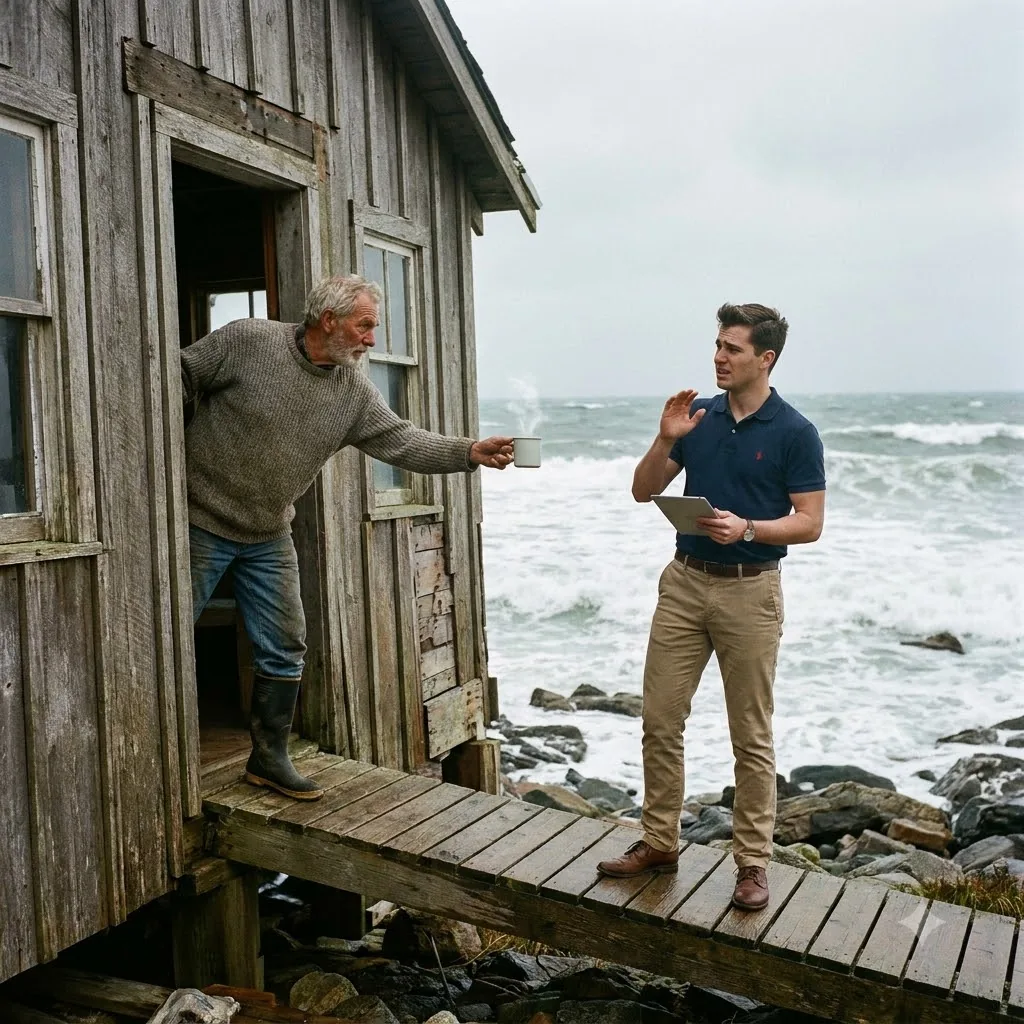
Arthur tightened his grip on the doorframe. The painted wood under his fingers was smooth, worn down by years of him leaning exactly here to compensate for the house’s tilt. “Loss?” Arthur repeated, his voice barely rising above the crashing surf below. “The foundation settled after the hurricane in ’18. It dropped a few degrees, yes, but the pilings are driven straight into the bedrock. It hasn’t moved an inch in five years.”
The young man shook his head rapidly, taking another half-step backward down the wooden access ramp. He tapped the iPad screen again. “Sir, the geo-survey this morning… they weren’t just checking the slope. They used ground-penetrating radar on the entire bluff.” He swallowed hard, his eyes darting to the corner of the house where the porch overhung the sheer drop. “The bedrock itself is fracturing. There’s a severe subterranean fissure opening right beneath your living room. The engineers say a strong high tide could trigger a catastrophic sheer collapse.”
Arthur looked down at the brass threshold plate. The young man’s refusal to step inside suddenly made a harsh, humiliating kind of sense. It wasn’t just a preference for level ground or a disdain for a messy old man’s coastal cabin. The boy genuinely believed that adding another hundred and sixty pounds of human weight to the structure might send the entire house plunging into the Atlantic.
“I’ve lived here for forty years,” Arthur said, trying to keep his tone even, though a cold knot was rapidly forming in his stomach. “Every house on this stretch groans in the wind.”
“The others aren’t sliding into the water,” the young man countered, his voice cracking slightly. He held out the tablet as if Arthur could read the dense topographical maps from six feet away. “The county zoning board has already revoked the certificate of occupancy. As of ten o’clock this morning, it is a criminal offense to remain inside the structure.”
Arthur looked back into his slanted hallway. He saw the coffee cup on the wedge block, the heavy wool coat defying gravity on its hook, the bookshelves he had meticulously bracketed to the wall studs to keep his expansive library from tumbling. Every corner of the space represented a careful, deliberate adaptation. He had learned to walk with a permanent list, to cook on a leveled stovetop, to sleep in a bed with sawn-off uphill legs. He had adapted his entire existence to the cliff, and now some municipal screen was telling him his survival meant nothing.
“I have nowhere else to go,” Arthur stated simply. It was the absolute truth. His modest pension barely covered his groceries and the climbing property taxes. His estranged nephew, David, lived three states away and hadn’t answered a phone call in two years. There was no backup plan, no savings account for a sudden relocation, no apartment waiting for him in the distant town.
“The county has emergency sheltering provisions,” the young man said, though he didn’t sound convinced by his own script. He fumbled in his trousers pocket and pulled out a folded piece of bright red cardstock. “But you can’t stay here. The sheriff’s department is already executing the mandatory evacuation orders for Sector Four.”
“I’m Sector Four?” Arthur asked.
The young man nodded. “You’re the only property in it. Because of the immediate risk.” He unfolded the red cardstock. It was a condemnation tag, glaring and authoritative. “I have to affix this to the primary entrance. And I have to advise you that… that you need to vacate the premises by four o’clock today. If you are still inside, law enforcement will forcibly remove you, and the county will bill you for the extraction and the subsequent demolition.”
Arthur checked his wristwatch. The crystal face was scratched, but the hands were clearly legible. It was almost two in the afternoon. Two hours. Two hours to pack up four decades of a life.
“Two hours,” Arthur breathed out, the reality hitting him like a physical blow. “I can’t even pack my clothes in two hours. I don’t have a truck. I don’t have boxes.”
“You aren’t permitted to remove heavy furniture anyway,” the young man warned, his eyes pleading with Arthur to just understand the severity of the math beneath their feet. “The shifting weight could trigger the fissure. You’re advised to take only essential medications, identification, and a single change of clothes.”
The wind battered the side of the house again, and the deep, resonant groan of the pilings echoed up through the floorboards. This time, the sound felt different to Arthur. It didn’t feel like the familiar song of the old timber settling into the dirt. It sounded like tearing. The mug of coffee on the entryway table visibly trembled, the dark liquid splashing over the ceramic rim and dripping onto the slanted floor.
The young man flinched violently at the sound, retreating all the way to the safety railing of the access ramp. He reached into his canvas tool belt and pulled out a heavy industrial staple gun.
“Sir, please,” the young man begged, extending his arm as far as he could over the gap without stepping onto the porch itself. “I need to tag the doorframe. Please just step outside.”
Arthur didn’t move. He stared at the bright red card in the boy’s shaking hand, the glaring black letters spelling out CONDEMNED. The house gave another sickening shudder, a deep vibration that started in the bedrock and traveled straight up through Arthur’s locked knees, accompanied by a sharp crack from the drywall above his head.