Story code: ST-000185
Part 4: The Final Angle
The staple gun fired with a deafening, metallic *thwack*. Then twice more in rapid succession.
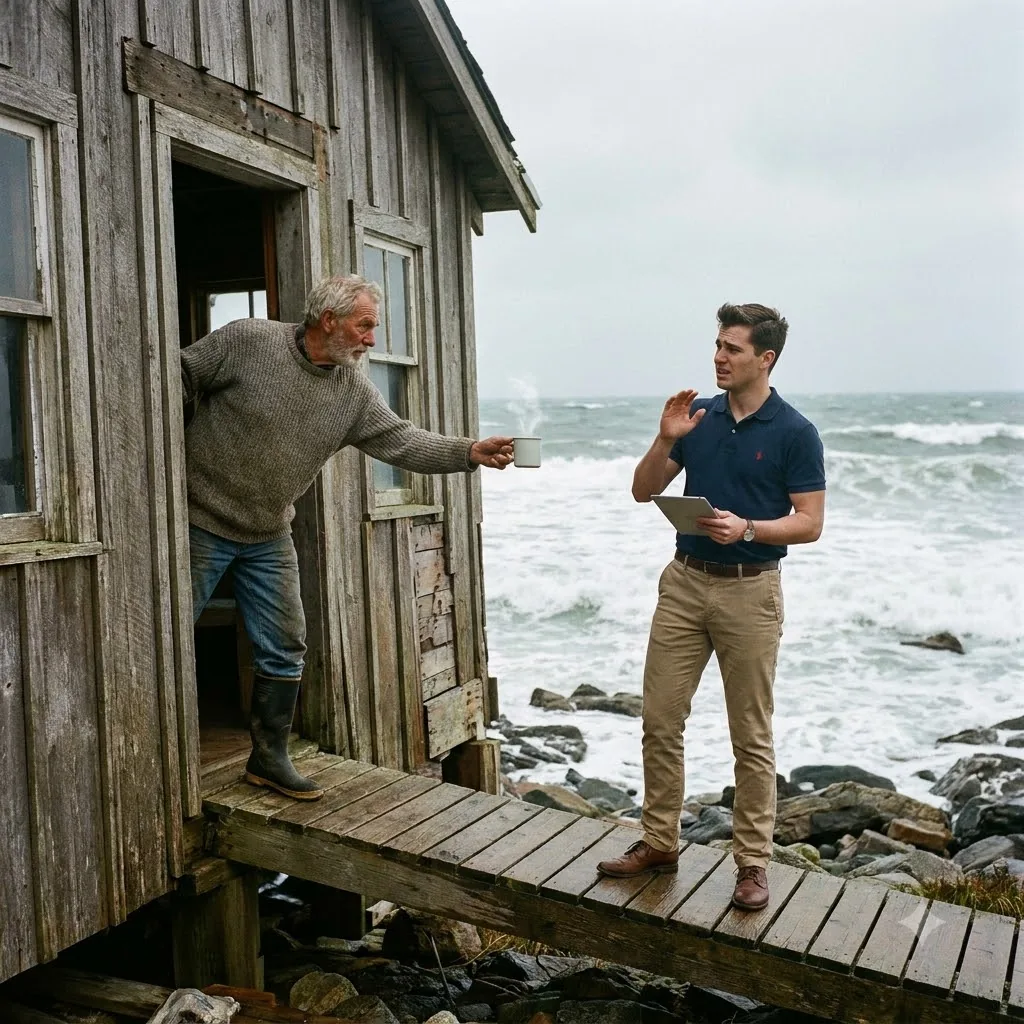
The young man stood panting in the doorway, staring wildly at the bright red cardstock now permanently affixed to the doorframe. He didn’t look down at Arthur, who was crumpled against the baseboard, clutching his ribs. The adjuster simply stumbled backward, his polished brown shoes finally retreating over the brass threshold plate. He turned and sprinted down the wooden access ramp, his corporate iPad clutched tightly against his chest.
Arthur stayed on the slanted floorboards, his breath coming in shallow, painful rasps. He listened to the frantic crunch of the young man’s footsteps on the gravel driveway, followed by the immediate, panicked revving of an engine. The tires of the silver rental sedan spun in the dirt, kicking up a spray of loose rocks before finding traction. The car sped away, its engine whine fading quickly into the roar of the coastal wind, leaving Arthur entirely alone on the edge of the world.
Slowly, agonizingly, Arthur pushed himself up. His bad hip screamed in protest, and his right shoulder throbbed where it had slammed against the plaster. He leaned heavily on the downslope wall, his slipper crunching over the broken glass of the fallen photograph. The wind whipped through the open doorway, carrying the salty chill of the encroaching tide, swirling the settled drywall dust into small, chaotic eddies.
He hobbled to the doorframe and looked at the red tag. *CONDEMNED. POLICY VOID.* The staples were driven so deep they splintered the old painted wood. The young man had achieved his goal. The bureaucracy had spoken, wrapping its cold fingers around Arthur’s life and squeezing until nothing remained. He was no longer a homeowner, no longer a citizen with a recognized address, no longer a policyholder with a safety net. He was just an old man standing in a wooden box that no longer officially existed.
Arthur closed the front door, sealing out the biting wind but not the deep, structural groan of the pilings beneath his feet. The house shifted again, a subtle, sickening lurch that sent a fresh shower of dust from the ceiling hairline fracture. He navigated the steep incline of the hallway, his body moving on muscle memory, compensating for a gravity that was steadily betraying him.
He stopped by the rotary phone resting on the small, leveled console table in the kitchen. His trembling hand hovered over the heavy plastic receiver. He thought of his estranged daughter, Eleanor. It had been nearly twelve years since she had packed her bags, furious at his stubbornness, furious at this very house. She lived in Chicago now, surrounded by concrete and steel, firmly anchored to solid ground.
He could call her. The county emergency operators might refuse to come out to Sector Four, but Eleanor would answer. He could swallow his pride, beg for a wire transfer, ask for a corner of her guest room. He pictured her voice-the pity, the exasperated sigh, the inevitable realization that her warnings about the cliff had been right all along. But more than the pride, it was a profound exhaustion that stayed his hand. Calling her meant dragging his ruin into her life. It meant forcing her to deal with a broken old man who had bet everything on a crumbling foundation and lost.
Arthur lowered his hand, leaving the receiver in its cradle. He didn’t want to be a burden, a problem to be solved by a daughter who had already mourned the loss of her father a decade ago. He accepted it then-the absolute totality of his erasure. The county had wiped away his property, the insurance company had wiped away his future, and he was choosing to let go of the last, fragile tether to his family. There would be no frantic packing, no panicked phone calls, no desperate flight.
He turned away from the phone and walked back into the living room. The spare mug of coffee still sat on the entryway table, the dark liquid angled sharply within the ceramic rim, perfectly parallel to the ocean outside.
Arthur crossed the ten-degree slope to his favorite armchair. The faded corduroy seat was propped up on its downhill side by two thick blocks of oak, keeping it level in a room that had long ago surrendered to the earth. He sank into the cushions, letting out a long, shuddering breath. The pain in his shoulder dulled to a low, distant ache.
Beneath him, the subterranean fissure shifted again. The house let out a tremendous, echoing crack, a sound like a great ship breaking its keel. The floorboards buckled slightly near the hearth, and a framed landscape painting slid off the wall, clattering to the floor.
Arthur didn’t flinch. He didn’t reach for his heavy wool coat on the leaning hook. He simply rested his hands on the armrests and turned his gaze to the large picture window facing the Atlantic. The gray waves crashed against the rocks forty feet below, rhythmic, violent, and endlessly indifferent. He leaned back in his slanted chair, closed his eyes, and listened to the deep, resonant breathing of the ocean, waiting for the cliff to finally take him home.