Story code: ST-000186
Part 2: The Demographic Proxy
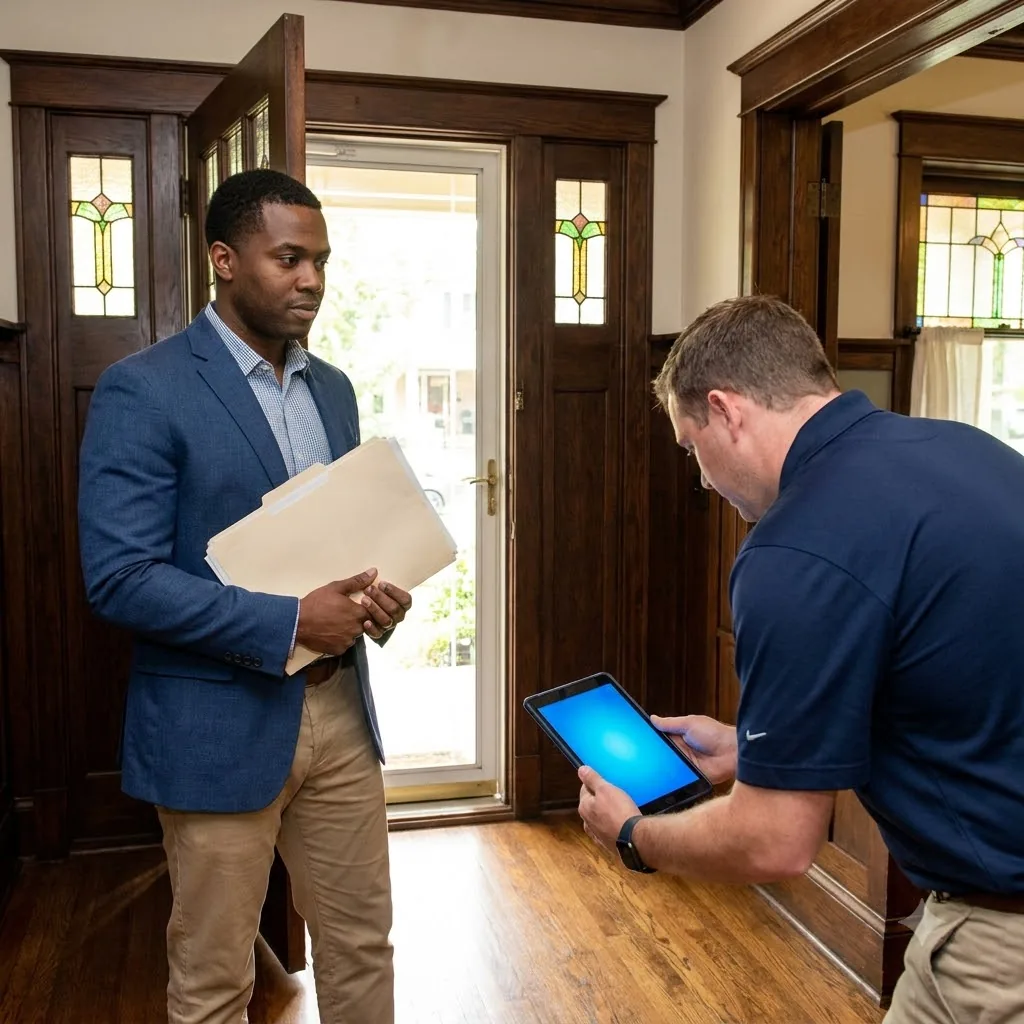
Marcus stared at the small metallic disc now marring the French polish of his banister. He slowly lifted his gaze from the scratched wood to Greg, whose face remained half-illuminated by the sterile, blue glow of the tablet.
“I don’t do comps,” Greg said, his voice flat and defensive. “I don’t look at receipts. I don’t care about the city permits. I am a third-party spatial technician. The proprietary system at the central office does the valuation. I just walk the camera around the rooms.”
Marcus felt a cold spike of adrenaline pierce through his anger. “You are telling me no human being actually evaluates the property?”
“The algorithm evaluates the property,” Greg replied, adjusting his grip on the telescoping camera wand. “It’s supposed to eliminate human bias. Make the entire market perfectly objective. Now, if you’ll excuse me, I have three more properties in this zip code to scan before five o’clock.”
“Show me,” Marcus demanded.
“Excuse me?”
“Show me what your perfectly objective algorithm is seeing.” Marcus stepped down off the bottom stair, closing the distance between them. He did not raise his voice, but he let his broad shoulders square up, projecting the same immovable, heavy authority that had commanded executive boardrooms for over a decade. “If you truly have no input, then you have no reason to hide the live data feed.”
Greg hesitated, his eyes darting toward the front door as if calculating an escape route. But he let out another heavy sigh, rotating the tablet to face Marcus. “Fine. You want to see the mesh? Look at it. It’s just geometry.”
Marcus looked down at the high-definition screen. It displayed a frozen, wide-angle scan of his living room and hallway. A wireframe grid of green lines mapped the precise dimensions of the walls, ceiling, and floors. But beneath the structural mesh, the system had painted a secondary layer of translucent bounding boxes over various objects in the house.
A green box outlined the pristine Calacatta marble kitchen island in the distance. A floating text string hovered over it: *Standardized Countertop Surface. Baseline Confirmed.*
Then, Marcus’s eyes caught a cluster of bright, warning-yellow rectangles hovering over the living room mantle. He leaned closer, his chest tightening as if the air in the room had suddenly thinned out. The yellow boxes were locked directly onto his framed family photos. One box squarely targeted a picture of Marcus and his wife at an Alpha Phi Alpha charity gala. Another outlined a vintage, original concert poster from the 1970s jazz scene in Harlem, while a third captured the imported Shona stone sculpture he had brought back from a trip to Zimbabwe.
Floating beside these yellow boxes was a chilling line of metadata: *Non-Standard Decor – Demographic Proxy: High Confidence – Applying Localized Depreciation Metric.*
Marcus felt the breath leave his lungs. The system wasn’t objective at all. It was digitally redlining his home. The algorithm had been trained on historical real estate data inherently corrupted by decades of racial prejudice, and it was actively using his personal belongings-the cultural markers of his Black family-as visual proxies to drag down his home’s value to match historically marginalized neighborhood baselines.
“Do you see this?” Marcus asked, his finger hovering millimeters from the glass screen. “It is penalizing the valuation because of who lives here. It is flagging my family’s identity as a financial risk metric.”
Greg squinted at the screen, his brow furrowing slightly before he shrugged, his gig-worker apathy returning in full force. “I don’t write the code, man. It just cross-references visual anomalies with regional sales data. It says ‘depreciation,’ so it adjusts the baseline.”
“It is automated racial profiling,” Marcus said, his voice trembling with a terrifyingly cold rage. “You are holding a device that is actively stripping equity from my home because I am Black. You need to delete this scan and restart it with the demographic filters turned off.”
“I can’t turn anything off!” Greg snapped, quickly pulling the tablet back against his chest. “I don’t have administrative privileges. I don’t even have an override button. I’m just the operator. If I hit reset, the app docks my pay for a botched job, and my daily completion rate drops.”
“I lost my job this morning,” Marcus said, the devastating truth slipping out before he could stop it. The raw desperation in his own voice disgusted him, but the panic was clawing at his throat. “Fifteen years of corporate loyalty, wiped out by an automated email. My severance is currently locked in a legal dispute with an AI-driven HR bot. This house’s equity is my family’s only immediate safety net. I will not let another faceless algorithm steal what is mine.”
Greg looked away, staring awkwardly at the pristine mahogany baseboards. “Look, I’m sorry about your job. Really. But the system is already compiling the first floor. It’s generating a preliminary estimate right now.”
Marcus glanced at the top right corner of the tablet. A small loading circle was spinning, calculating the real-time value. The number flashed on the screen in stark, red text: $415,000.
Marcus had purchased the home for $550,000 five years ago and poured over a hundred thousand dollars into the meticulous restorations. The machine was wiping out nearly a quarter of a million dollars of hard-earned wealth in seconds.
“It’s just low because it hasn’t factored in the second-floor square footage yet,” Greg said quickly, though he still refused to meet Marcus’s eyes. “I just need to scan the bedrooms. I’m on a strict timer. The session times out in six minutes, and if I don’t finish, it locks in this preliminary number and flags you in the central database as a non-compliant homeowner.”
Greg took a step toward the stairs, lifting the multi-lensed camera wand once again.
Marcus stood entirely paralyzed on the bottom tread. The second floor was intensely personal. It held his children’s bedrooms, their diverse artwork, his wife’s massive collection of African-American literature, and generations of family photo albums. If the camera swept through those rooms, the algorithm would harvest a thousand more demographic proxies, driving the valuation deeper into the ground. But if he stopped the scan, the system would lock in the catastrophic preliminary number.
He had six minutes before the machine finalized his financial ruin.