Story code: ST-000186
Part 3: The Compliance Score
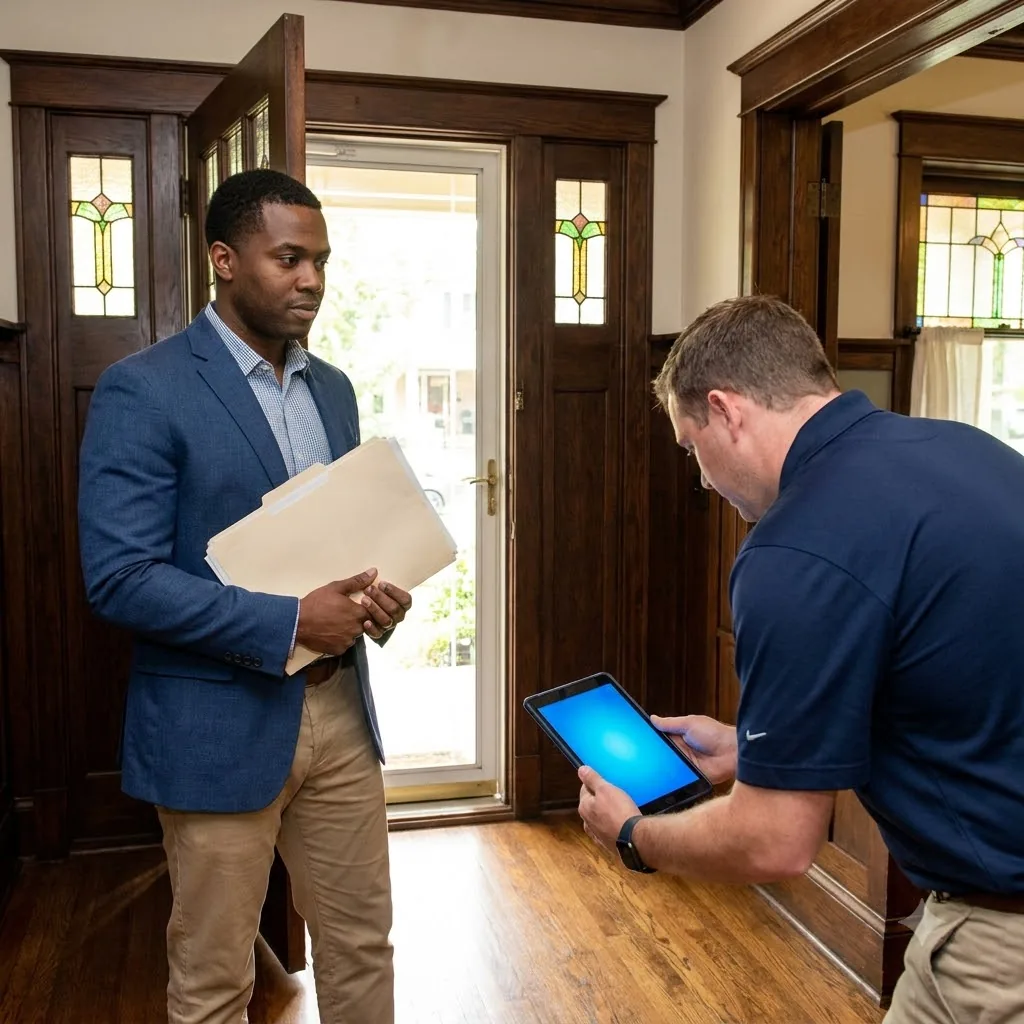
Marcus stood unmoving on the bottom stair. The Craftsman’s foyer, usually a space of warm, amber light and welcoming wood tones, felt suddenly tight, compressed by the blinking red digits on the tablet’s screen. Five minutes and forty-two seconds.
Greg shifted his weight, his heavy boots squeaking against the refinished oak. He raised the telescoping carbon-fiber wand again, trying to angle the spherical camera over Marcus’s shoulder to catch a glimpse of the upstairs landing.
Marcus reached out and wrapped his hand around the cold, rigid shaft of the wand. He didn’t yank it, but he locked his arm, completely halting its momentum.
“Hey!” Greg barked, his eyes going wide. “Do not touch the equipment! That violates the terms of the spatial appraisal.”
“Lower the camera,” Marcus said. His voice was a flat, unyielding baritone. It was the exact tone he had used to dismantle hostile takeover attempts and dress down underperforming vice presidents. It was a voice that expected immediate compliance.
Greg tugged at the wand, but Marcus held fast. For a second, the appraiser’s corporate bravado flared. “Let go of the hardware, or I’m hitting the abort button right now. You’ll get the four-fifteen valuation, and the system will red-flag your property file for non-compliance. You’ll never get a fair refinance rate from any bank on the network.”
“There is no fair rate to get,” Marcus said. He slowly released the wand, but he did not yield an inch of the staircase. “The system is already penalizing me for existing in this space. Now, put the tablet down and call your managing underwriter.”
“I don’t-”
“Call them,” Marcus interrupted, stepping down from the bottom tread to close the physical gap between them. He towered over Greg by three inches, letting his broad shoulders square up. “Every real estate valuation firm has a licensed senior appraiser who signs off on the final numbers. I want them on speakerphone. I will explain the demographic proxy error, and they can remotely scrub the metadata from this session.”
Greg swallowed hard. He looked down at the tablet. Four minutes and nineteen seconds. The red loading circle spun mockingly beside the disastrously low dollar amount.
“You don’t understand,” Greg said, his voice losing its clipped, mechanical edge. He sounded suddenly breathless. “The central office doesn’t take field calls.”
“Then dial your direct supervisor.” Marcus tapped the screen of the tablet. “Someone issued your route today. Someone monitors your uploads. Get a human being on the phone who has the administrative credentials to override this algorithm.”
Greg backed up a step, his eyes darting frantically from the tablet to Marcus, and then to the heavy oak front door. The smug, dismissive attitude that had shielded him since he walked into the house began to fracture. His shoulders slumped, the rigid posture of a man pretending to be in charge evaporating into thin air.
“There is no supervisor,” Greg said, his voice dropping to a harsh whisper.
Marcus frowned, the thick leather dossier in his hand suddenly feeling incredibly heavy. “What do you mean, there is no supervisor? You work for a national firm.”
“I work for an app,” Greg said, his hands shaking slightly as he gripped the edges of the tablet. “I don’t have an office. I don’t have a manager. I just log into the portal at six in the morning and drive to the GPS pins it spits out.”
Marcus stared at him, the executive logic in his brain struggling to process the structural void. “Who signs off on the appraisals? The law requires a certified human signature.”
“They fired them,” Greg blurted out, the professional detachment completely shattering. “All the senior staff, all the regional underwriters. The company gutted the entire compliance department last October. They pushed an update that lets the algorithm act as the licensed entity. It auto-generates the signature based on the mesh scans I upload.”
Three minutes and forty seconds.
Marcus felt the floor tilt beneath him. The anger that had been boiling in his chest since his own automated termination that morning suddenly hit a wall of absolute, chilling dread. There was no one to reason with. There was no manager to leverage, no human error to correct. The invisible assessor wasn’t just a tool; it was the entire infrastructure.
“You are holding the camera,” Marcus said, his voice quieter now, laced with a desperate kind of disbelief. “You see what it’s doing. It is stripping a quarter of a million dollars from my family. Cancel the scan. Tell the app the equipment malfunctioned. Throw the wand in the yard, I don’t care. I’ll pay you whatever your day rate is.”
Greg shook his head, his face pale in the blue glow of the screen. “You think I want to do this? You think I care about your photos or your marble countertops? I’m just a data-gatherer.” He turned the tablet around again, his thumb hovering over a small gauge at the bottom of the screen. “Look at this. This is my compliance score. It’s at ninety-two percent.”
Marcus looked at the small green bar beneath Greg’s profile picture.
“If I manually abort a scan that has already generated a first-floor mesh, it logs it as user-error evasion,” Greg said, his words spilling out in a panicked rush. “It drops my score by five points. If I fall below ninety, the system assumes I’m inefficient. It deactivates my account. Automatically. No warnings, no HR department, no severance.”
Greg looked up at Marcus, his eyes wide and pleading, stripped of all authority. “I have a mortgage too, man. If I don’t walk up those stairs right now, I’m fired.”
Two minutes and fifty-five seconds.
The red numbers pulsed on the screen. Marcus stood motionless, the heavy binder of receipts in one hand, staring at the terrified man holding the camera. The silence of the restored Craftsman house pressed in around them, thick and suffocating, as the machine in Greg’s hands quietly ticked away both of their livelihoods.