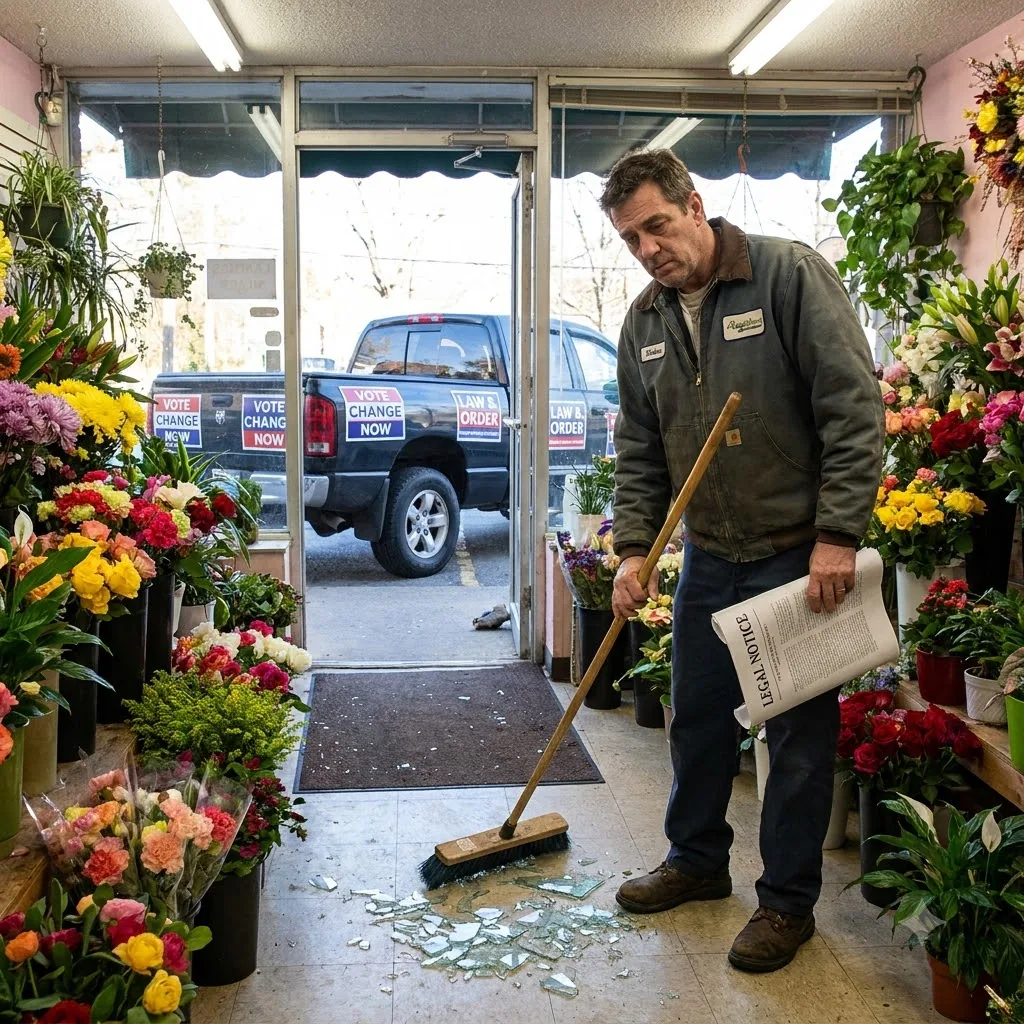
Story code: ST-000190
Part 2: The Pedestrian Blockade
Julian stumbled backward as the heavy black door swung outward, the sudden movement forcing him to brace against the damp brick wall of the alley. A thick boot hit the asphalt. The man who climbed down from the lifted cab didn’t look like a typical campaign volunteer. He wore a sharply tailored charcoal suit under a heavy wool overcoat, a glossy *Tradition First* pin fastened perfectly to his lapel. He was broad-shouldered, with closely cropped graying hair and a smile that didn’t reach his flat, pale eyes.
Julian recognized him instantly. Marcus Vance, the mayor’s deputy chief of staff. The man who had sat silently in the back row of the federal courtroom yesterday, taking meticulous notes as the judge issued the injunction.
“Morning, Julian,” Vance said, his voice a smooth, practiced baritone that easily cut through the rumble of the idling engine. He leaned back against the open door of his truck, crossing his arms. He made no move to return to the driver’s seat.
“Move the truck, Marcus,” Julian said, keeping his voice as steady as his shivering jaw would allow.
Vance sighed, looking down at his expensive leather boots. “I’d love to. Truly. But she just stalled out on me. Total transmission lockup. I’ve already called a tow, but you know how dispatch is on a freezing morning like this. They said it might be an hour. Maybe two.”
The engine was still humming perfectly, pumping rich, unburned exhaust into the narrow alley. Julian stared at the spinning cooling fan visible through the truck’s massive chrome grille. “The engine is running.”
“Alternator issue,” Vance lied, his smile widening a fraction. “Can’t risk turning it off. You know how it is.”
Julian pressed his hand against the pocket of his coat, feeling the folded edge of the court order. “I have a federal injunction. You have no legal right to block my exit. If I call the police-”
“The police are a little tied up this morning, Julian,” Vance interrupted, his tone shifting from fake polite to deathly quiet. He reached into his overcoat and retrieved a sleek smartphone. He tapped the screen a few times and held it out.
Julian hesitated, then stepped closer to look at the bright screen. It was a live video feed from the public library, located six blocks away. The broad concrete steps leading up to the main entrance were completely submerged under a sea of people. Dozens of massive black flags bearing the *Tradition First* slogan whipped in the winter wind. Men and women in heavy winter gear stood shoulder-to-shoulder, holding signs that declared Julian a danger to the community. At the perimeter, a handful of city police officers stood idly by the barricades, casually sipping coffee and watching the crowd.
“The mayor decided to host a last-minute rally for family values,” Vance explained, slipping the phone back into his pocket. “Right on the public sidewalk outside the library. Fully permitted, of course. We expected fifty people. Looks like three hundred showed up. The precinct had to pull every available unit just for crowd control.”
Julian’s chest tightened. The air in the alley suddenly felt suffocating, thick with diesel fumes and the crushing realization of the trap. The shattered glass on his floral shop floor, the ruined orchids, the hours spent boarding up the window in the freezing dark-it had all been a calculated distraction. The overnight vandalism was just a primer to keep him exhausted and isolated while the mayor mobilized a small army.
“You have thirty-two minutes until the library doors open,” Vance said, checking a heavy silver watch on his wrist. “Even if my truck magically started working, you can’t drive your van through a pedestrian blockade. And if you don’t cross the threshold of that library by nine o’clock, your reading is automatically canceled per the facility’s late-arrival policy. Judge’s order or not.”
Julian looked back at his own delivery van, trapped in the alley. The heavy plastic bin filled with storybooks, craft supplies, and the salvaged floral arrangements sat in the passenger seat. It weighed nearly forty pounds. Walking six blocks through the biting wind with it would be agonizing. Walking into that mob with it felt impossible.
Vance stepped back up into the cab of the truck, the metallic clack of the door shutting echoing like a cell door slamming shut. The tinted window rolled down an inch. “Go back inside, Julian. Board up the rest of your shop. Stay warm.”
Julian stood in the exhaust smoke for three agonizing seconds. He could feel a microscopic shard of glass from the shop floor digging into the heel of his shoe, a sharp, stinging reminder of the violation he had already endured. He turned his back on the campaign truck and marched to his van.
He didn’t bother locking it. He yanked the passenger door open, grabbed the heavy plastic bin by its molded handles, and hauled it against his chest. The sharp edge of the plastic immediately dug into his ribs. He bypassed the idling truck by scraping his shoulders against the rough brick wall of the alley, squeezing through the twelve-inch gap between the truck’s rear bumper and the building.
The cold hit him like a physical blow as he emerged onto the open sidewalk. He began to walk.
Each block felt twice as long as the last. His fingers, wrapped tightly around the handles of the bin, went numb by the second intersection. The wind whipped his unbuttoned coat around his legs. He kept his eyes locked on the horizon, ignoring the confused stares of morning commuters. He was running strictly on adrenaline and the frantic, hollow thumping of his own exhausted heart.
As he turned the final corner onto Elm Street, the distant hum of the morning commute was swallowed by a unified, deafening roar.
Julian stopped in his tracks. The video on Vance’s phone hadn’t done it justice. The entire library plaza was choked with bodies. Megaphones crackled with aggressive, distorted chants. The police had set up metal barricades, but they were positioned to keep people *out* of the library, not to clear a path to the doors. Behind the reinforced glass of the library’s double doors, Julian could see Mrs. Gable, the head librarian, her face pale and terrified as she frantically spoke into a desk phone.
A uniformed officer broke away from the barricade line and walked directly toward Julian, resting a heavy hand on his utility belt. The officer’s face was stern, his eyes dropping to the plastic bin of children’s books in Julian’s shaking arms.
“Sidewalk’s closed for a permitted demonstration,” the officer shouted over the roar of the crowd, stepping squarely into Julian’s path. “I’m going to need you to turn around, sir.”