Story code: ST-000230
Part 2: Community of Care
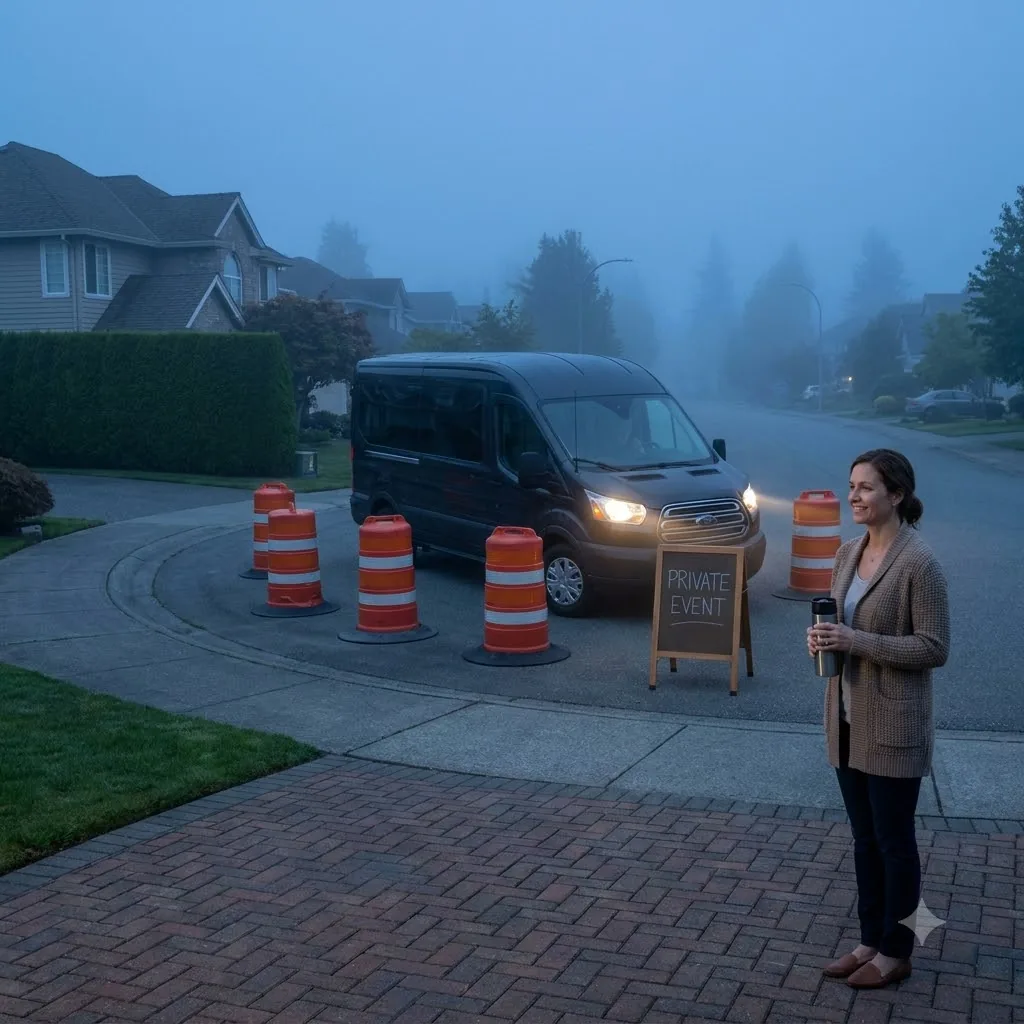
Sarah kept her hand locked rigidly on the driver-side door handle, her knuckles turning white as the man in the charcoal suit closed the distance between the black sedan and her driveway. The pre-dawn fog seemed to swallow the sound of his leather dress shoes on the wet pavement. He bypassed the heavy orange traffic barrels with practiced ease, stepping right up to Eleanor’s side.
Eleanor did not look surprised. She beamed, lowering her silver thermos to extend a welcoming, overly familiar hand.
“Mr. Sterling,” Eleanor said, her voice dripping with the practiced, aggressive warmth of a charity gala host. “Right on time. I trust the private gate code the association provided worked without issue?”
“Flawlessly, Eleanor,” the man replied. He had a smooth, polished voice that carried an undercurrent of absolute, uncompromising authority. He turned his attention to Sarah, his eyes scanning her boots, her heavy denim jacket, and finally locking onto her face. “Ms. Sarah Jennings?”
Sarah did not answer. She stood perfectly still against the idling twelve-passenger van, her chest tight. The low vibration of the engine against her spine was the only reminder that she still had power, though her physical avenues of escape were rapidly shrinking.
Sterling held up the thick manila envelope, tapping it lightly against his palm. “I am Investigator Sterling with the State Department of Public Health and Safety. Eleanor and the neighborhood board were kind enough to reach out to our emergency intervention hotline late last night. They expressed deep, collective concern regarding your current activities.”
“This is a residential dispute over a noise ordinance,” Sarah said, keeping her tone meticulously flat. “If the HOA wants to fine me for idling, they can mail the citation. You have no jurisdiction over community bylaws, and you have no business blocking my driveway.”
“Oh, we aren’t here for the noise, Sarah,” Eleanor interrupted, taking a half-step forward. She clutched her thermos against her pristine fleece zip-up like a shield. “We believe in a community of care. When the Harrisons noticed you loading heavily medicated individuals into a commercial transport vehicle at three in the morning, we realized we couldn’t just stand by. We pooled our community action funds to put a retainer on a premier legal team in the city. They woke a district judge up an hour ago.”
Sarah’s stomach plummeted. The progressive buzzwords twisted in the damp air, forming a grotesque parody of neighborhood solidarity. Her neighbors had not merely called the police to complain about a running engine. They had weaponized their vast, collective bank accounts to buy immediate, state-level intervention.
“We are centering the safety of your passengers,” Mr. Miller called out from across the street. He was now marching halfway down his own driveway, his plush bathrobe flapping slightly in the chill breeze. He held up a sleek, late-model smartphone, the camera lens pointed directly at Sarah.
Next door, the Harrisons emerged from their porch, also wielding glowing screens. They walked down to the edge of the cul-de-sac, forming a digital barricade, documenting her every twitch. They were building a fortress of fake, progressive concern, completely blind to-or perfectly content with-the brutal reality of the state power they had summoned.
“Ms. Jennings,” Sterling said, undoing the metal clasp of the manila envelope. He pulled out a crisp, freshly stamped stack of legal documents. “I have a signed, expedited injunction authorizing a comprehensive welfare inspection of this vehicle and its occupants. The state has reason to believe you are attempting to transport vulnerable citizens across state lines to receive unlicensed, prohibited medical treatments.”
“You cannot search my vehicle without a proper warrant,” Sarah said, her voice tightening as she squeezed the door handle. “An injunction is not a search warrant.”
“It is under the new State Care Enforcement Act,” Sterling replied, a thin, placid smile spreading across his face. “Especially when acting on credible tips from concerned community leaders who have already funded the legal groundwork for an emergency intervention.”
He stepped past the heavy orange barrel, entering the apron of Sarah’s driveway.
Sarah’s eyes darted past him, desperate for a physical way out. The sleek black sedan was parked horizontally across the bottom of her driveway, blocking the right side completely. The three water-filled barrels blocked the center. The only gap was the left side of her property-a sloping, manicured patch of wet grass. If she could throw the heavy van into drive, jump the curb, and tear through her own azalea bushes, she might be able to squeeze past the sedan’s rear bumper and hit the street.
But as if reading her mind, Mr. Miller stepped off the curb and planted himself directly in the middle of her front lawn. He held his recording phone up higher, a smug guardian of the grass.
“Don’t do anything rash, Sarah,” Mr. Miller said, his tone thick with condescending pity. “We are creating a safe space for those people inside. You don’t need to traffic them. The state can provide them with the proper, approved rehabilitation.”
Sarah looked back at the van’s tinted windows. Behind that glass, five terrified patients were curled into the heavy bench seats, clutching blankets and overnight bags. They had trusted Sarah to navigate the underground network, to get them out of a state that had aggressively criminalized their basic healthcare. Now, they were trapped in an affluent suburban cul-de-sac, cornered by supposedly enlightened neighbors who believed their wealth gave them the moral authority to police everyone else’s bodies.
“Step away from the door, Ms. Jennings,” Sterling commanded. The polite polish was entirely gone from his voice, replaced by cold, bureaucratic steel.
“I am leaving,” Sarah said. She pressed her thumb against the lock button of the handle, ready to yank it open and dive into the driver’s seat. “Get off my property.”
“Your property rights do not supersede state health mandates,” Eleanor chimed in, taking another leisurely sip of her coffee. “We voted, Sarah. The neighborhood is united on this.”
Sterling did not wait for Sarah to move. He stepped right up to the hood of the van, placing his hand flat on the damp metal. He leaned forward, pressing his face close to the passenger-side window, trying to peer through the heavy, dark tint.
A sudden, sharp cough echoed from inside the cabin, perfectly audible over the low rumble of the exhaust.
Sterling’s eyes lit up. He stepped back and reached into the inner pocket of his charcoal suit jacket. He did not pull out a badge or a pen. He pulled out a heavy, spring-loaded steel window punch.
“I have confirmed the presence of detained individuals inside this transport,” Sterling announced loudly, making sure the neighbors’ phones picked up the audio. He leveled his gaze at Sarah over the hood of the van. “You have exactly thirty seconds to unlock these doors and surrender your keys, Ms. Jennings. If you do not comply, I will shatter this glass and forcibly extract the patients myself.”