Story code: ST-000230
Part 3: The Data Broker
Sarah shoved herself away from the driver-side door, sprinting around the idling hood to plant her body directly between Investigator Sterling and the passenger window. The damp, cold metal of the van bit through the thin layers of her denim jacket as she pressed her back against the door.
“Get away from my vehicle,” Sarah demanded, her voice shaking with a dangerous, adrenaline-fueled edge.
“Twenty seconds, Ms. Jennings,” Sterling said. He didn’t step back. He kept the heavy, spring-loaded steel punch raised, his eyes devoid of anything resembling human empathy.
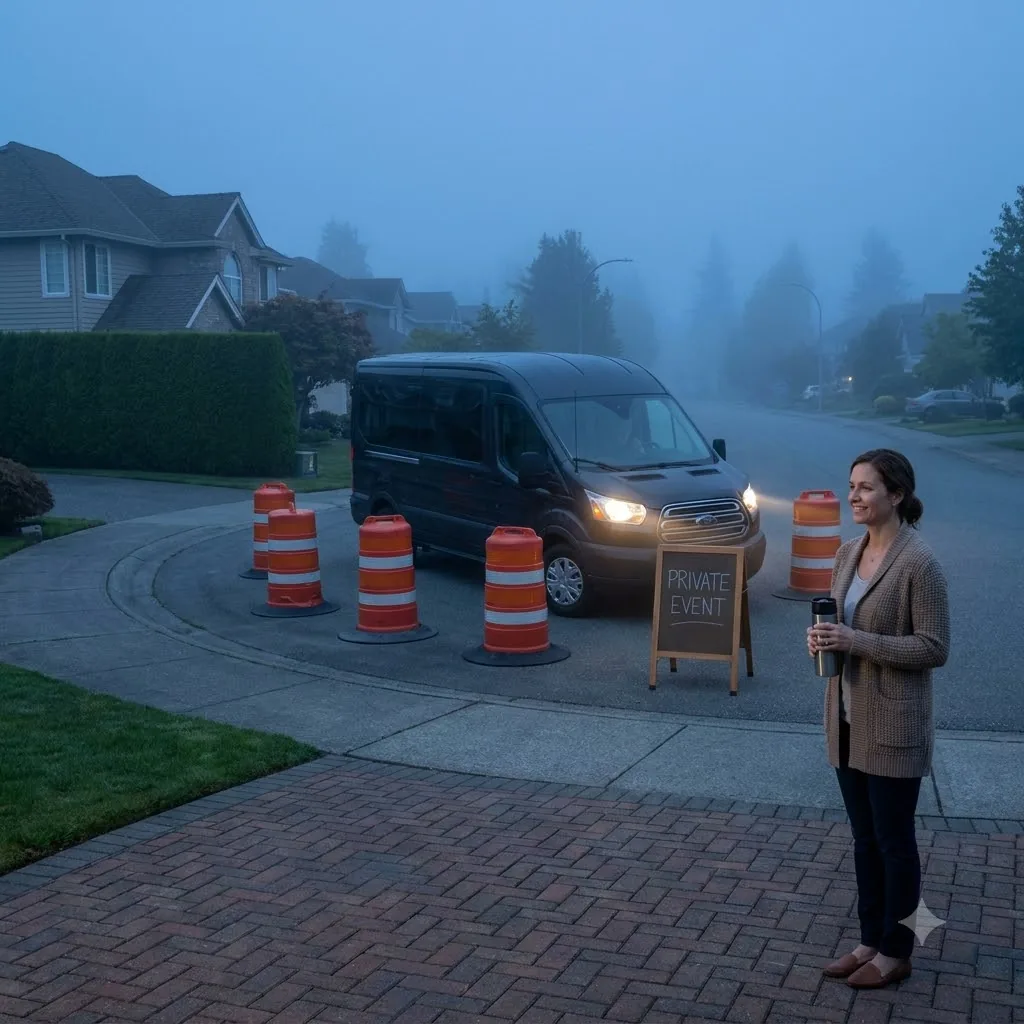
A sudden screech of tires on wet asphalt echoed through the quiet cul-de-sac, drowning out the steady hum of the van’s exhaust. A heavy, silver municipal SUV swung wide around Sterling’s black sedan, its tires chewing through the edge of Sarah’s front lawn before slamming into park directly behind the HOA’s orange traffic barrels.
The driver’s door swung open. A woman in a tailored navy trench coat stepped out into the fog. She didn’t carry a thermos or a phone. She carried a thick, leather-bound folio, her heels clicking sharply against the concrete as she bypassed the barricade.
Sarah recognized her instantly from the news broadcasts. It was State Prosecutor Evelyn Vargas, the lead architect behind the state’s aggressive new medical enforcement task force.
“Put the window punch away, Sterling,” Vargas called out, her voice cutting through the mist like a whip. “There is no need to create a scene for the local neighborhood watch. We already have everything we need.”
Sterling lowered his arm, stepping back from the hood with a rigid nod.
Eleanor turned toward the new arrival, her pristine smile widening. She adjusted her grip on her coffee thermos, stepping into the apron of the driveway. “Prosecutor Vargas. We are so grateful you could come in person. I trust the board’s preliminary efforts were helpful in securing the injunction?”
“Helpful is an understatement, Eleanor,” Vargas said, stopping a few feet from Sarah. She opened her folio, pulling out a glowing tablet and a stapled stack of printed server logs. “Your digital initiative was incredibly thorough. We verified the passenger manifest hours before she even started the engine.”
Sarah stared at the tablet in Vargas’s hand, a cold spike of confusion piercing through her panic. “There is no digital manifest. I keep paper records. You don’t have a warrant for anything inside this van, let alone my locked glovebox.”
Vargas offered a thin, patronizing smirk. “You didn’t need to digitize your records, Ms. Jennings. Your patients did it for you. When you brought them into your home clinic last night, they connected their phones to the guest Wi-Fi in your living room.”
Sarah’s breath hitched. She had a secure, password-protected network specifically set up for the patients waiting in her home, allowing them to contact their families and check their encrypted healthcare apps before the long drive across state lines.
“Your neighborhood board’s private cybersecurity contractors were highly effective,” Vargas continued, turning her attention to the recording neighbors. “The packet-sniffing software they aimed at your router caught the automated handshakes from the prohibited medical scheduling apps on your patients’ phones.”
Sarah turned slowly to look at Eleanor. The HOA chair stood perfectly still, the aggressively cheerful smile frozen on her face. Mr. Miller and the Harrisons were still holding their phones up, but the smug certainty in their posture suddenly wavered.
“You hacked my network?” Sarah’s voice dropped to a horrified whisper as the scale of the violation washed over her. “While they were sitting in my living room, drinking tea, you were intercepting their medical data?”
“We authorized a standard, community-wide digital hygiene audit,” Eleanor said, her pitch rising defensively. She looked directly at Mr. Miller’s camera lens, desperate to maintain the narrative. “It is perfectly legal for the board to monitor ambient broadband traffic to ensure the safety of our collective neighborhood footprint. We were simply looking out for our community.”
Vargas let out a sharp, humorless laugh, entirely uninterested in playing along with the HOA’s suburban public relations spin.
“Please, Eleanor, let’s not dress this up for the cameras,” Vargas said bluntly. “You paid thirty thousand dollars to Paladin Cyber to aggressively scrape every byte of data passing through the clinic’s router. You isolated the IP addresses, mapped the data logs to the state’s prohibited healthcare registry, and handed the entire unencrypted packet over to my office.”
Mr. Miller’s phone dipped slightly. He looked over the glowing screen, his brow furrowed in genuine confusion. “Eleanor? The board voted on a firewall upgrade for the clubhouse. What is she talking about? Thirty thousand dollars?”
Eleanor’s grip on her thermos turned white-knuckled. “We took decisive action for the collective good, Tom. We cannot have an illegal, high-traffic medical facility operating in a residential zone. We had to prove what she was doing to get her out of our subdivision!”
“And prove it, you did,” Vargas interrupted, pulling a heavy, officially sealed document from the back of her folio. She stepped forward and shoved the paper directly against Eleanor’s chest. “Here is your end of the bargain. The state appreciates the data logs. In exchange, my office has signed off on the board’s petition. The state is granting an expedited, zero-day eviction order based on commercial zoning violations.”
Sarah stared at the eviction notice, the devastating reality snapping into focus. This was never about a noise ordinance. It was never about a “community of care” or concern for the vulnerable people in the van. The progressive neighbors had weaponized the state’s brutal new healthcare laws not out of moral conviction, but to fast-track an eviction and preserve their property values.
“The clinic is officially seized by the state, nullifying her property rights,” Vargas announced, her voice echoing off the brick facades of the silent houses. “You can have the sheriff padlock her doors by noon, exactly as your board requested in the trade.”
Eleanor stood clutching the eviction notice, her mouth opening and closing as she searched for a sanitized buzzword to justify the transaction. But across the wet asphalt, Mr. Miller slowly lowered his camera entirely, staring in stunned silence as the moral high ground of their neighborhood watch crumbled into dust.