Story code: ST-000262
Part 2: The Compliance Check
“City Dispatch, Operator Forty-Two,” a flat, nasal voice crackled through the phone’s earpiece, shattering the ambient hum of L’Aura’s empty dining room.
“Yes, good afternoon,” Julian said, modulating his tone to perfectly balance civic alarm with polite restraint. “I need to report an escalating public safety hazard at the corner of Elm and Fourth. An unregulated street vendor has effectively barricaded the sidewalk, and the situation is completely out of hand.”
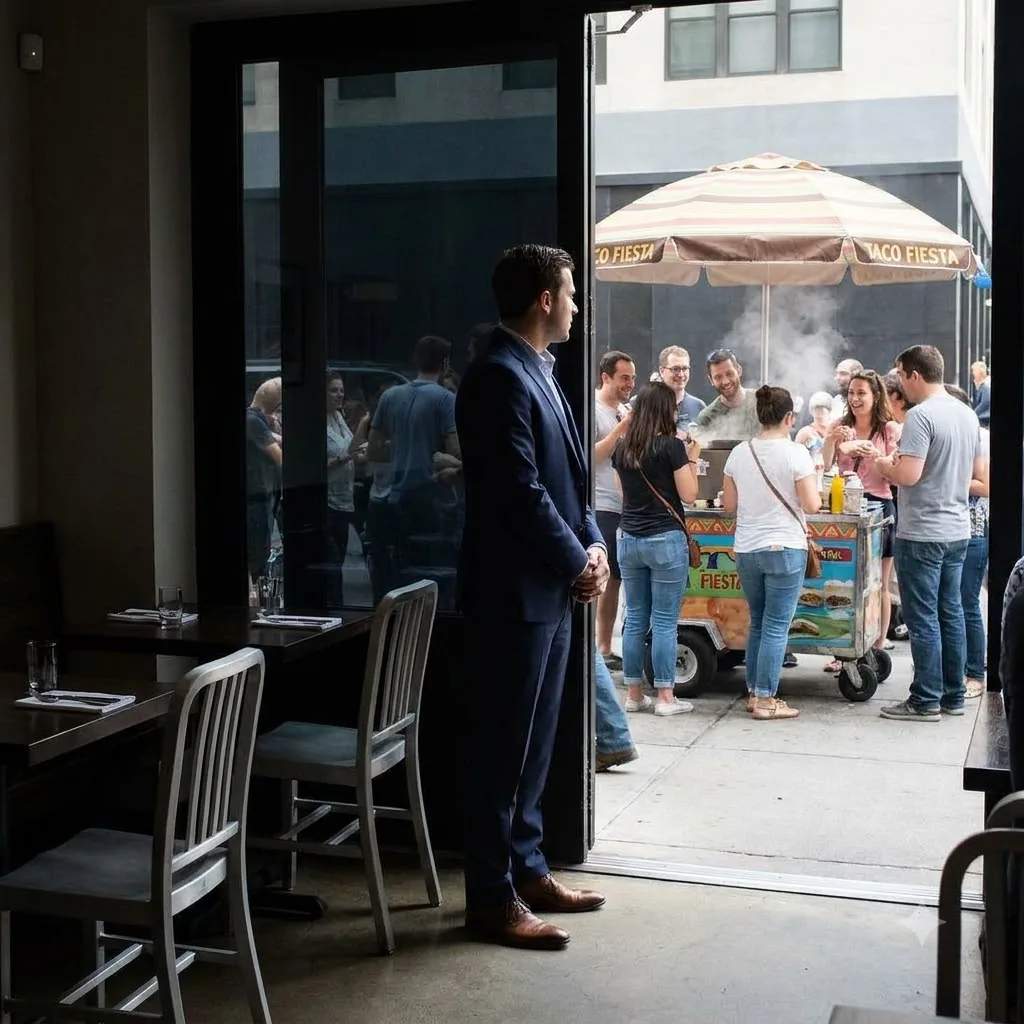
Julian paced the length of his imported Spanish tile, feeding the dispatcher a curated sequence of bureaucratic buzzwords. He described the battered propane burners as “combustible materials operating without visible fire suppression.” He framed the queue of laughing customers as a “severe choke point forcing vulnerable pedestrians into active traffic.” He made sure to emphasize the grease potentially staining the historic cobblestones, framing it as an environmental degradation issue.
“Can I get a name and a callback number for the report?” the operator asked, her keyboard clacking dully in the background.
“I’d prefer to remain anonymous,” Julian replied smoothly, his eyes locked on the chaotic mass of people outside his window. “The individuals surrounding this… operation… can be quite aggressive. I’m merely a concerned pedestrian who had to force my way into the street just to get past the mob.”
“Understood. I’ll dispatch a Code Enforcement unit to evaluate the right-of-way. Have a safe day, sir.”
Julian ended the call and slipped the phone into the breast pocket of his tailored blazer. A triumphant, razor-thin smile played on his lips. He checked the time on his gold watch-a lavish gift he had bought for himself the day the bank approved his exorbitant restaurant loan. The very loan that was currently suffocating him with its monthly interest. He wiped a microscopic, non-existent smudge from the mahogany host stand, suddenly feeling a surge of profound justification. The contrast between his expensive, bleeding failure and her cheap, unregulated success was an affront to the natural order of business. Bureaucracy was a weapon, and he had just aimed it flawlessly.
Twenty agonizing minutes later, a white municipal pickup truck with amber flashing lights pulled to a stop at the curb. A Code Enforcement officer wearing a high-visibility vest and carrying a metal clipboard stepped out onto the pavement.
Julian pressed himself as close to the plate glass as he dared, eager to watch the hammer of municipal justice fall. He anticipated panic. He expected the vendor to frantically pack up her battered folding table and flee the scene.
Instead, the officer approached the canvas umbrella and offered a polite nod. The vendor, an older woman with silver hair pulled into a tight bun, didn’t even stop stirring her large, steaming pot. She returned the smile, wiped her hands on an apron, and calmly reached beneath her table. She produced a heavy, brightly colored laminated placard attached to a lanyard.
Julian squinted, his breath fogging the cold windowpane. A permit? That was entirely impossible. The city council had placed a strict moratorium on new mobile vending licenses in the historic district two years ago.
The officer examined the laminated placard, checked something off on her clipboard, and handed it back with a thumbs-up.
Julian’s stomach violently dropped, twisting into a cold, tight knot. The officer wasn’t shutting the cart down. The vendor was entirely legal.
Then, the officer turned her back on the bustling food cart and looked directly at the pristine facade of L’Aura.
She unclipped a yellow measuring wheel from her heavy utility belt, set it on the very edge of the street curb, and began walking straight toward Julian’s immaculate, completely empty patio.
Panic seized Julian’s chest. He practically lunged for the heavy brass handle of his front door, shoving it open and stepping out into the brisk afternoon air. He forced his most charming, accommodating smile onto his face, though his jaw muscles screamed with the effort.
“Good afternoon, Officer!” Julian called out, stepping gracefully past his velvet rope. “Is there something I can help you with today?”
The officer stopped the measuring wheel with a sharp click. She looked Julian up and down, taking in his tailored blazer and pristine cuffs. “Are you the owner of this establishment?”
“I am,” Julian said, standing tall. “Julian Vance. We pride ourselves on maintaining a beautiful, orderly streetscape for the neighborhood.”
“Well, Mr. Vance,” the officer said, her voice entirely devoid of warmth. “We received an anonymous complaint regarding a severe pedestrian choke point on this corner. I just verified the vendor’s mobile right-of-way variance, and she is operating exactly within her designated legal zone.” She tapped her pen against the metal clipboard. “However, your decorative A-frame menu board and these heavy brass planters are extending twenty-two inches past your permitted property line.”
Julian froze. The polite, menacing facade he had carefully maintained all afternoon threatened to shatter instantly. Behind the officer, several people in the vendor’s long line turned their heads, their attention captured by the officer’s authoritative tone.
“There must be some misunderstanding,” Julian said, dropping his voice to a conspiratorial whisper, desperately hoping the officer would mirror his quiet volume. “My patio layout was approved by the city months ago. The real hazard is that open flame-”
“The propane rig is up to current fire code,” the officer interrupted, deliberately raising her voice slightly over the ambient street noise. “Your brass planters, on the other hand, are physically obstructing the tactile paving for the visually impaired. That is an immediate ADA violation, which is exactly what the caller reported.”
Julian felt a terrible, prickling heat rise furiously in his cheeks. The very accusations he had so cleverly weaponized over the phone were now being hurled directly at his own chest. A man in the vendor’s line-the same businessman Julian had scoffed at earlier for eating on the sidewalk-let out a loud, derisive chuckle. The man nudged his companion, pointing a greasy foil wrapper directly at Julian’s sad, deserted tables.
“I assure you, I am incredibly sensitive to community accessibility,” Julian stammered, his eyes darting frantically toward a teenager in the crowd who had just raised a smartphone, the camera lens pointed squarely at Julian. “I will have my staff drag the planters back immediately.”
“You don’t appear to have any staff out here,” the officer noted dryly, sweeping her gaze over the desolate patio. “And simply pushing them back isn’t going to resolve this today. Since I was dispatched here for a severe right-of-way obstruction, policy dictates I do a full compliance check on your outdoor seating. I need you to go inside and bring out your city-approved blueprints, your health department rating, and your current variance paperwork. Right now, please.”