Story code: ST-000321
Part 2: The Institutional Erase
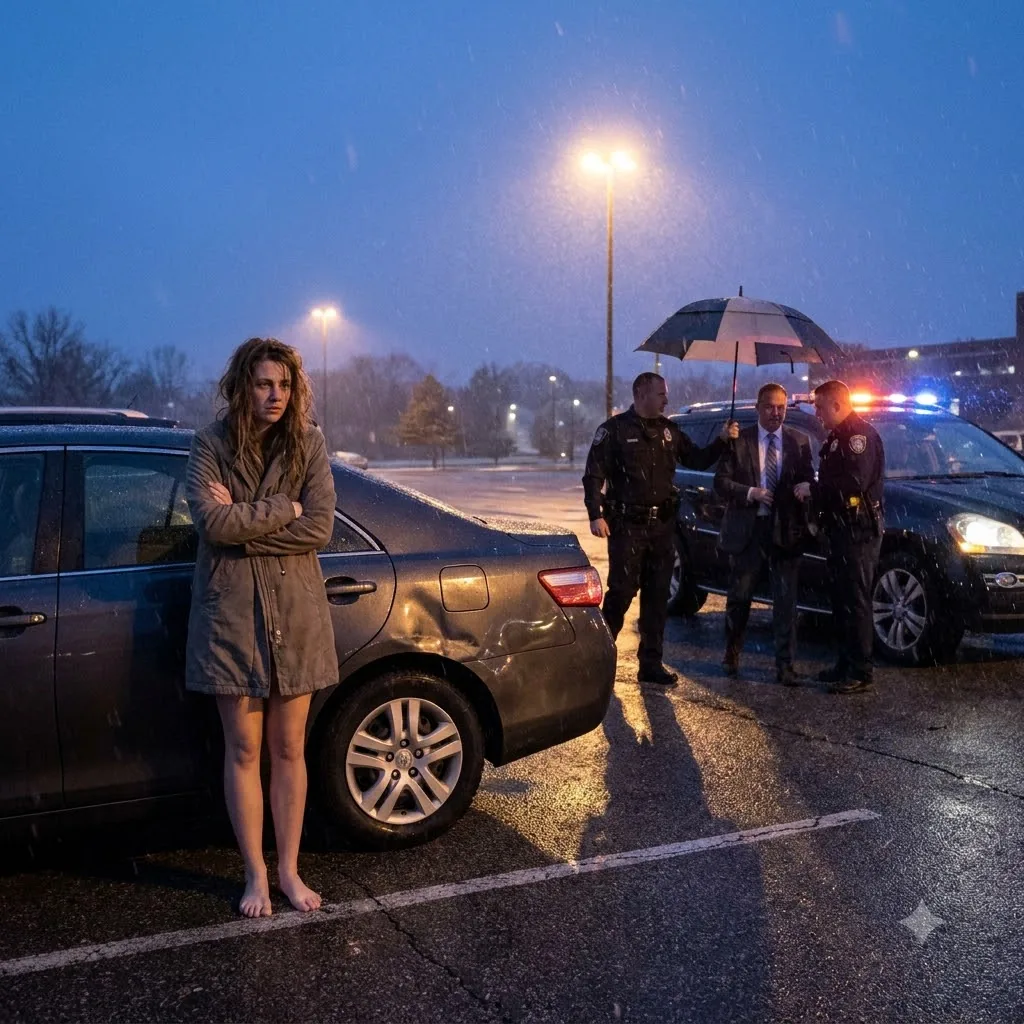
The cruiser’s tires hissed on the wet pavement as it pulled away, taking the drunk Vice Chancellor into the warm, consequence-free night. I was left standing in the freezing sleet, given only fifteen minutes to pack up my entire existence before a tow truck hauled away my home.
Panic overrode the throbbing pain in my skull. I tore at the mangled passenger door. The metal shrieked against bent hinges, but it gave way just enough for me to squeeze inside. The cabin was a disaster of shattered safety glass, deployed airbags, and the sharp chemical stench of antifreeze. The bitter wind ripped right through the blown-out windows. I grabbed my canvas backpack from the floorboard. My hands were shaking so violently I could barely work the zippers. I shoved in my laptop, my worn copy of Campbell’s Biology, three pairs of wool socks, and the small fireproof lockbox holding my birth certificate and meager cash tips from the dining hall.
I tried to pull my heavy sub-zero sleeping bag from the back seat, but the collapsed roof of the Honda had pinned it down. I yanked at the fabric, tearing the nylon shell, just as blinding yellow strobe lights flooded the commuter lot. The tow truck was early.
“Step away from the hazard,” the driver barked, hopping out of the cab. He didn’t look at my bleeding forehead or my soaked clothes. He just dragged thick steel chains across the icy asphalt toward my front axle.
“Please, my clothes are in the trunk. I just need one more minute-”
“Impound protocol,” he grunted, ratcheting the chains tight. “Vehicle is a sealed biohazard due to the fluids. You can petition the university to release personal effects during normal business hours.”
I was forced to stand back and watch my home get winched into the air, the ruined front tires spinning uselessly. As the truck drove away, leaving nothing behind but an oil stain and broken glass, the absolute silence of the commuter lot crushed the breath out of me.
I spent the remaining hours of the night locked inside a handicap stall in the 24-hour campus library. I pressed coarse, wet paper towels to the gash above my eyebrow, watching the sink water turn pale pink. Every time I closed my eyes, I saw Miller’s Lexus hurtling toward my door. I huddled over the baseboard heating vent, shivering uncontrollably in my damp jeans, waiting for the administrative offices to open.
At 8:00 AM, I pushed through the heavy glass doors of the Campus Safety Department. The air inside smelled of stale coffee and expensive floor wax. A receptionist in a crisp uniform sat behind a thick plexiglass partition, barely glancing up when I approached.
“I need to file an insurance claim,” I said, my voice hoarse. “Vice Chancellor Miller totaled my car last night.”
The receptionist didn’t blink. She typed my name into her terminal, her acrylic nails clacking sharply against the keys. She hit print, slid a single sheet of paper beneath the glass slot, and went back to her screen.
It was the official accident report. My eyes scanned the sterile black text. Every single line was a deliberate erasure of reality.
*Vehicle 1 (Honda Civic): Abandoned. Improperly parked, obstructing designated fire lane. Owner cited for unauthorized residency/camping.*
*Vehicle 2 (Lexus SUV): Driven by Richard Miller. Speed: 10 mph. Weather conditions: Poor visibility.*
There was no mention of his intoxication. No mention that I was inside the car when it was struck. It framed the entire incident as Miller accidentally scraping an illegally dumped piece of junk in the dark.
“This is a lie,” I whispered, gripping the edge of the counter. “He was doing at least fifty. He was drunk. I was inside the vehicle, my head hit the steering wheel-”
“Miss,” the receptionist interrupted, her tone plunging to sub-zero. “The responding officer noted no injuries on the scene. The report is finalized.”
“Then I want to speak to the officer. I need Miller’s insurance to pay for my car. It’s my-” I stopped myself before I said *home*. “It’s my property.”
She slid a second piece of paper through the slot. A bright yellow invoice.
“Because your vehicle was leaking hazardous materials on university property, you are responsible for the emergency hazmat cleanup fee, standard towing, and a fifty-dollar daily impound rate. Your current balance is four hundred and eighty dollars.” She looked up, her eyes flat and empty. “Furthermore, the Dean of Students has been notified of your unauthorized residency citation. A hold has been placed on your spring registration pending a disciplinary hearing.”
The room spun. They weren’t just protecting him; they were bankrupting me. They were throwing me out of school. I had exactly twenty dollars in my lockbox. I was standing in wet jeans, bleeding from the head, utterly invisible to the machine that was methodically destroying me.
“If the balance isn’t paid in forty-eight hours,” she added, “the university retains the right to crush the impounded vehicle to recoup costs.”
I stumbled backward, the yellow invoice burning in my hand. They were going to crush the Honda.
The panic surged, choking me, but then a sharp, distinct memory pierced through the fog of terror.
When the officer had swept his heavy flashlight over my rolled blankets and portable stove last night, he hadn’t noticed the small, black square suction-cupped high behind my rearview mirror. It was partially hidden by the foil sunshade. It was a cheap, battery-operated dashcam I had bought for thirty dollars online, terrified of someone breaking into the car while I slept.
It was motion-activated. It recorded audio.
It had an SD card currently sitting inside my crushed car, holding the undeniable truth: the speed, the impact, and the Vice Chancellor’s slurred confession to the campus police.
They had sealed the car to protect themselves, completely unaware they had locked the only piece of evidence inside their own vault. But if I didn’t find a way to break into the university impound lot before the car was crushed in forty-eight hours, I would lose everything permanently.