Story code: ST-000337
Part 4: The Hypocrite
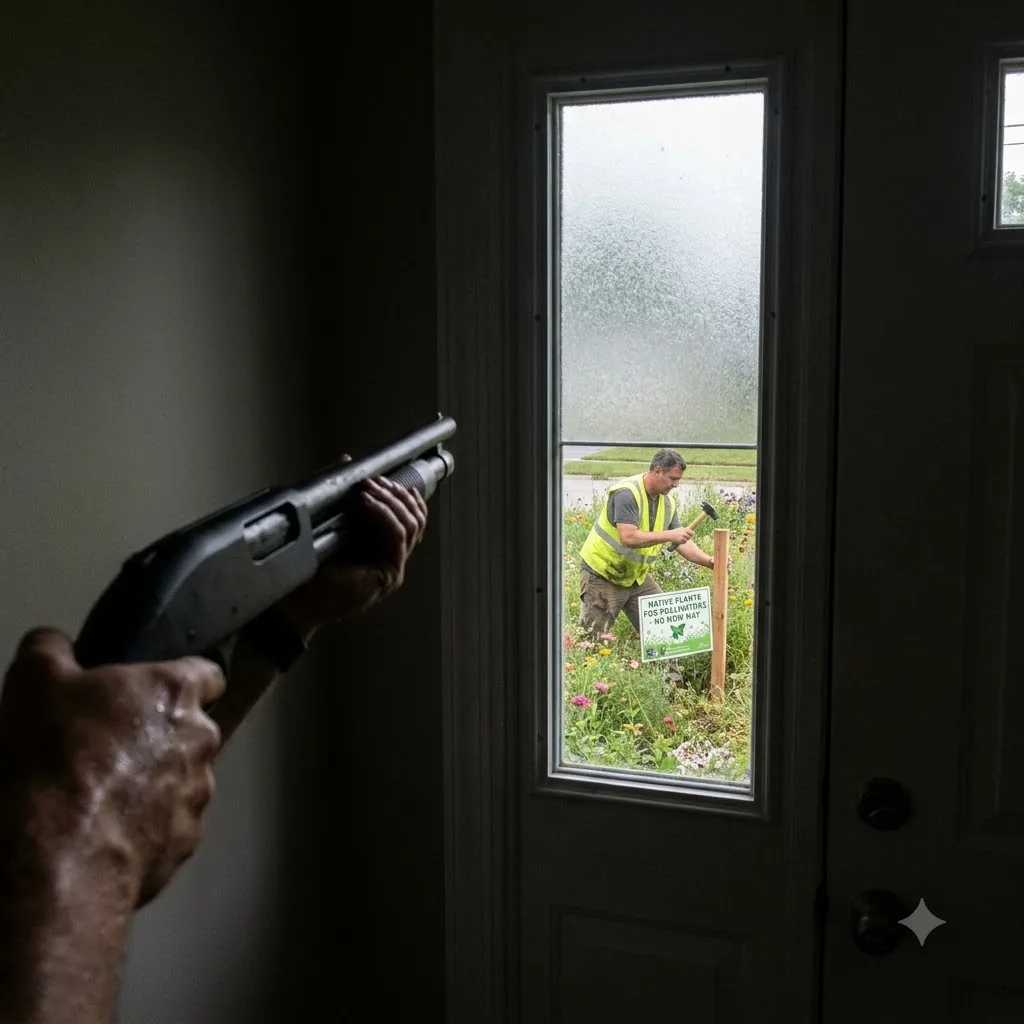
The piercing wail of police sirens shattered the heavy, humid air, rising above the low hum of the idling flatbed truck on the street. The frantic sound broke the suffocating spell on the porch, but the city planner didn’t flinch. He remained practically pressed against the barrel of the twelve-gauge, his dark eyes locked on Elias with unwavering contempt.
Elias’s finger hovered over the trigger guard, trembling so violently he could hear the internal mechanism of the shotgun rattling. The sheer absurdity of the moment crashed over him. He wasn’t a protector. He wasn’t a hero defending his sanctuary. He was a barefoot, terrified man holding a lethal weapon inches from an unarmed civil servant’s chest.
“That’ll be dispatch,” the planner said, his voice dropping to a harsh whisper. “They monitor the open mic. You want to pull that trigger, Elias, you better do it now.”
Elias let out a ragged, trembling breath. The remaining adrenaline evaporated from his veins, leaving behind a cold, hollow nausea. His muscles gave out. He lowered the heavy barrel toward the porch deck, his hands going completely numb. The shotgun slipped from his sweat-slick grip, striking the wooden planks with a pathetic, hollow clatter. It didn’t look like a tool of righteous defense anymore; it was just a piece of ugly, heavy metal resting beside his bare feet.
The sirens crescendoed as two police cruisers careened around the corner, their tires screeching against the asphalt. Red and blue lights fractured the morning sun, washing wildly over the pulverized remains of the native garden.
But it wasn’t the flashing lights that made Elias’s stomach plummet. It was the movement on the periphery.
Up and down the quiet suburban street, front doors were opening. The commotion had drawn his neighbors out of their homes. Across the street, Sarah Jenkins-who had co-hosted the neighborhood block party with Elias just three weeks ago-stood in her driveway, her hand clamped tightly over her mouth in sheer horror. Two houses down, Mr. Abernathy, a retired teacher who frequently clipped Elias’s columns from the local paper, was staring at the porch, his face pale and bewildered.
They were all watching the neighborhood saint, the impassioned advocate for radical hospitality and nonviolence, standing over a discarded shotgun, having just threatened to execute a municipal worker over a patch of coneflowers.
“Hands in the air! Step away from the weapon!” a voice boomed from behind the glaring lights of the cruisers.
Elias didn’t hesitate. He raised his trembling hands above his head and sank slowly to his knees on the hard wooden deck. The rough grain of the porch bit into his bare shins. Two officers sprinted up the walkway, their boots trampling over the same crushed goldenrod the city planner had flattened earlier. One officer kicked the shotgun away, sending it sliding across the porch, while the other grabbed Elias’s arms, pulling them roughly behind his back to secure his wrists in cold, heavy steel cuffs.
“I’m sorry,” Elias whispered, staring blankly at the splintered door frame. “I didn’t… I didn’t know.”
The officer, ignoring him, hauled Elias to his feet and guided him down the steps, marching him straight through the ruined garden. The city planner was already speaking to a police sergeant on the sidewalk, aggressively pointing at the shattered hand-painted sign in the mud, then producing a folded stack of municipal work orders from his canvas pouch.
Elias was deposited against the side of a squad car, the metal warm against his cheek. From this vantage point, the full scope of his disastrous hypocrisy finally clicked into place. The planner had mentioned the collapsing sewer main. Elias knew that line; he had read about it in the zoning reports he usually skimmed for his op-eds. The easement clearance wasn’t just to fix the elementary school’s basement. It was the foundational infrastructure upgrade required for the new affordable housing project proposed for the empty lot down the block-the very same housing project Elias had publicly, loudly championed in his writing, repeatedly accusing the city of dragging its feet.
The city hadn’t been dragging its feet. They had been trying to clear the utility easement through his front yard so the housing project could actually proceed. And he had barricaded his door and drawn a gun to stop them.
The police sergeant nodded at the planner and waved a hand toward the street. The driver of the track loader, who had been sitting quietly in the cab, turned the ignition key. The massive diesel engine roared back to life, belching a thick cloud of black exhaust into the pristine morning air. The heavy metal treads ground forward, biting deeply into the dark, damp soil, completely obliterating the last remaining stalks of the swamp milkweed.
Elias watched the heavy machinery tear through his beloved sanctuary, legally paving the way for the development he had demanded. He turned his head, desperately seeking a sympathetic face among the small crowd of onlookers. But Sarah had already turned her back, walking slowly up her driveway, and Mr. Abernathy was shaking his head, retreating behind his closed front door. The vibrant, inclusive community Elias believed he had built was gone, entirely eradicated by the brutal truth of who he really was when his own private paradise was threatened.