Story code: ST-000337
Part 2: The Breach
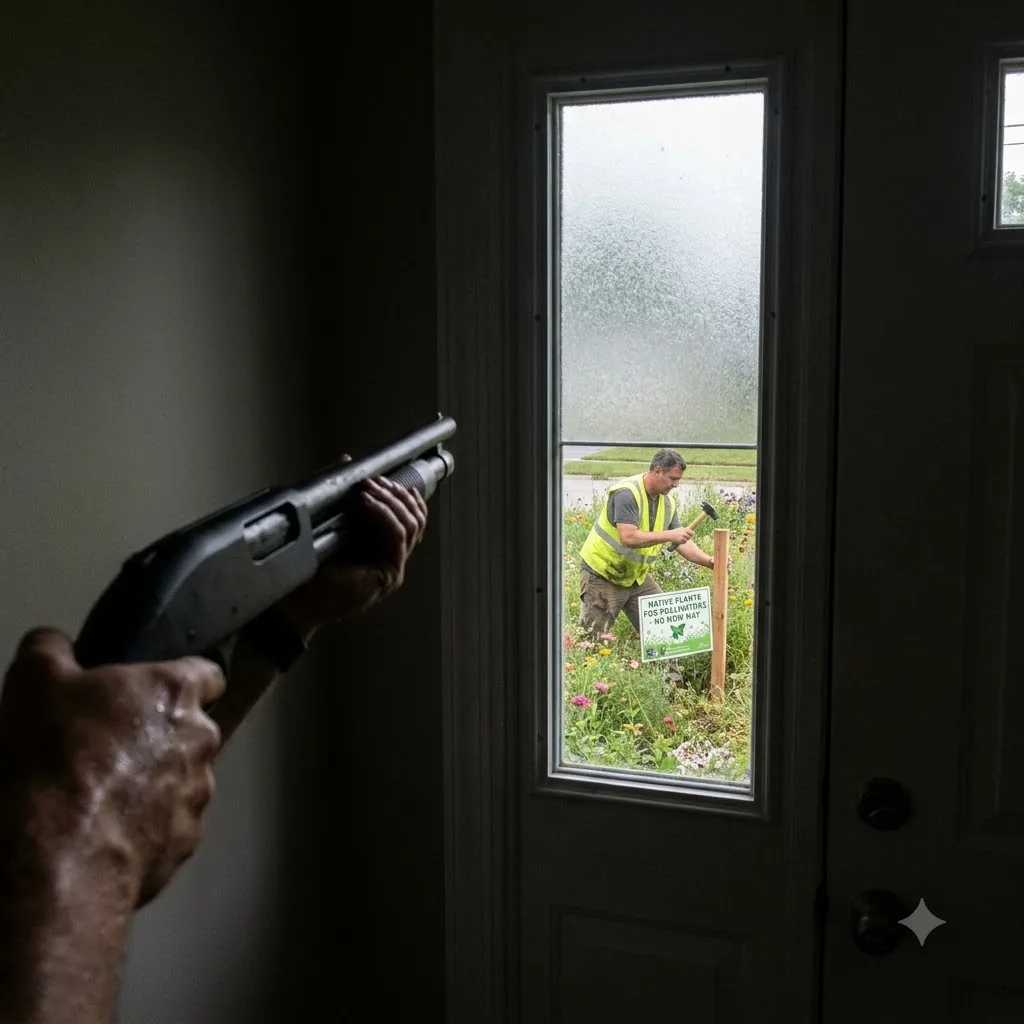
The heavy tread of the intruder’s boots echoed through the hollow wood of the porch, sending tremors up Elias’s shins. The man in the high-vis vest paused directly outside the door, his massive silhouette blocking the morning sun. A shadow fell over the barricaded entryway. He could hear the man breathing-a wet, heavy rasping sound that penetrated the thin pane of glass. Elias clamped his teeth together, praying the frantic hammering of his own pulse wouldn’t give him away.
The brass handle of the front door twisted violently. The knob hit the lock mechanism, but the intruder didn’t stop; he shoved his shoulder against the heavy wood. The door groaned, bowing slightly inward, and the bottom edge scraped against the polished top of the oak credenza. Elias threw his full body weight against the heavy furniture, his bare feet slipping against the floorboards as he fought to keep the barricade in place. The shotgun pressed painfully into his collarbone, but he refused to loosen his grip.
After a terrifying ten seconds of pressure, the pushing stopped. The man outside let out a frustrated grunt. Elias pressed his ear toward the door, listening intently. A sharp burst of static crackled from the other side of the wood, followed by a harsh, electronic beep. The man had unclipped a radio from his belt.
“Yeah, dispatch, I’m at the location,” the man’s voice boomed, muffled slightly by the door but loud enough to rattle Elias’s nerves. “Front door is locked. Looks like the resident is either uncooperative or not home. I don’t care. The perimeter is marked.”
A garbled, static-laced voice replied from the radio, the words indistinguishable to Elias.
“Understood,” the intruder replied, his tone chillingly detached. “We’re proceeding with the clearance. Tell the crew to bring the heavy equipment up the driveway. Tear out everything down to the soil line. If the structure gets in the way, we’ll breach it.”
Elias felt the blood drain entirely from his face. *Breach it.* The phrase echoed in his mind, carrying military overtones that completely shattered his understanding of reality. This wasn’t a mistaken city surveyor. City workers didn’t talk about breaching structures because of an overgrown garden. Was this retaliation? Had one of his online articles about systemic land reform drawn the attention of a dangerous fringe group? His mind raced through a dozen horrifying scenarios as the smell of his own nervous sweat mingled with the scent of the gun oil.
A low, mechanical rumble vibrated through the floorboards, pulling Elias’s attention back to the narrow window. He leaned into the sliver of exposed glass. Down at the street level, a massive flatbed truck idled against the curb, expelling a thick cloud of black diesel exhaust. The words on the side of the truck were obscured by thick layers of dried mud, making it impossible to identify the company or the agency.
On the back of the flatbed sat a bright yellow track loader, its heavy metal bucket resting ominously on the wooden planks. Two more men, both wearing identical dark safety glasses and unbranded high-vis vests, hopped out of the truck’s cab. They carried chainsaws and heavy-duty brush clearers. One of the men gestured toward Elias’s house, laughing at something the driver said, before unlatching the heavy steel ramps at the back of the trailer.
The man on the porch turned away from the door and whistled sharply, waving his arm. “Bring it up!” he yelled toward the street. “Clear a path straight to the steps!”
Elias watched in sheer disbelief as the driver climbed into the cage of the track loader. The diesel engine roared to life with a deafening clatter that shook the picture frames on Elias’s hallway walls. The machine rolled down the steel ramps, its rubber treads hitting the asphalt with a heavy thud. Instead of pulling into the driveway, the loader pivoted, its tracks tearing jagged gouges into the pavement, and lurched directly over the curb.
The steel treads crawled mercilessly into the dense center of the pollinator garden. Years of Elias’s painstaking labor-the vibrant patches of bee balm, the delicate butterfly weed, the carefully arranged river stones-were pulverized beneath the sheer weight of the machine. The heavy steel bucket dropped to the earth, scraping against the topsoil and ripping the remaining native plants out by their roots.
A deep, primal surge of anger momentarily pierced through Elias’s paralyzing fear. They were destroying his sanctuary. They were erasing his life’s work in a matter of seconds. He desperately wanted to scream, to throw open the door and demand they stop, but the cold steel of the shotgun in his hands anchored him to his terrifying reality. He was one man, isolated, barricaded against a crew of aggressive strangers intent on destroying his property.
The man on the porch suddenly turned back toward the house. He reached into his canvas pouch again, but this time, he didn’t pull out a wooden stake. He withdrew a long, heavy steel pry bar. The flat end of the tool glinted under the morning sun. He stepped right up to the front door, wedging the sharp steel edge directly into the narrow gap between the door and the wooden frame, right next to the deadbolt.
The horrific sound of splintering wood cracked through the hallway. The door frame groaned under the immense leverage. The oak credenza shifted a fraction of an inch backward, squeaking against the floorboards.
Elias’s thumb shoved the safety catch forward. The distinct, metallic click seemed impossibly loud in the confined space of the entryway. Outside, the man with the pry bar froze, his gloved hand resting heavily on the steel tool, and slowly tilted his head toward the narrow window.