Story code: ST-000353
Part 2: The Scapegoat
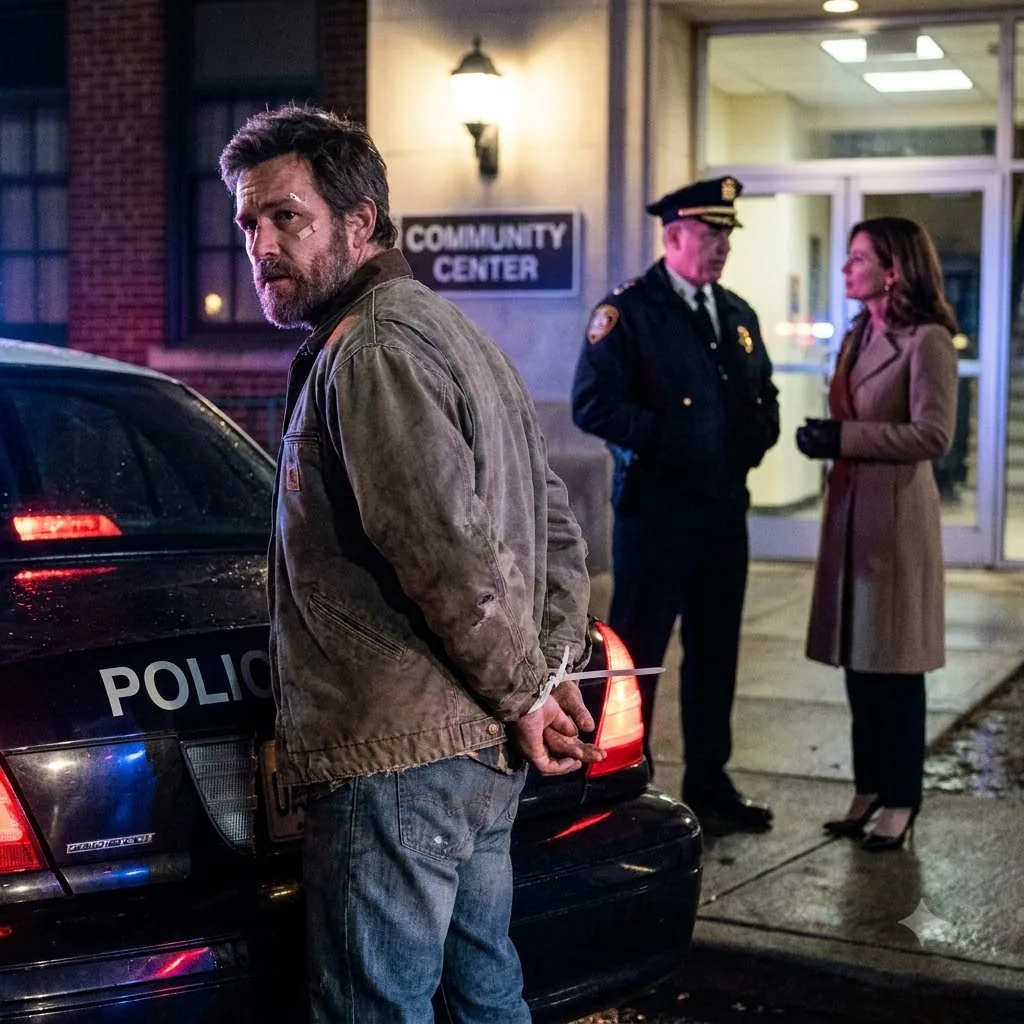
Wyatt threw his bruised shoulder against the heavy door, but the reinforced steel didn’t even shudder. He kicked his heavy boots against the plexiglass partition dividing the front and back seats, the sound returning as a dull, pathetic thud in the cramped space. Blood trickled down the bridge of his nose, pooling at the corner of his eye, blurring his vision with a warm, stinging haze. He tried to wipe his face on his shoulder, but the zip-ties bound his wrists so tightly behind his back that the slightest movement sent white-hot lances of pain shooting up his forearms.
He was completely trapped in a soundproof box, a caged animal placed on display for the very people he had tried to protect.
Through the thick, tinted window, the chaotic scene outside played out like a silent, horrifying film. The flashing red and blue strobes washed over the terrified crowd. Wyatt strained his neck, searching the faces of the parents huddled behind the yellow police tape. He recognized a mother in a torn green sweater-just ten minutes ago, Wyatt had physically stood in front of her and her two small children, drawing his weapon and aiming it toward the shadowy side exit to shield them from the impending threat. Now, she was pointing a shaking finger directly at the police cruiser. She wasn’t looking at him with gratitude. She was looking at him with absolute, unadulterated terror. The responding officers were already interviewing her, nodding gravely as they wrote in their notepads, occasionally glancing toward Wyatt’s cruiser with hardened, accusatory glares.
The narrative was already being rewritten in real-time.
The driver’s side door of the cruiser abruptly swung open, letting in a brief, chaotic blast of sirens and shouting before slamming shut again. A broad-shouldered officer settled into the front seat. He didn’t look back at Wyatt. Instead, the officer reached out and twisted a dial on the dashboard console. The police scanner was muted, replaced instantly by the crisp, even audio of a local news radio station.
“…live from the Oak Trace Community Center,” a reporter’s voice crackled through the cruiser’s rear speakers, “where Police Chief Miller is about to make a brief statement regarding the horrific panic.”
Wyatt froze, his breath catching in his throat. He stared through the scratched plexiglass partition, looking past the driver’s silhouette to the bright cluster of television cameras across the street. Chief Miller stepped up to a hasty arrangement of microphones, bathed in the blinding white light of the media’s floodlights.
“Ladies and gentlemen, the situation is fully contained,” the chief’s voice echoed simultaneously through the radio speakers in the cruiser and from the distant bullhorn outside. “Thanks to the rapid and decisive response of our tactical units, we have apprehended the armed, disturbed individual who incited tonight’s panic. At no point was the broader community in danger of anything other than this single man’s terroristic actions.”
Wyatt slammed the back of his head against the rigid plastic seat, his chest heaving. *Terroristic actions.* He had drawn his weapon because someone else had caused the stampede. He had seen the heavy, sagging backpack. He had seen the real threat. But now, he was being publicly branded as the sole aggressor.
“We are also profoundly grateful to Elena Rostova,” the chief’s voice continued smoothly over the broadcast. “Her composure during the evacuation helped prevent further tragedy, and her ongoing philanthropic investments in our city’s youth will not be deterred by this isolated act of violence.”
Wyatt stared at the black town car idling at the curb. It all made a sickening, crystal-clear kind of sense. Elena Rostova wasn’t just a wealthy community organizer; she was the financial lifeblood of the mayor’s upcoming reelection campaign and the primary benefactor of the police union’s pension fund. If the public discovered that her teenage son had brought a massive, lethal threat to a crowded youth center-something so heavy it bowed the thick nylon of his backpack-her entire philanthropic empire would instantly crumble. The scandal would sever the city’s most lucrative funding pipeline.
Chief Miller wasn’t just coddling a wealthy citizen; he was protecting a multi-million-dollar political asset. And to do that, the city needed a scapegoat. They needed a lone, heavily armed villain to take the fall. Wyatt, a man standing in the dark with a drawn, legally registered sidearm, was the perfect, expendable target.
Through the cruiser’s windshield, Wyatt watched the black town car slowly pull away from the curb. The officer who had hidden the backpack in the trunk stood at attention, offering a crisp, respectful salute as the luxury vehicle glided past the barricades. The real evidence-the actual reason the crowd had screamed and trampled each other-was vanishing into the night, securely escorted away by the very people sworn to find it.
As the town car’s taillights disappeared around the corner, the officer in the front seat of the cruiser shifted the vehicle into drive. He finally adjusted the rearview mirror, making direct eye contact with Wyatt. The officer’s eyes were utterly dead, devoid of any sympathy or doubt.
“Dispatch, this is Unit Four,” the officer said into his shoulder radio, his voice flat and practiced. “I’m transporting the suspect. Bypassing the downtown precinct due to the media presence. Diverting to the Ridgeville holding facility.”
Wyatt’s stomach plummeted. Ridgeville wasn’t a standard holding facility; it was an overflow processing center twenty miles outside the city limits, completely isolated from journalists, lawyers, and public scrutiny.
“Copy that, Unit Four,” dispatch replied. “Suspect is to be held in solitary processing. No phone calls until federal agents arrive in the morning to assume the domestic terrorism investigation.”
Federal agents. Terrorism. The words hung in the stale air of the cruiser like an execution order. Wyatt twisted his bloody wrists against the thick plastic restraints until he felt his skin tear, but the zip-ties didn’t yield a millimeter. The cruiser accelerated, turning away from the bright lights of the community center and plunging into the dark, empty stretch of the industrial highway. He wasn’t just being arrested; he was being systematically erased.