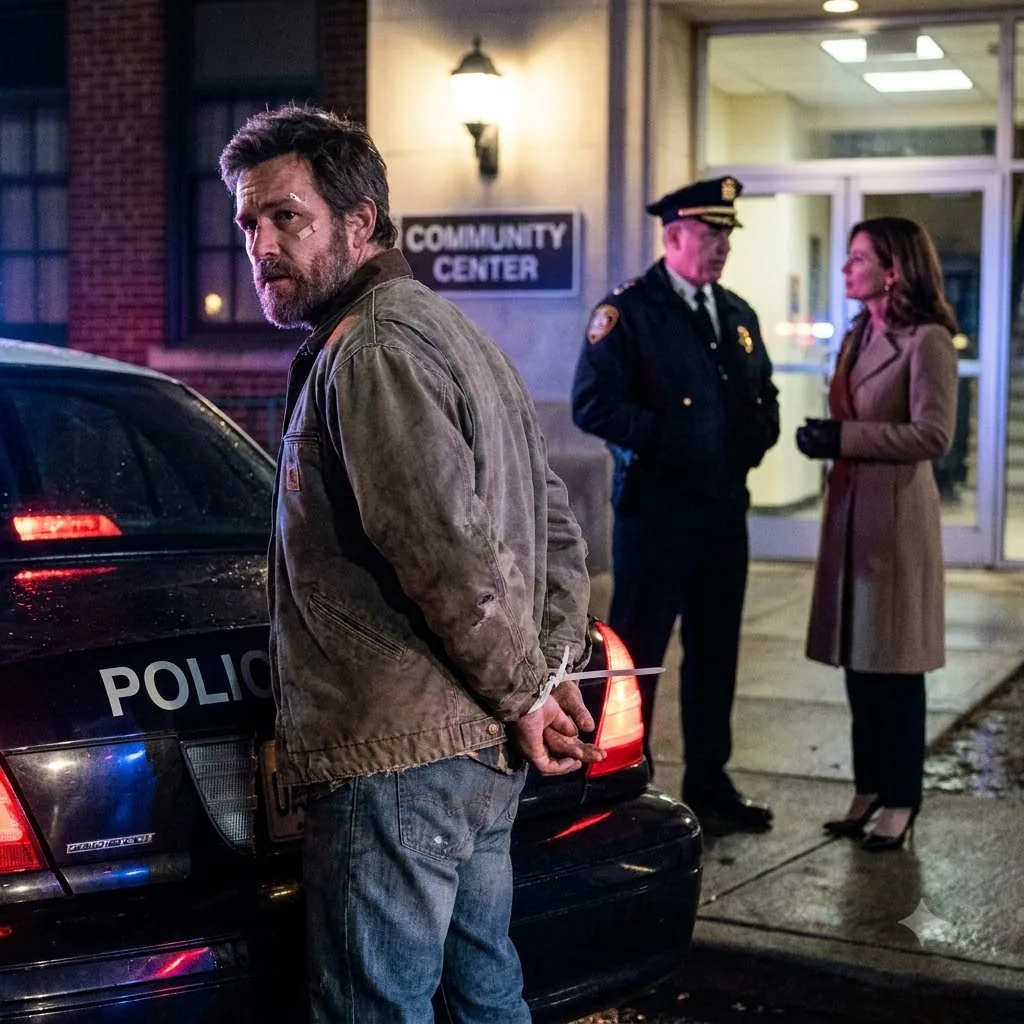
Story code: ST-000353
Part 3: Public Record
The digital timer on the podium glowed a harsh, unforgiving 3:00. Wyatt gripped the edges of the polished mahogany, his thumbs tracing the faint, healing pink scars that still circled his wrists. The murmurs in the crowded city council chambers were not subtle. Behind him, he could feel the burning stares of a hundred local residents and the unblinking lenses of three local news cameras. To them, he was still the Oak Trace Community Center terrorist, the violent instigator who had miraculously managed to secure an exorbitant bail while awaiting his federal trial.
Council President Hayes leaned into his microphone, his expression tightened with overt disdain. “Mr. Wyatt, you have three minutes for public comment. I will remind you that this chamber is not a venue for litigating pending criminal charges. Keep your remarks to civic matters, or I will have the sergeant-at-arms remove you.”
Wyatt didn’t look at Hayes. His gaze was fixed dead ahead on the front row of the gallery, where Elena Rostova sat in a tailored ivory suit. Just ten minutes prior, she had stood before this very council to accept a ceremonial key to the city, applauded for her unwavering philanthropic courage in the face of senseless local violence. Chief Miller stood at the edge of the dais behind her, his arms folded casually across his chest, wearing a smug, untouchable smirk.
Wyatt reached into his jacket pocket. His fingers brushed the small, metal casing of a USB flash drive. It had cost him the last of his life savings, a private investigator, and a very nervous whistleblower at a neighboring hardware store to obtain the file.
“I’m here regarding civic infrastructure,” Wyatt said, his voice echoing flatly through the PA system. “Specifically, the security camera infrastructure in the alleyway adjacent to the Oak Trace Community Center.”
Chief Miller’s arms dropped slowly to his sides. His smirk faltered, just a fraction.
Wyatt pulled the drive from his pocket and jammed it into the podium’s public presentation port. He tapped the touchscreen panel, routing his input to the two massive projector screens flanking the council dais.
“For the past month, this council, the police department, and the media have repeatedly assured the public that a lone, deranged man incited the panic at the community center,” Wyatt said, keeping his eyes locked on Elena. She was staring at the blank projector screens, a tiny, barely perceptible furrow forming between her immaculate brows. “The official police report states there was no other threat. The official narrative says I drew my weapon to terrorize families.”
“Mr. Wyatt,” Hayes interrupted, his voice booming over the speakers. “I warned you about discussing your pending case-”
Wyatt slammed his finger onto the play icon on the touchscreen.
The dual projector screens flared to life. The room instantly quieted as high-definition, color night-vision footage filled the walls. The timestamp in the bottom right corner flashed the exact date and minute of the panic. The camera angle was elevated, looking down directly into the narrow alley beside the community center’s side exit-an angle not controlled by the city, but by the private hardware store next door.
Elena Rostova leaned forward, her perfectly manicured hands gripping the wooden back of the pew in front of her.
On the silent screen, a group of teenagers spilled out of the side exit. At the center of the frame was a young man wearing a distinct, expensive two-tone designer jacket. He was carrying a heavy dark canvas backpack.
Wyatt watched Elena’s breath catch. She recognized the jacket. Everyone in her elite social circle would recognize the jacket. It belonged to her seventeen-year-old son.
The silent footage played out with damning clarity. Elena’s son aggressively shoved a rival teenager against the brick wall. The boy’s face was twisted in rage. He slung the heavy canvas backpack off his shoulder, unzipped the main compartment, and reached inside.
The council chambers fell into a suffocating, graveyard silence. The only sound was the low, electric hum of the projectors.
On the screens, Elena’s son pulled a massive, chrome-plated pistol from the bag. He racked the slide and pressed the barrel directly into the forehead of the cornered teen. The surrounding kids on the video immediately scattered, their mouths open in silent, terrified screams, stampeding back toward the main courtyard.
“That is the panic,” Wyatt said into the microphone, his voice slicing through the dead air of the room. “That is the terror.”
On the video, just as the stampede began, a figure stepped into the alley from the street. It was Wyatt. The footage clearly showed him placing himself deliberately between the fleeing children and the armed teenager. It showed Wyatt drawing his legally registered sidearm, keeping it pointed down at a low ready, and raising his left hand, shouting for the teenager to drop the weapon.
Elena’s son panicked. The video captured him frantically shoving the chrome pistol back into the depths of the canvas backpack, zipping it shut, and sprinting away into the shadows of the alley. Wyatt was left standing alone, holding his ground, right as the first flashing red and blue lights of Chief Miller’s cruisers washed into the frame.
Wyatt pressed the pause button. The image froze on the undeniable sight of Elena’s son shoving the gun into the bag-the exact same bag Wyatt had watched an officer place into the trunk of Elena’s town car an hour later.
Wyatt looked away from the screen and directly at Chief Miller. The police chief was completely rigid. The blood had drained entirely from his face, leaving his complexion the color of dirty ash. He stared at the frozen image of the chrome pistol, his jaw slack, his hands hovering uselessly near his duty belt. He had no excuse. He had personally supervised the sanitation of that scene.
Wyatt turned his gaze down to the front row. Elena Rostova was no longer sitting with pristine posture. She was trembling violently, her knuckles bone-white as she clutched the wooden pew. The ceremonial key to the city rested forgotten on the floor by her designer heels.
The timer on the podium beeped, a sharp, piercing sound signaling that Wyatt’s three minutes were up. He didn’t move. He kept his eyes locked on the trembling philanthropist and the paralyzed chief of police, letting the frozen, fifty-foot image of the absolute truth hang heavy and irrefutable over the silent room.