Story code: ST-000395
Part 3: The Auction Block
The fluorescent lights of the Westview Middle School auditorium dimmed, casting a harsh, pale glow over four hundred anxious parents. Up on the stage, a massive projector screen displayed the sleek, blue-and-white logo of SentinelTech. A woman in a tailored navy blazer-their VP of District Partnerships-was pacing the stage with a wireless microphone, her voice echoing off the cinderblock walls as she praised the “unprecedented success” of yesterday’s lockdown drill.
I stood in the very back of the auditorium, pressed against the cold metal of the AV control rack, my laptop balanced precariously on a stack of folding chairs. My hands were shaking so badly I could barely type. My bank accounts were completely zeroed out. My daughter was at home with my wife, refusing to take off her biometric tracker because she was terrified a SWAT team would show up if she unclasped the plastic band. The corporation thought they had broken me. They thought freezing my money and threatening me with a forty-million-dollar lawsuit would buy my silence and force me into submission.
They forgot I was the lead architect of their goddamn network.
“SentinelTech doesn’t just monitor,” the VP purred into the microphone, clicking a remote to bring up a slide of a smiling, perfectly calm student. “We anticipate. Our biometric wristbands ensure that if a child is in distress, our threat-assessment algorithms dispatch help before a crisis even begins. It is a closed-loop environment of absolute security.”
I looked down at my screen. A green blinking cursor waited at the bottom of a command prompt. I had spent the last fourteen hours rewriting the school district’s administrative access protocols, exploiting a backdoor I had coded three years ago-a diagnostic bypass meant for emergency server maintenance.
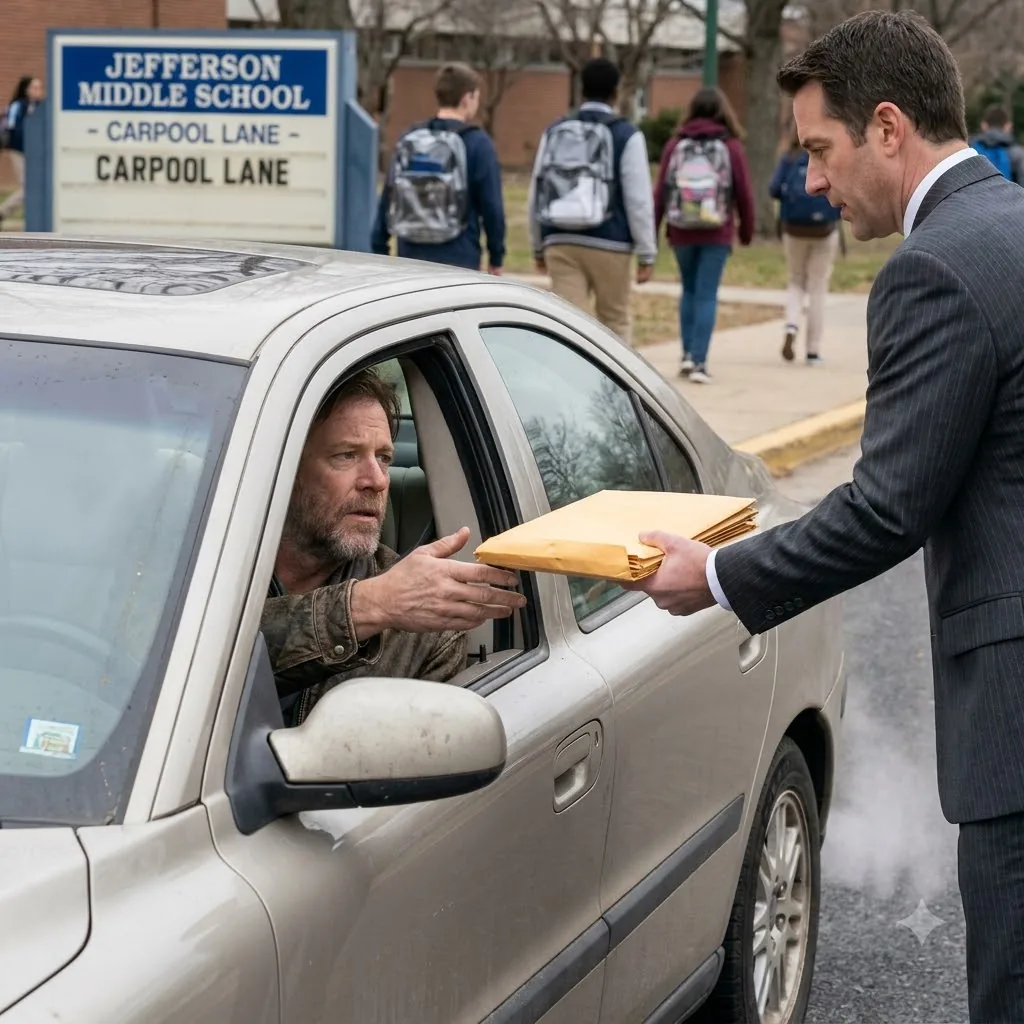
Down in the front row, sitting with his legs casually crossed, was the man in the charcoal suit. The lawyer who had ambushed me in the carpool lane. He checked his heavy silver watch, radiating a smug, untouchable invulnerability.
I hit the `Enter` key.
The giant projector screen above the stage violently flickered. The slide of the smiling child warped into a jagged mess of static before snapping into a stark, dark-mode interface. The polished blue-and-white presentation vanished entirely, replaced by the raw, unvarnished developer backend of SentinelTech’s live server.
A collective murmur rippled through the audience.
“Apologies, folks, just a minor AV hiccup,” the VP said smoothly, clicking her remote. Nothing happened. She clicked it again, harder. The dark screen remained, columns of rapidly scrolling numbers and text reflecting in her wide eyes.
I reached up to the auditorium’s soundboard, slid the main channel fader all the way down to kill her microphone, and plugged my headset mic directly into the PA system override.
“It’s not a hiccup,” my voice boomed through the massive overhead speakers, startling the entire room. Hundreds of heads swiveled, scanning the shadows at the back of the room until they found me. “My name is Mark. I wrote the code for the safety app your children are wearing right now. And I need you to look at what’s really happening on that screen.”
The man in the charcoal suit leapt out of his folding chair, his relaxed demeanor shattering instantly. He frantically gestured to two broad-shouldered security guards standing by the fire exits. “Cut the power to the board!” he shouted, his voice barely carrying over the murmuring crowd without a microphone.
“Too late,” I said, my finger hovering over my trackpad. “I’ve locked the projector to a mirrored feed from an off-site cloud server. You can’t turn it off unless you physically rip the projector out of the ceiling.”
I dragged my mouse across my laptop, highlighting a specific module on the giant screen.
“SentinelTech told you yesterday’s active shooter drill was a routine test of the locking mechanisms,” I continued, my voice echoing with a strange, hollow calm. “That was a lie. It was a product demonstration.”
I double-clicked a file labeled *Westview_Live_Auction_Log*.
The screen split into two columns. On the left, a cascading list of student identification numbers appeared. Next to each ID was a live biometric readout. Heart rate. Galvanic skin response. Respiration.
“Watch the screen,” I ordered. “This is a recording of the backend data from yesterday afternoon at exactly 2:15 PM. The moment the lockdown sirens went off.”
On the screen, the numbers spiked violently. The fonts flashed from green to yellow, then to a rapid, pulsing red. The parents in the room gasped as they recognized the student ID formats.
“Those are your kids,” I said, gripping the edge of the AV rack. “Those are their exact panic levels, measured in real-time as they were shoved into lockers and told there was a man with a gun in the hallway. But look at the right side of the screen.”
I expanded the second column. The header read: *BIDDING_EXCHANGE_API*.
The room fell dead silent.
As the children’s panic levels spiked on the left, a flurry of automated transactions populated the right. Strings of corporate acronyms and dollar amounts flashed in a blinding blur.
“This isn’t a safety network,” I said, staring directly at the lawyer in the front row, whose face had gone ash-white. “It’s an automated auction block. Every time your child’s anxiety crosses a predetermined threshold, their biometric profile is bundled and sold to third-party data brokers. Pharmaceutical companies mapping early-onset anxiety disorders. Targeted advertising algorithms looking for psychological vulnerabilities. Insurance adjusters building long-term risk profiles.”
A woman near the middle aisle stood up, pointing a trembling finger at the screen. “That’s… that’s my son’s ID number,” she choked out. “Someone just paid forty cents for his panic attack?”
“It’s a dynamic market,” I said, my voice rising in volume. “The higher the fear, the higher the bid. Yesterday wasn’t a drill. They deliberately terrified twelve-year-olds to generate a premium data harvest. They induced a mass panic event because the algorithms pay out more when the biological responses are synchronized.”
Chaos erupted. Chairs scraped violently against the linoleum floor. A father in the third row lunged toward the stage, screaming at the VP, who was now backing away, her hands raised defensively. The two security guards froze, completely unsure who to restrain as a mob of furious parents swarmed the aisles.
The man in the charcoal suit shoved his way through the panicked crowd, his expensive silk tie askew. He stopped at the bottom of the stage steps, staring up at the massive projection. I clicked one final button on my laptop. The feed shifted from yesterday’s recording back to the present moment. The data on the screen was updating again.
The room was full of terrified, enraged parents, all holding the mandatory safety app on their own phones. And the right side of the projector screen was lighting up with fresh bids.
The lawyer looked from the cascading auction prices to me, standing in the back of the room. His mouth opened, but no words came out. He had forty million dollars’ worth of legal threats in his briefcase, and absolutely no defense against the truth currently broadcasting at two hundred inches across the auditorium wall.