Story code: ST-000451
Part 2: The Algorithm’s Edge
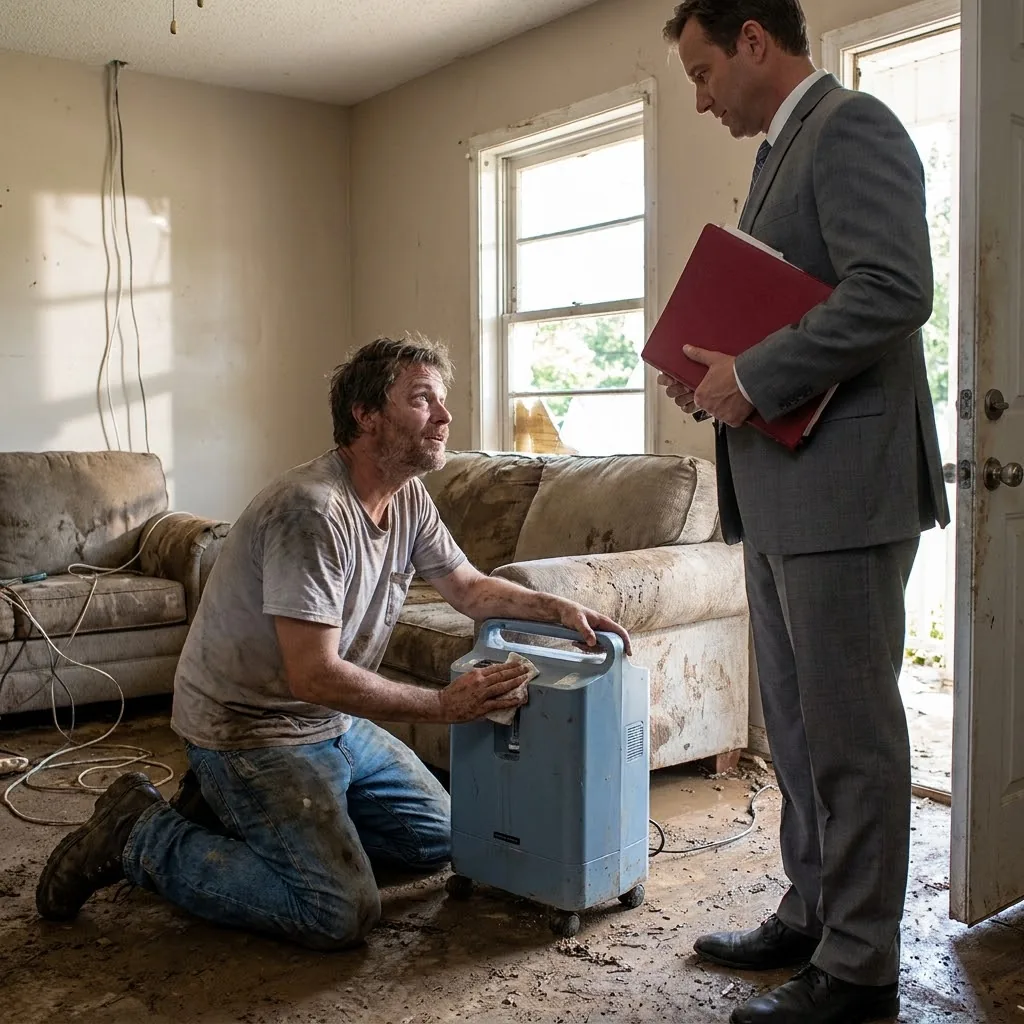
Harlan stared at the crisp, unblemished collar of the man’s dress shirt, the words *policy voided* repeating in his mind until they lost all meaning. It had to be a joke. It had to be a cruel, bureaucratic mistake. Harlan had paid his premiums on time for nineteen years. He had spent the last ninety-six hours rationing sips of bottled water, holding Mary’s trembling hand in the dark, telling her that the insurance company had promised an emergency evacuation.
The man didn’t offer a single word of apology. He smoothly adjusted his grip on the red binder and turned on his polished leather heel, his eyes already seeking the easiest path through the debris toward the exit. “A formal letter of cancellation has been mailed to your secondary address on file. Have a safe afternoon, Mr. Vance.”
*Have a safe afternoon.*
The sheer, sociopathic absurdity of the statement snapped the final, fraying thread of Harlan’s restraint.
He moved with a sudden, violent speed born of pure desperation. His mud-caked boots slammed against the warped floorboards, splashing stagnant water against the drywall. Harlan hit the heavy wooden front door with his shoulder, driving it shut with a massive crack that shook a fresh shower of pulverized plaster from the ceiling. He grabbed the brass deadbolt and threw it hard to the left. The loud, metallic slide echoed like a gunshot in the damp, quiet room.
The actuary froze. For the very first time, a flicker of genuine human emotion-a tiny, involuntary twitch of self-preservation-cracked his immaculate corporate mask. He looked from the locked deadbolt to Harlan’s chest, taking a single, measured step backward.
“Mr. Vance,” the man said, his voice dropping into a low, practiced register designed to de-escalate volatile policyholders. “Interfering with a licensed field adjustor is a federal offense under the current emergency mandate. I must ask you to step away from the door.”
“My wife is dying,” Harlan said. His voice didn’t shake. It came out incredibly flat, hollowed out by days of suffocating terror. “Her lungs are filling with fluid. If she doesn’t get a sterile transport van up this ridge today, she drowns in her own bed.”
“The proprietary algorithm detected that your property was retroactively rezoned into a high-risk flood plain three weeks ago,” the man recited, clutching the heavy red binder tighter against his chest like a shield. “Section 8, Clause C of your agreement clearly stipulates that any preexisting environmental hazard nullifies emergency evacuation protocols. It is out of my hands.”
“I don’t give a damn about your algorithm,” Harlan said, stepping closer. The smell of the man’s expensive cologne-something sharp, crisp, and citrusy-clashed violently with the nauseating stench of the river mud. “You’re going to open that binder. You’re going to find the override form for the medical transport, and you are going to sign it right now.”
“I do not possess the digital authority to override a voided status.” The man reached swiftly into the breast pocket of his tailored suit. He pulled out a sleek, heavy satellite phone. Its thick, rubberized antenna confirmed Harlan’s deepest suspicion: this man had a direct line out, entirely bypassing the dead cell towers in the valley. “I am contacting the local authorities. You will be arrested, and your wife will be left here without any assistance whatsoever.”
Harlan lunged. He didn’t think; he simply reacted. His blistered, calloused hands shot out, his fingers wrapping around the man’s wrist with crushing force. The actuary let out a sharp gasp of pain, his fingers splaying open. The red binder slipped from his grasp, hitting the wet floorboards with a heavy, wet slap. The laminated pages burst open, spilling into a filthy puddle of brown river sludge.
Harlan squeezed tighter, twisting the pristine white cuff of the man’s shirt until he lost his grip on the satellite phone. Harlan snatched it out of the air before it could fall, shoving the heavy device deep into the front pocket of his damp jeans.
“Nobody is coming,” Harlan whispered, stepping so close he could see the terrified widening of the man’s pupils. “The concrete bridge on County Road 9 washed out three days ago. The mud on this ridge is three feet deep. You walked up here from the interstate, didn’t you? Took you at least an hour of hiking through the muck.”
The man swallowed hard. He tried to yank his arm back, but Harlan’s grip was locked like a rusted vise. The charcoal suit fabric bunched and wrinkled in Harlan’s mud-stained fists, the pristine wool soaking up the grime from Harlan’s skin.
“Let me go,” the man demanded, though his voice wavered, the polished, corporate authority rapidly stripping away. “This won’t change the algorithm’s verdict. The denial is permanently logged in the mainframe.”
“Then you’re going to un-log it,” Harlan said, shoving the man backward.
The actuary stumbled, his glossy leather shoes finding zero traction on the slick, spore-coated sludge covering the hardwood. He fell hard, his arms flailing as he crashed into a ruined armchair. He slid down into the stagnant, foul water pooling near the baseboards. He stared at his ruined suit trousers in absolute horror, looking at the black mud as if it were battery acid burning through his skin.
From down the hall, the oxygen concentrator gave a sputtering, mechanical whine, followed by the terrifying, ragged sound of Mary coughing. It was a wet, desperately shallow sound, scraping against Harlan’s eardrums like coarse sandpaper.
Harlan pointed a trembling finger toward the dark hallway. “Do you hear that? That’s what breathing this air does to a compromised immune system. You’ve been in here for five minutes. How do your lungs feel?”
The man scrambled backward until his spine hit the waterlogged plaster of the wall. He looked wildly around the room, really looking this time, taking in the sagging ceiling, the creeping black mold, and the heavy, suffocating humidity. For the first time, the physical reality of the environment seemed to penetrate his spreadsheet-driven brain.
“I need my phone,” the man stammered, pulling a pristine white handkerchief from his pocket and frantically wiping the foul water from his hands. “I have to contact the regional director in Chicago. It’s the only possible way to request a manual executive override.”
“You’re not calling anyone until you figure out exactly what you’re going to say to guarantee that transport van,” Harlan said, planting his heavy boots firmly in front of the door.
“It requires a Level Four authorization!” the man yelled, genuine panic finally shattering his composure. “If I miss the satellite uplink window at the top of the hour, the corporate network locks out all field devices for rolling security updates! We’ll be locked out for twelve hours!”
Harlan’s blood ran cold. He glanced at the digital clock on the humming oxygen machine. It was forty-five minutes past the hour.
Fifteen minutes.
Mary coughed again, a prolonged, terrifying rattle that ended in a sharp, breathless wheeze. The concentrator’s warning light suddenly flashed a harsh, violent yellow. The intake filters were clogging with drywall dust faster than Harlan could clean them. He needed to swap the sterile tubing right now, or the machine would push contaminated air directly into her lungs. But to do that, he would have to turn his back on the desperate man, who was already eyeing the heavy iron fire poker resting by the ruined hearth.
Harlan reached into his pocket and pulled out the heavy satellite phone, its green connection light blinking steadily in the gloom. He held it out, just out of the actuary’s reach, the weight of the impossible choice crushing his chest.
“Then you better think of a very convincing lie to tell your director,” Harlan said quietly, his thumb hovering over the red power button. “Because if that van isn’t approved before this light goes off, neither of us is ever leaving this house.”