Story code: ST-000451
Part 3: The Loophole
The actuary’s eyes darted toward the heavy iron fire poker resting on the ruined hearth. Harlan read the subtle shift in the man’s weight. He didn’t bother lunging for the poker. Instead, Harlan reached into the open canvas tool bag on the sagging coffee table and pulled out his twenty-two-ounce Estwing framing hammer. The solid steel shaft felt heavy and grounding in his blistered fist. He let the hammer rest against his thigh, making sure the actuary saw the sharp, wicked curve of the steel claws.
Harlan turned away from the terrified agent and walked to the front window. He reached for the heavy iron crank-handle of the exterior storm shutters. He spun it hard. The grinding squeal of rusted metal gears echoed through the house, and a solid sheet of corrugated steel lowered over the glass, plunging the room into a dim, gray gloom. He moved to the next window. *Clack, clack, clack.* The second steel shutter slammed down into the sill.
“What are you doing?” the actuary asked, his voice spiking an octave.
Harlan didn’t answer. He finished the living room, sealing the interior completely. The already stifling humidity immediately thickened. Without the faint drafts from the broken windows, the smell of black mold and stagnant river mud intensified, trapped inside the airtight box of the house.
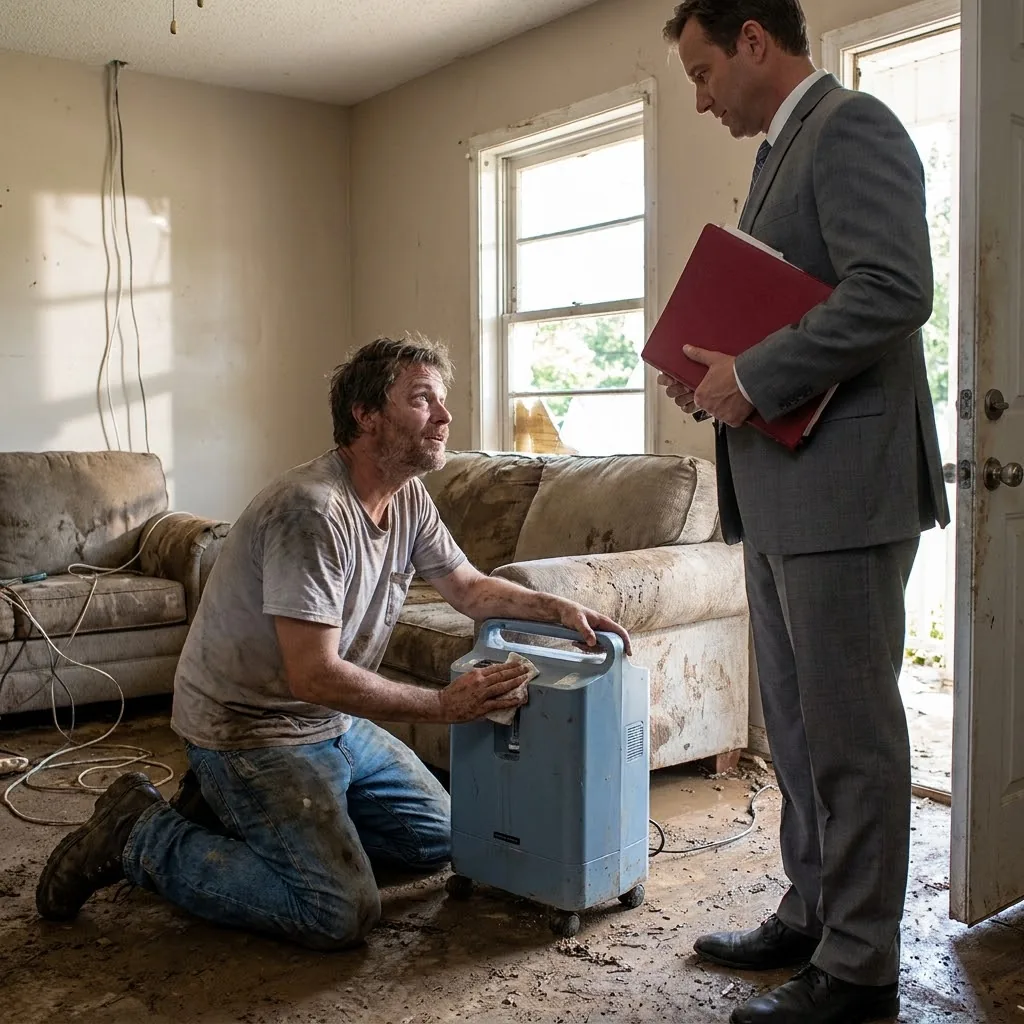
Harlan walked down the short hallway to the bedroom threshold. The oxygen concentrator was wheezing, its yellow warning light flashing frantically. Harlan reached down, grasped the thick black power cord, and yanked it violently from the wall outlet.
The machine’s rhythmic thumping cut out instantly. A shrill, continuous beep pierced the damp air, followed by a mechanical female voice from the digital interface: *”Warning. AC power lost. Auxiliary battery engaged. Estimated runtime: thirty minutes.”*
The actuary scrambled to his feet, his glossy leather shoes slipping in the mud. “You’re insane! You just cut her life support!”
“I put a clock on the wall,” Harlan said. His voice was entirely devoid of the frantic desperation he had felt five minutes ago. It was replaced by a cold, terrifying resolve. “In exactly thirty minutes, that battery dies. When her machine stops, she suffocates. And when she stops breathing, I take this hammer, and I make sure you stay in this toxic box with us forever. We all drown in the same dead air.”
Harlan pointed the steel head of the hammer at the red binder lying in the sludge. “Pick it up.”
The actuary hesitated, staring at the weapon. He slowly bent down and retrieved the heavy binder, filthy brown water dripping from the laminated tabs onto his pristine charcoal trousers.
“You told me it takes a Level Four authorization from Chicago to bypass the algorithm,” Harlan said, stepping back to block the hallway. “You told me you don’t have the digital authority. But a multi-billion-dollar corporation wouldn’t send a field adjustor into a disaster zone without a manual fail-safe. Cell networks go down. Satellites drop out. Find the loophole. You have twenty-eight minutes.”
“I need the phone to call my director!” the actuary pleaded, wiping a streak of black mud across his pale cheek as he clutched the binder against his chest.
“I’m not giving you the phone so you can call the police,” Harlan said. “Read your book. Find a way to do it yourself.”
The actuary stared at the sealed steel shutters, then at the hammer in Harlan’s hand. He flipped open the heavy binder. The room grew dead quiet, save for the frantic rustling of heavy paper, Mary’s terribly shallow breathing down the hall, and the steady, unforgiving countdown beep of the battery.
The trapped air grew dense and hot. Ten minutes passed. The actuary’s immaculate suit was soaked with sweat, the crisp white collar clinging to his neck. He tugged desperately at his silk tie, loosening it as the thick, spore-laden humidity began to work its way into his lungs. He let out a sharp, dry cough, then a wet hack, quickly pressing his ruined white handkerchief to his mouth.
“Twenty minutes,” Harlan announced.
“This is a proprietary algorithm!” the actuary shouted, his voice cracking, shedding the absolute last of his polished corporate armor. “It’s designed to protect the company’s bottom line in catastrophic loss zones! It automatically voids high-risk claims! There is no manual override for field agents!”
“Keep reading,” Harlan said, gripping the hammer tighter. He refused to beg. The pleading man was dead.
The battery let out a double beep. *”Fifteen minutes.”*
The actuary coughed again, doubling over slightly. He frantically wiped the sludge off a bright yellow tab in the back of the binder. His eyes darted across the dense, microscopic text. He stopped. His breathing hitched. He reread the page, his manicured finger tracing a line of small print hidden deep in an appendix.
He slowly looked up at Harlan. His face was ghostly pale, stripped of all arrogance and bureaucratic shielding. The absolute terror in his eyes was suddenly replaced by a sickening, undeniable realization.
“The phone,” the actuary whispered. His voice was a ragged scrape. He held out a trembling, mud-stained hand. “I don’t… I don’t need the director.”
Harlan didn’t move. He stared at the outstretched hand, processing the words.
“The Section 4 emergency cipher,” the actuary stammers, his eyes locked on the heavy steel hammer. “It’s an offline administrative bypass. It forces the transport approval into the queue locally. It bypasses the algorithm instantly.”
The sheer weight of the lie crashed into the dim room. The actuary had possessed the power to save Mary the very second he walked through the front door. The entire routine-the cold denial, the algorithm’s verdict, the fabricated necessity of a regional director-was nothing but a calculated, bureaucratic wall meant to make Harlan give up and accept his wife’s death quietly.
Harlan pulled the heavy satellite phone from his pocket, his thumb resting over the red power button, the steel framing hammer still gripped tightly in his right hand. The battery alarm let out another sharp, rhythmic beep, and neither man made a single move to break the standoff.