Story code: ST-000455
Part 3: The Manual Override
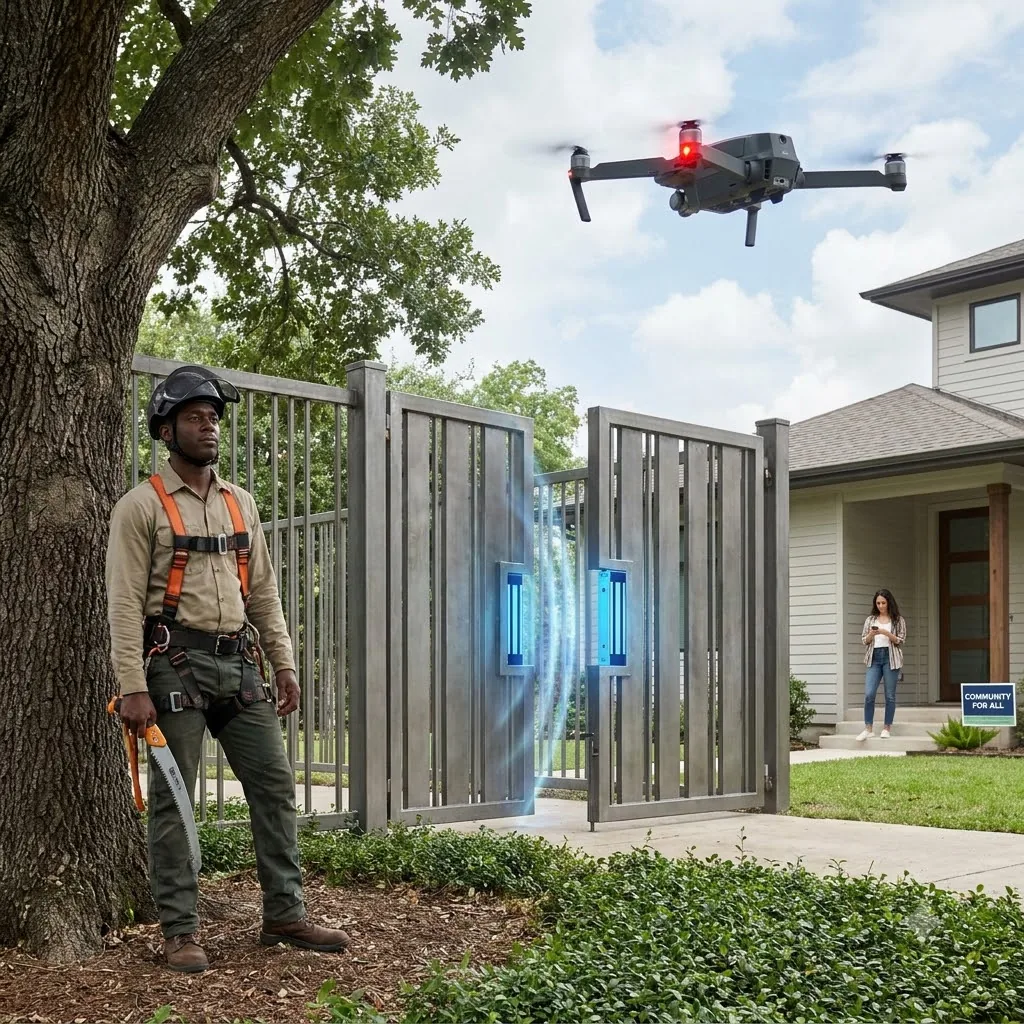
Marcus slowly lowered his knees onto the jagged crushed gravel. The sharp stones bit through the heavy fabric of his cargo pants, but he didn’t dare shift his weight. Hovering inches above his left shoulder, the drone’s twin metal prongs snapped with blue electricity. The ozone smell of the taser arcs mixed with the damp, earthy scent of the arboretum. He kept his hands raised high, palms open, his heart hammering a frantic rhythm against his ribs as the private security guard kept a hand resting securely on his pepper spray.
Before the guard could bark another command, the wail of approaching sirens shattered the tense quiet of the neighborhood. A pair of city police cruisers tore around the corner, their red and blue lights washing over the manicured lawns and casting long, chaotic shadows through the iron bars of the gate. The cruisers pulled up at sharp angles, effectively boxing in the security SUV and Marcus’s work truck.
Doors opened, and two uniformed city police officers stepped out. Unlike the private guard, they didn’t immediately draw their batons or shout aggressive commands. The older of the two, a heavy-set sergeant with salt-and-pepper hair, took one look at the fully marked pickup truck, the pole saw lying harmlessly in the dirt, and Marcus kneeling in his high-visibility vest.
The sergeant scowled and pointed at the guard. “Turn off that flying taser right now, buddy.”
The security guard stiffened, his hand dropping from his belt. “Officer, this is an active Level 3 perimeter breach-”
“He’s wearing a bright green vest with a tree service logo, and he’s parked in front of a tree service truck,” the sergeant interrupted, his voice dripping with exhausted disbelief. “Kill the drone and open the gate. Now.”
The guard fumbled with his tablet. The electric crackle ceased, and the drone ascended a few feet, its rotors slowing to a less aggressive hum. “I disabled the countermeasures,” the guard said defensively, “but I can’t disengage the magnetic locks. The lockdown was initiated by a resident via the Oakridge Protect app. It requires the resident’s manual clearance or a verified police override code, which takes dispatch ten minutes to process.”
Marcus let out a long, shaky breath and slowly lowered his arms, though he remained on the ground. He looked across the street toward the wrap-around porch. The woman in the beige cardigan was gone. Her steaming mug still sat on the railing, but the front door of her massive colonial-style home was firmly shut. She had retreated behind deadbolts the moment real police arrived.
The sergeant sighed, unhooking his radio mic. “Where’s the resident who triggered it?”
“Across the street,” Marcus called out, his voice hoarse. “She was standing right on her porch. I asked her for help, and she locked me in.”
The sergeant nodded to his partner to stay by the gate, then walked across the immaculate street, stepping carefully around the cheerful lawn signs proclaiming kindness and acceptance. He walked up the steps to the porch and pressed the illuminated button of the smart doorbell.
A chime echoed faintly from inside the house. A moment later, the woman’s voice crackled through the doorbell’s two-way speaker, sounding metallic, tinny, and distinctly defensive. “I am inside,” she announced. “I don’t feel safe coming out there right now.”
“Ma’am, this is Sergeant Harris with the city police,” he said, leaning toward the small camera. “We have the situation secured. I need you to step outside and clear the lockdown alert on your phone so we can get this man out of the garden.”
“He’s an intruder,” the intercom crackled back immediately. “The HOA app sent me an emergency alert! It said there was a 94 percent threat-match for a violent offender. It told me to secure the perimeter. I was just following the automated security protocol to protect my property.”
Kneeling in the dirt, Marcus felt a hot surge of anger cut through his lingering adrenaline. She was doing it again. She was blaming the sterile, invisible authority of an algorithm to wash her hands of what she had done.
“It didn’t alert you!” Marcus yelled through the iron bars, ignoring the guard’s warning glance. “You were standing out there watching me for a solid two minutes! You were sipping your coffee! You only pulled out your phone after I pointed to my company truck!”
“I received a 94 percent threat-match,” the woman repeated over the intercom, her tone perfectly clipped, speaking only to the sergeant. “The AI doesn’t lie, Officer. I rely on the system to tell me who belongs in our neighborhood. I will not apologize for trusting the technology.”
Sergeant Harris turned his head and looked back at the private security guard standing by the gate. “Hey,” Harris called out. “You’ve got the master dispatch tablet for this system, right? Pull up the digital log for this exact alert.”
The guard blinked, looking down at his screen. “Uh, yes, sir. Pulling up the alert history for the arboretum zone.”
Marcus pushed himself off the gravel, finally standing up. He walked to the bars, gripping the cold iron as he watched the guard scroll through the data.
“Okay, what does the automated system log say?” Harris asked, his voice loud enough to be picked up clearly by the porch microphone. “Did the perimeter AI flag the arborist?”
The guard squinted at the tablet, his brow furrowing. He tapped the screen again, looking incredibly uncomfortable. “No, sir,” the guard muttered. “The arboretum cameras logged the individual at 8:14 AM. The system correctly identified his uniform and cross-referenced the vehicle license plate. It issued a green clearance code: Authorized Vendor. Routine maintenance.”
A heavy silence fell over the street. The intercom emitted nothing but a faint, staticky hiss.
“So how did we get a Level 3 lockdown?” Harris asked, crossing his arms.
The guard swallowed hard. “At 8:22 AM, the log shows a ‘Manual User Override’ from the resident’s account. She manually dismissed the ‘Authorized Vendor’ clearance tag. Then… she opened the manual query tool.”
“What does that mean?” Marcus asked, his grip tightening on the bars.
The guard refused to meet Marcus’s eyes. He stared strictly at the tablet. “It means she used her phone camera to take a picture of him. She uploaded the photo into the app’s community watch feature and manually bypassed the local vendor registry, forcing the AI to run his face against an external, national database of outstanding warrants until it found a physical similarity.”
Sergeant Harris turned slowly back to the smart doorbell camera. “Ma’am,” Harris said, his voice flat and unforgiving. “The app didn’t alert you to a threat. The system told you he was a hired tree trimmer. You erased that notification, took a picture of him without his knowledge, and actively forced your app to hunt for a criminal record until it spit out a generic match.”
The staticky hiss of the intercom continued.
“You didn’t follow an automated protocol,” Harris continued, leaning closer to the lens. “You manufactured one. Now unlock the gate.”
From the speaker on the porch, there was no defense about algorithms. There was no shield of technology left to hide behind. There was only the quiet, damning click of the intercom being abruptly disconnected.