Story code: ST-000455
Part 4: Rot at the Roots
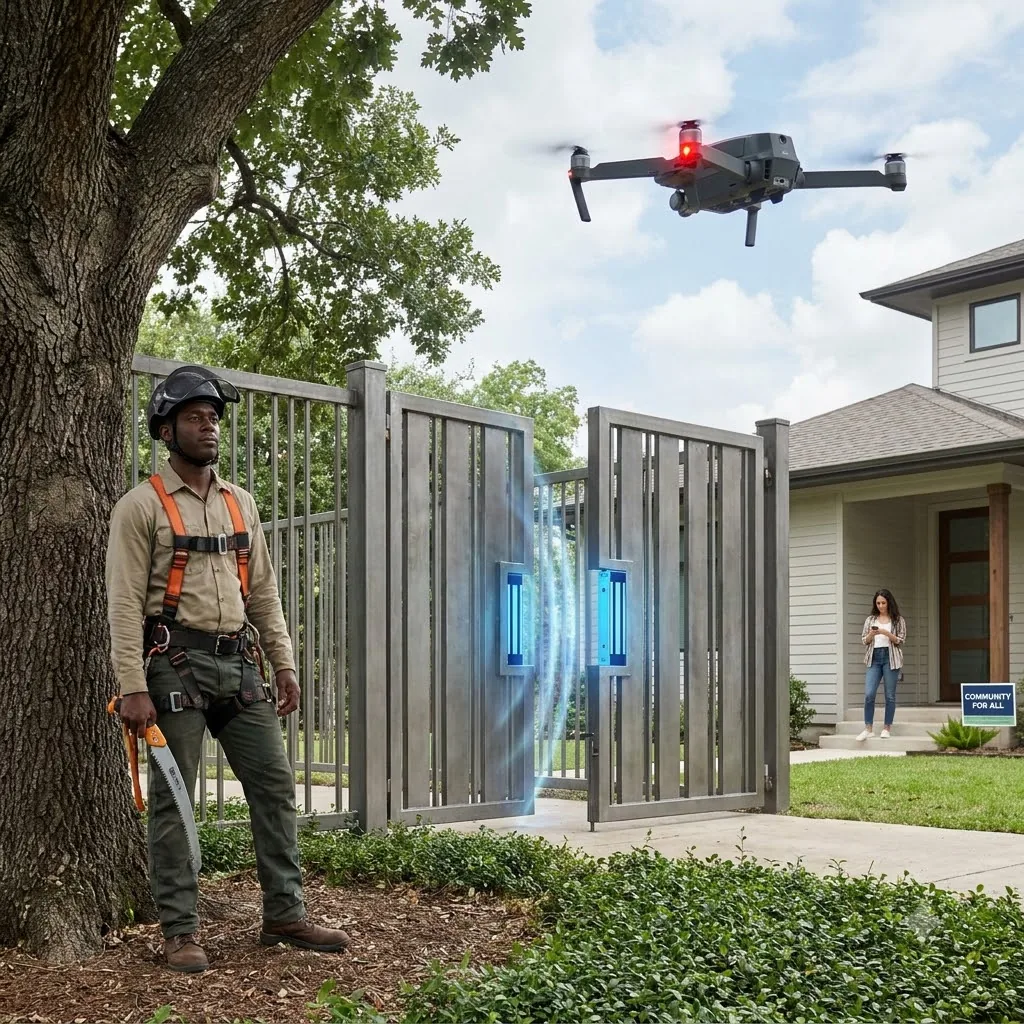
A loud, definitive *clack* echoed across the immaculate street as the heavy iron gates of the arboretum finally released. The magnetic seal broke, and the gate swung outward with a faint creak of hinges. Above Marcus, the security drone ceased its low, synthetic hum, retracting its taser prongs before buzzing upward to disappear into a charging housing concealed within the canopy of a weeping willow.
Marcus pushed the gate open the rest of the way and stepped out onto the asphalt. His knees ached where the crushed gravel had bitten through his cargo pants, and his hands still trembled slightly with the fading rush of adrenaline. He walked straight to his heavy-duty pickup, dropping his telescoping pole saw into the truck bed with a metallic clatter.
Sergeant Harris walked over, holding a small notepad. “I need your ID just for the incident report, Marcus,” the older officer said, his tone entirely conversational, a stark contrast to the aggressive barking from the private security guard earlier.
Marcus pulled his wallet from his back pocket and handed over his driver’s license. The private security guard stood a few paces away, his shoulders slumped, staring at his boots. The guard had tucked his pepper spray and baton far out of sight, looking thoroughly embarrassed. He opened his mouth to speak as Marcus passed, but Marcus simply held up a hand, shutting the man down before a single excuse could leave his lips.
The sound of a deadbolt turning drew Marcus’s attention across the street. The heavy front door of the massive colonial home swung open, and the woman in the beige cardigan stepped out onto her wrap-around porch. She walked slowly down the steps, carefully navigating past her brightly colored yard signs proclaiming kindness and acceptance.
As she crossed the manicured street toward the police cruisers, Marcus saw that her eyes were red. Tears streamed down her cheeks, glistening in the harsh morning sunlight. She stopped a few feet away, clutching her silver smartphone against her chest like a talisman.
“I am so, so sorry,” she said, her voice wavering, pitching into a practiced, trembling register of distress. “I was just terrified. The world is so dangerous, and when the app warned me… I just panicked.” She wiped at her eyes, letting out a jagged sob. “It’s this biased technology. These algorithms, they have so much implicit bias built into them. I read an article about it just last week. The AI just defaults to profiling, and it completely misled me. It tricked me.”
Marcus leaned against the side of his work truck, crossing his arms over his high-visibility vest. He looked at her crying face, feeling absolutely nothing. The adrenaline had burned away, leaving only a cold, heavy exhaustion in his chest.
She wasn’t apologizing to him. She was apologizing to the audience-to Sergeant Harris, to the guard, and to her own fragile self-image. Even now, with her digital paper trail fully exposed by the police, she was desperately trying to shove her own prejudice into the cold circuitry of her phone.
“It didn’t trick you,” Marcus said, his voice quiet but sharp enough to make her flinch. “The system gave you a green checkmark. It told you I was the tree guy. You deleted that. You took my picture while I was begging you for help, and you fed it into a database until it gave you the answer you wanted.”
“I just… I didn’t understand the interface,” she stammered, fresh tears spilling over. “I’m not good with the technology. Please, you have to understand, I would never-”
“I understand perfectly,” Marcus interrupted. He turned to Sergeant Harris, who handed his ID back. “Are we done here, Officer?”
“You’re free to go, Marcus,” Harris said softly, slipping his notebook into his pocket. “If you want to press charges for unlawful detention or reckless endangerment, give me a call. The report will be on file.”
“Thank you,” Marcus said. He didn’t look at the woman again. He walked around to the driver’s side of his truck and pulled open the heavy door.
“Wait, what about the trees?” the woman asked, her voice cracking as she took a step toward his truck. She gestured toward the massive, sprawling heritage oaks that lined the edge of her pristine lawn, their branches casting long shadows over her driveway. “The HOA sent an email saying they have wilt. They said if they aren’t treated this week, they’ll have to be removed.”
Marcus paused, resting his hand on the steering wheel. He looked up at the towering oaks hanging directly over her colonial home. With a trained eye, he could already see the telltale signs of the disease taking root. The leaves at the crown were curling and browning at the edges, and dark, oozing patches of sap stained the massive trunks. Oak wilt was aggressive. Once it reached the root grafts, it would spread rapidly, hollowing out the wood from the inside. Left alone, those massive branches would become brittle death traps suspended directly over her roof.
“You’re right,” Marcus said, climbing into the cab of his truck. “They have wilt.”
“So you’re going to fix them?” she asked, a hopeful, desperate note creeping into her voice. “You’re going to treat them?”
“No,” Marcus said, pulling the door shut. He rolled down the window just far enough to look her in the eye one last time. “I don’t work in hostile environments. You can tell your HOA I’m canceling the contract.”
He turned the key, the heavy diesel engine roaring to life and drowning out whatever tearful protest she offered next. He put the truck in gear and pulled away from the curb, leaving the woman standing alone in the street. In his rearview mirror, Marcus watched her shrink into the distance, standing in the shadow of her dying trees, surrounded by yard signs that suddenly meant absolutely nothing at all.