Story code: ST-000830
Part 3: The Poisoned Canvas
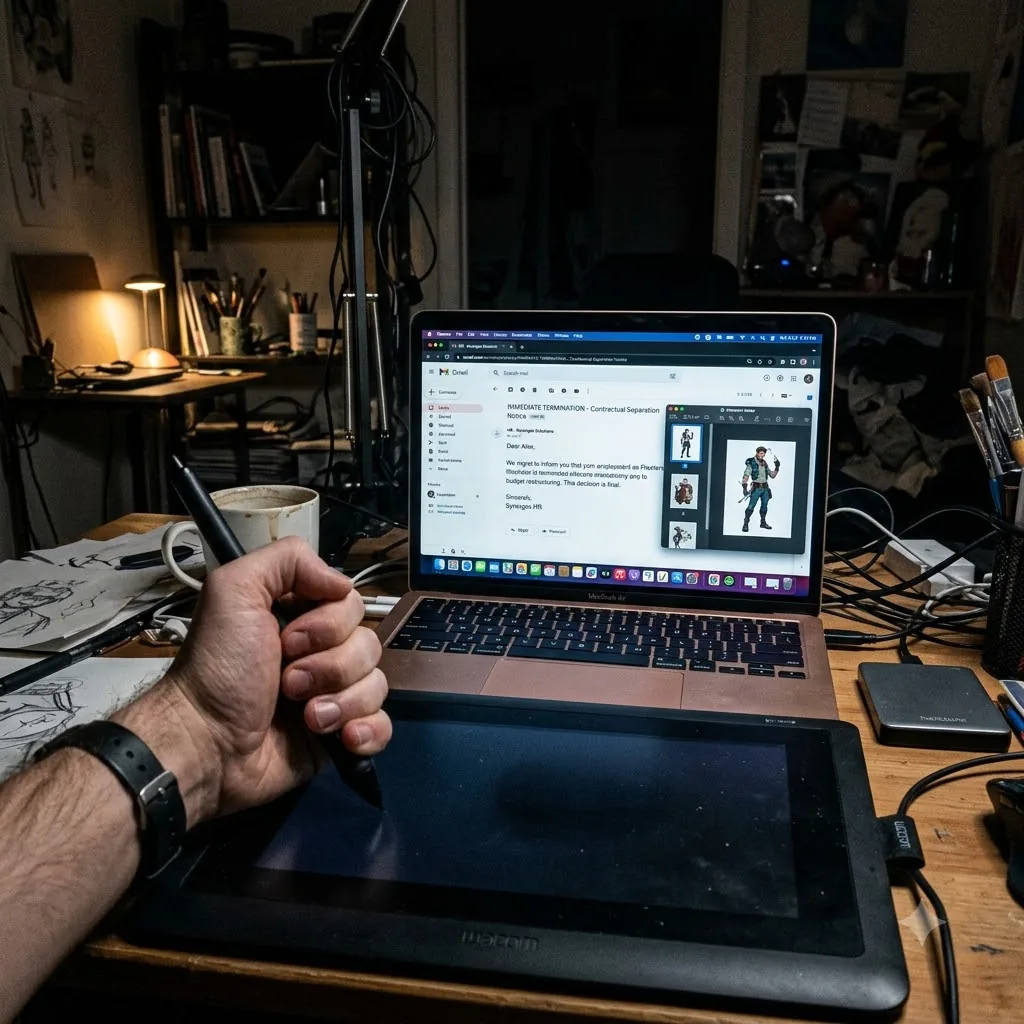
I didn’t need to hack Genesis-Nine. I just needed to let it gorge itself. The metadata from Sentinel Media’s pitch deck proved Elias Thorne’s enterprise scraper was still silently tethered to the hidden backend directory of my portfolio site, constantly updating its cloned “Maya Lin” sub-model. I spent seventy-two straight hours manic at my drawing tablet, fueled by tap water and absolute, singular rage. I digitally painted a sprawling, hyper-detailed cityscape. I layered the heavy-handed charcoal smudges. I washed the sky in my exact, stormy cerulean blue, recreating the precise signature hesitation at the curve of the arc.
But I wasn’t just painting. I was building a bomb.
In the lower left quadrant, disguised within the dense, crosshatched shadows of a subway entrance, I embedded a mathematically precise anomaly. Working pixel by pixel, I wove a two-dimensional Data Matrix barcode seamlessly into the digital ink wash. I saved the massive, high-resolution file directly into the bridge directory. Then, I spent my last forty-five dollars to register the unreleased image with the U.S. Copyright Office. The trap was set.
Four days later, Elias Thorne paced a brightly lit stage at the Moscone Center in San Francisco, live-streamed to two million concurrent viewers. I watched from my cramped apartment, my laptop resting on a crate of obsolete paint tubes. Thorne wore his trademark minimalist gray sweater, beaming as he introduced ‘Genesis Live-Sync’-a premium tier that supposedly synthesized real-time “aesthetic inspiration” for corporate clients without plagiarizing human creators.
“Watch the magic happen,” Thorne declared, typing a prompt for a gritty urban storyboard into his sleek console.
The massive, forty-foot LED screen behind him flared to life. The machine vomited my unreleased cityscape.
It was breathtakingly fast, rendering in seconds what had taken me three days of agonizing labor. But the algorithm didn’t understand the soul of art; it only understood pattern weight and contrast. When the neural network processed the sharp, geometric grid of my hidden Data Matrix code in the shadows, it didn’t blur it into stylistic noise. Prioritizing the sharp edges, the machine faithfully, perfectly sharpened the code. It blew my hidden trap up to the size of a minivan for the entire world to see.
I didn’t have to sue him. The internet noticed the bizarre, blocky artifact in the AI’s masterpiece within minutes. By midnight, tech journalists on Twitter had isolated and scanned it. The code linked directly to a plain-text page on my website: *Property of Maya Lin. Registered Copyright. Unreleased. Do not scrape.* The billionaire tech savior had just broadcast his machine strip-mining a broke freelancer live on stage.
Now, I am sitting in a freezing, glass-walled conference room forty floors above Century City. I have exactly four dollars and twelve cents in my checking account, my eviction notice is taped to my front door, and my stomach is hollow from hunger. But the men across the table, who control a market cap of eighty billion dollars, are sweating.
Elias Thorne didn’t show his face, but his lead crisis counsel, a man named Sterling, sits with predatory posture in a bespoke navy suit. Next to him is Sentinel Media’s Head of Legal, a man who won’t even make eye contact with me.
Sterling pushes a thick, glossy folder across the expanse of the polished mahogany table.
“Ms. Lin. We are prepared to offer you two hundred and fifty thousand dollars,” Sterling says, his voice a practiced, soothing baritone. “This more than covers your lost Sentinel Media contract, plus a very generous retroactive consulting fee. In exchange, you sign this non-disclosure agreement, and we issue a joint press release.”
“A press release stating what?” I ask, my voice remarkably steady.
“Stating that the artifact in Mr. Thorne’s demo was a bizarre, one-in-a-billion algorithmic hallucination,” Sterling says smoothly, folding his hands. “Genesis-Nine does not copy, Ms. Lin. It learns concepts. It iterates. If it produced a pattern resembling your barcode, it was a mathematical anomaly. Infinite monkeys on infinite typewriters. We are paying you for the public relations inconvenience and your silence. You cannot prove direct, one-to-one replication in a court of law.”
I don’t touch the folder. I don’t even look at the obscene amount of money that could change my life. Instead, I reach down into my battered canvas portfolio tube. The pop of the plastic cap sounds violently loud in the quiet room.
I pull out a massive, heavy-stock physical printout of the unreleased painting. I unroll it flat onto the mahogany table, deliberately weighing the bottom corners down with my cheap smartphone and Sterling’s solid gold fountain pen.
Sterling’s polite, corporate smile finally falters.
“This is the master file I placed on my server,” I say. “Take a close look at the lower left quadrant. The shadows under the subway awning.”
Sterling leans forward. His eyes flick over the dense, erratic crosshatching.
“I didn’t just paint a barcode,” I say, my voice dropping to a hard whisper. “I painted a trap. Before I uploaded it, I went into the digital negative and manually inverted the hex values of exactly three pixels in the top right orientation square. It’s a deliberate, coded flaw. It renders the matrix technically broken to a standard phone scanner, but mathematically unique. A digital fingerprint.”
I slide a plastic jeweler’s loupe across the table. It hits Sterling’s NDA folder with a soft thud.
“Your machine didn’t hallucinate a random arrangement of blocks,” I say. I tap the screen of my phone, bringing up the ultra-HD press still of Thorne’s live demo. I zoom in on the AI-generated shadow. “Your scraper bypassed my firewalls, illegally downloaded an unreleased, copyrighted image, and blindly regurgitated my exact, corrupted hex values.”
Sterling looks down at my cracked phone screen. Then he picks up the loupe and leans over the physical printout.
For ten agonizing seconds, the only sound in the room is the faint, sterile hum of the air conditioning. The Sentinel Media lawyer swallows hard, the sound clicking in his throat. Sterling slowly lowers the loupe, the color draining entirely from his face as he stares at the undeniable proof of a billionaire’s theft, permanently trapped in three microscopic pixels of cerulean blue.