Story code: ST-001332
Part 3: The Slipping Grip
At exactly 14:15:00, the red tally light on the primary broadcast camera illuminated, signaling that the Vance Climate Initiative’s live stream was active. Evelyn Vance immediately transitioned into her public persona, her voice projecting warm, measured resolve across the city council steps. In the technical alcove, my monitors showed the dual feeds side by side: the clean, cropped broadcast frame on the left, and the wide-angle raw footage on the right. On the official feed, Evelyn was a picture of poised leadership, gesturing toward the municipal glass doors as she began her address. On the raw feed, the physical reality of the Vance family dynamic remained visible.
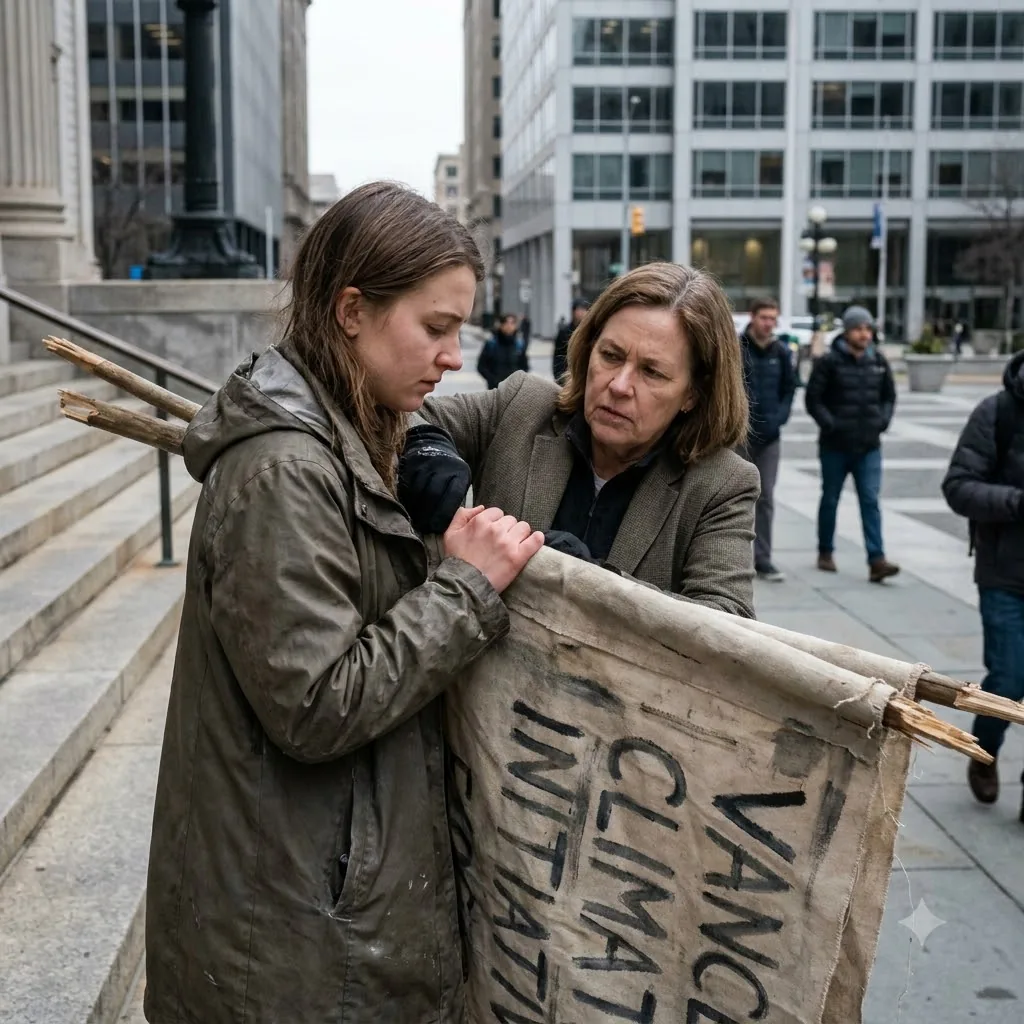
Chloe Vance stood on the concrete step, her right shoulder visibly lower than her left. The twelve-foot Vance Initiative Protest Banner, constructed from thick canvas and heavy pine supports, was sagging. The raw video zoom captured the physical strain in Chloe’s wrists. Her fingers, wrapped around the rough wood, had gone pale, and small flecks of splintered pine clung to her skin. Evelyn’s left hand remained flat against Chloe’s back, her fingers pressing into the fabric of Chloe’s jacket to prevent her from shifting her weight. The family’s public script demanded this configuration-an image of youth and intergenerational unity supporting the campaign’s local environmental pledge. Yet the physical alignment was failing.
‘We stand here today to demand absolute transparency from our local representatives,’ Evelyn announced to the assembled reporters, her face bright with a practiced smile. ‘Our campaign is funded by the people, for the people, free from the corrupting influence of commercial developers who buy compliance behind closed doors.’
On the raw audio feed from Evelyn’s active wireless clip-on microphone, the sound of her rapid, shallow breathing ran parallel to her spoken words. Every time Evelyn paused for rhetorical effect, the mic picked up the faint rustle of her coat pressing against Chloe’s shoulder. Chloe’s gaze remained fixed on a seam in the concrete steps. Her jaw was clamped shut. She did not nod, nor did she look up when Evelyn referenced the family’s collective sacrifice.
By the third minute of the broadcast, the local news pool began to notice the gap in the staging. An assistant camera operator in the press row adjusted his lens, tilting down from Evelyn’s face to focus on Chloe’s hands. At the same time, the technical director in the Media Alcove pointed a finger at the audio console. The raw audio feed of Evelyn’s pre-show warning was still routing to the local press distribution box, where three separate radio journalists were monitoring the line. A quiet murmur rippled through the media alcove as the journalists looked from their headphones to the family on the steps.
I watched the audio levels on channel four spike as Evelyn spoke. It was not her public speech causing the spike, but the friction of her hand tightening on Chloe’s coat. The tension was reaching a critical point. Chloe’s left foot slid back half an inch on the stone step. Her breathing grew heavier, visible in the rising and falling of her shoulders. She was no longer adjusting her grip; she was simply holding on. The pressure was no longer contained to the family circle; the offstage warning had been recorded, and the physical weight of the banner was pulling Chloe’s hands down inch by inch.
A local reporter from the city daily, holding a digital recorder, leaned over to his colleague and whispered, pointing toward the audio booth. On the secondary feed, I saw him check his phone, where the live broadcast stream was running with a ten-second delay. He was cross-referencing the audio with the video, matching the whisper to the tight grip of Evelyn’s fingers. The private warning was now part of the public record, circulating among the press corps before the speech had even reached its midpoint.