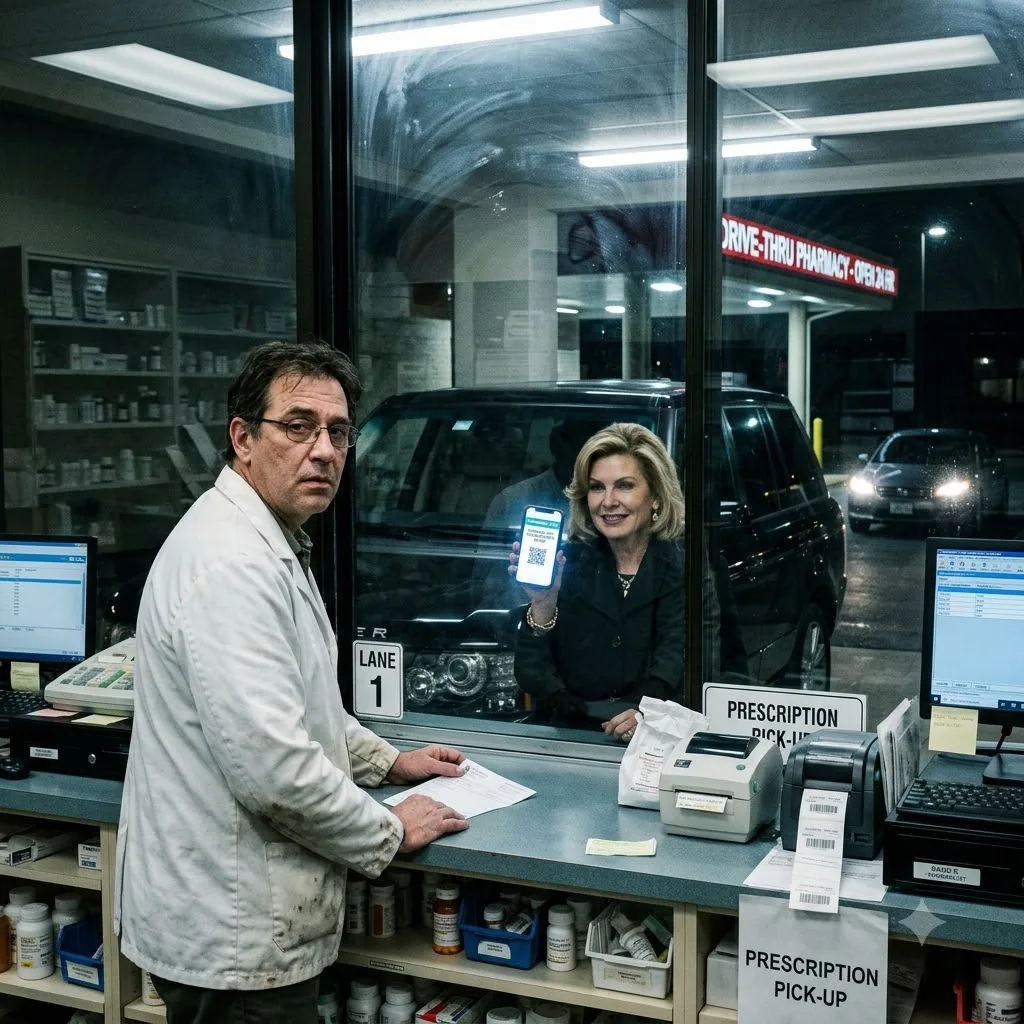
Story code: ST-001012
Part 3: The Coordinates
Elias stared at the black square on his phone, the dead camera feed mocking him. The afternoon heat radiating from the asphalt felt suffocating. He shoved the phone into his pocket and sprinted toward his ten-year-old Corolla. His hands shook so violently he dropped his keys twice before finally managing to unlock the door.
He threw himself into the driver’s seat, the engine whining as he cranked the ignition. He threw the gearshift into reverse, his tires chirping against the pavement. He needed to get to his street. He needed to get to Sarah.
Before he could back out of the parking spot, a shadow crossed his rearview mirror. A vehicle slid smoothly across the narrow rear access lane, parking completely perpendicular to his bumper.
It was the silver sedan.
The driver’s side window was completely rolled down. The woman from the drive-thru leaned out, her phone no longer held in her hand but locked into a motorized, stabilizing gimbal. The red recording light was a steady, unblinking eye.
She hadn’t gone home. She had circled the building, waiting for the inevitable outcome of her digital strike.
Elias slammed on the brakes, shoving the car back into park. He burst out of his door, the sweltering air hitting him like a physical wall.
“Move your car!” Elias shouted, his voice cracking as he pointed toward the street. “My children are in that house!”
The woman didn’t flinch. Her face remained a mask of pristine, rehearsed calm. She looked past Elias, speaking directly into the lens of her camera.
“Here he is, guys,” she said, her voice bright and perfectly projected, completely at odds with the gravity of what she had unleashed. “The pharmacist who thinks his personal bigotry gives him the right to deny healthcare. It looks like management finally took out the trash. He’s been suspended.”
“They are swatting my house!” Elias closed the distance, stopping three feet from her door. The urge to reach through the window and shatter the plastic recording device was a physical ache in his forearms. “There are men on my porch! They taped over my security camera! Tell them to stop!”
She adjusted the angle of the gimbal slightly, ensuring Elias’s red, sweating face remained centered in the frame. “I didn’t tell anyone to do anything,” she said, her tone dripping with practiced innocence. “I’m just a journalist, holding space for accountability. If the community is expressing their valid anger, that’s on you. Actions have consequences.”
“It’s a hostage response!” Elias yelled, feeling the panic constrict his throat. “The police think there’s an armed situation! If my wife opens that door-”
“Then maybe you should have done your job,” she interrupted, smiling thinly at the camera. “Freedom of religion isn’t freedom from consequence. Right, chat?”
Elias stared at her, the horrific realization settling heavily in his chest. She didn’t care if Sarah was hurt. She didn’t care if the police breached his door with rifles raised. A tragedy would only increase her viewership. She was insulated by her screen, entirely detached from the blood and bone reality of the mob she had summoned.
He stepped back, frantically calculating the space. If he rammed her sedan with his Corolla, he could push it out of the way. It would wreck his front end, but it would clear the lane. He turned toward his car.
The heavy metal fire door of the pharmacy groaned open.
Elias stopped. Marcus stepped out into the blinding sunlight.
Marcus was the store’s plainclothes loss prevention officer. He usually spent his shifts invisible in the back office, logging shoplifters and managing the perimeter alarms. Right now, he was wearing his gray suit jacket, a bright yellow corporate lanyard dangling from his breast pocket.
In his right hand, he held a manila folder.
“Marcus, get back inside,” Elias warned, his voice tight. “She’s live. She’ll put you on the feed.”
Marcus didn’t stop. He walked with a heavy, deliberate stride directly toward the silver sedan. He didn’t look at Elias. His eyes were locked entirely on the woman.
“Corporate just sent an urgent directive,” Marcus said, his voice a low, carrying baritone that easily cut through the ambient roar of the nearby highway. “They ordered all personnel to stand down. They said PR is drafting a public apology to you, and that engaging with you in any capacity right now would violate the company’s de-escalation policy.”
The woman smirked, tilting the gimbal toward Marcus. “Smart company. You should listen to them. Are you bringing me my apology?”
“No,” Marcus said. He stopped right beside her window, deliberately placing himself in the center of her frame. “I bypass corporate channels when they ask me to facilitate a felony.”
The smirk on the woman’s face faltered, just a fraction. “Excuse me?”
Marcus opened the manila folder. He pulled out a stapled stack of papers and dropped it onto her lap, right over her steering wheel.
“That is a printed copy of the state’s cyber-harassment and swatting statutes,” Marcus said, his voice devoid of any customer-service softness. “Specifically, Section 14, Paragraph 3, which details the criminal liability for anyone who orchestrates, incites, or provides targeting coordinates that result in a fraudulent emergency response.”
“I didn’t incite anything,” she snapped, looking down at the papers as if they were venomous. “This is a public sidewalk. This is protected speech.”
“You’re in a private loading zone,” Marcus corrected smoothly. “But more importantly, I’ve been in the security office pulling your drive-thru audio. You didn’t just read his address. You actively instructed your viewers to ‘make them feel the heat at home.’ That’s not journalism. That’s a target package.”
The woman swallowed hard. Her finger hovered over the screen of her phone, momentarily blocking the chat scrolling wildly on the display. “You can’t prove intent.”
“I don’t have to,” Marcus said. He pulled a yellow carbon-copy slip from the folder and held it up to the camera lens. “This is an active police report number. I just got off the phone with the precinct captain. I didn’t call corporate legal. I called the detectives. I gave them your license plate, your handle, and the raw security footage of you initiating the harassment campaign.”
The woman’s hand dropped from the gimbal. The unblinking red light of the camera suddenly seemed less like a shield and more like a spotlight.
“The officers staging outside Elias’s house?” Marcus leaned in, resting his knuckles on the edge of her car door. “They’ve just been notified it’s a swatting attempt linked to an active cyber-crimes investigation. They aren’t going in blind anymore. But the detective I spoke with is very interested in the person who lit the match. They are tracing the IP addresses of the people on that porch right now. When they catch them, those trespassers are going to point directly at this livestream to secure a plea deal.”
The woman stared at Marcus, her mouth slightly open. She looked from the yellow slip to the camera, then down to the thick packet of statutes sitting in her lap. The chat on her screen was blurring past in a frantic waterfall of text, but she wasn’t reading it anymore. The airless bubble of her online immunity had just popped against the sharp edge of the criminal justice system.
“If I were you,” Marcus said, stepping back from the car, “I would end the stream, retain a defense attorney, and move your vehicle before I have it impounded as evidence in a federal investigation.”
She didn’t have a witty retort. She didn’t have a corporate script to mock. The woman simply stared at the active police report number, her manicured fingers trembling as they hovered over the ‘End Broadcast’ button.