Story code: ST-000199
Part 4: The Bureaucratic Override
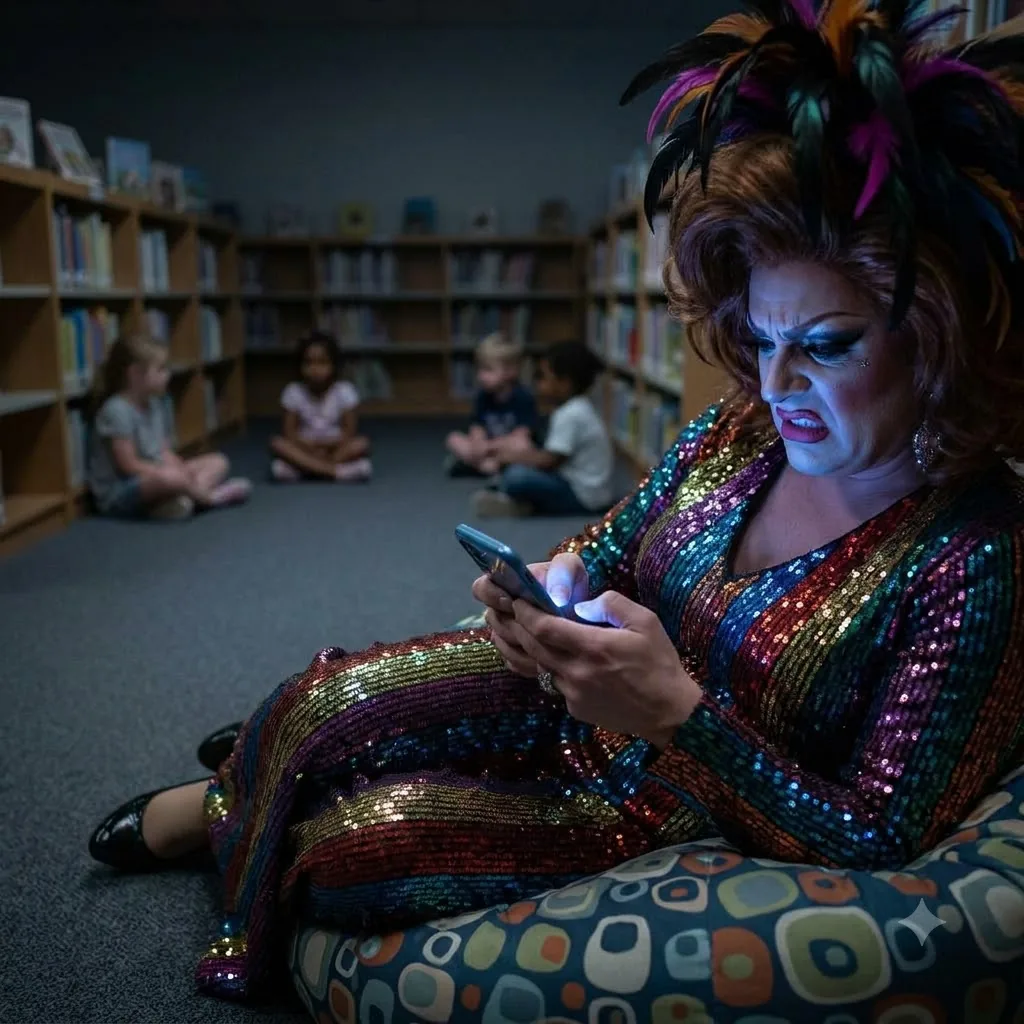
The protestor’s thumb trembled. The red button glowing on his phone screen seemed to mock him, but the imposing silhouette of the heavily armored machine lurking in the library lobby broke whatever manufactured resolve he had left. Before Julian could scream at him again, the boy surrendered, pressing the glass. The ring light snapped off, plunging them both back into the dim ambient glow of the courtyard streetlamps.
Immediately, the mechanical humming from the library atrium shifted pitch. A pair of black-and-white city patrol cruisers rolled silently into the brick plaza, their lightbars flashing a sterile, rhythmic blue. They hadn’t used their sirens. The automated pacification unit had likely transmitted the de-escalation signal to the dispatch grid the second the livestream ceased.
Two human officers stepped out of the cruisers. They didn’t draw their weapons. They didn’t shout commands. They simply walked up to the protestor, unclipped the rifle from his back, and placed him in zip-ties. The young man didn’t fight back; he just sagged, muttering weakly about his rights while the officers patted down his pockets. It was entirely mundane. The terrifying climax of Julian’s night was evaporating into a quiet, administrative procedure.
Julian stood shivering in the night air, the heavy synthetic hair of his wig blowing across his face. He watched the officers guide the boy into the back of a cruiser. Inside the glass atrium, the pacification unit powered down its targeting laser and retreated into a stationary standby mode. The pale librarian emerged from the children’s section, herding the toddlers out into the main lobby. Their tiny faces pressed against the glass as they watched the flashing blue lights. They were safe. The nightmare was over.
But Julian’s nightmare wasn’t. He raised his phone, his acrylic nails tapping the cold screen to wake it. The localized emergency alert had vanished, replaced by his standard lock screen. The time read 11:14 PM. Forty-six minutes until midnight. Forty-six minutes until his landlord checked the digital payment portal and initiated eviction protocols.
Julian opened the gig-work app. The login screen still displayed the padlock icon next to his email address, but the red hazard banner was gone. In its place was a standard gray button: *Submit Automated Appeal*.
Julian tapped it eagerly. A generic form loaded, asking for the reason for the appeal. He didn’t have a keyboard to type out the nuances of a clout-chaser, an AI security grid, and a trapped drag queen. He only had a pre-populated dropdown menu.
He selected *System Error/Incorrect Flag*. He checked the mandatory box certifying he was no longer in a hazard zone. He held his breath, his thumb hovering over the final submit button. He prayed to whatever algorithms governed the digital universe that a human might see it this time. Someone who could look at the map, see the resolved police dispatch, and release his twelve hundred dollars.
He pressed the button.
The loading circle spun. One second. Two seconds.
A new notification popped up, outlined in absolute, unforgiving red.
*Appeal Denied. Account Terminated.*
Julian stared at the screen, his heart dropping heavily into his stomach. He tapped the notification, desperate for any context. An automated email had already populated in his inbox.
*Dear Contractor,* it read. *Your automated appeal has been processed by our rapid-response matrix. System logs confirm your device was present in an Active Hazard Zone during a Level 1 Deployment. As per your contractor agreement, remaining in an active threat environment is a violation of our liability protocols. Furthermore, GPS tracking indicates you approached the hostile subject to interfere with the hazard resolution, violating Section 6.1 (Interference with Law Enforcement). Your balance of $1,200.00 has been seized to cover administrative penalties. This decision is final and cannot be overturned.*
Julian’s mouth fell open. He read the sterile, automated words again. *Approached the hostile subject.* The gig app hadn’t just scraped the emergency data. It had tracked his phone’s GPS coordinates leaving the library. It had tracked him walking up to the protestor. The algorithm didn’t see a man saving fourteen children from a potential firefight; it only saw a dot moving toward another dot marked as dangerous. It saw a liability.
The phone slipped from his trembling hand, clattering onto the brick pavement. The screen cracked, a jagged spiderweb of shattered glass that mirrored the broken library doors behind him.
Julian didn’t bend down to pick it up. He stood frozen in his glittering emerald gown, watching the police cruisers silently roll out of the plaza. The protestor was gone, on his way to a holding cell where he would likely bond out by morning, his livestream a viral success. The toddlers were safe, waiting for their parents. The library was secure.
But Julian had nothing. He wrapped his arms around his corset, the sequins cold and abrasive against his skin. The city around him hummed with invisible data-lines of code communicating, optimizing, and protecting corporate property. He had survived the physical threat, but he had been utterly erased by the digital one. Tomorrow, the eviction notice would be taped to his apartment door. The money he had bled for was gone forever, swallowed by an unfeeling machine that would never know his name. Julian closed his eyes, completely alone in the bright, empty plaza, waiting for midnight to arrive.