Story code: ST-001034
Part 4: Clean Slate
The name hung in the stale air of the bedroom, a heavy, immovable object that completely shattered the rhythm of his mother’s breathing.
For a long moment, the only sound in the room was the ambient whir of the cooling fans inside Kevin’s PC tower. His mother stared at him, her eyes wide, the severe, authoritative lines of her face slackening into something that looked terrifyingly fragile. She looked from Kevin to the glaring yellow highlight on the secondary monitor, then back to his face.
“You’re lying,” she whispered, though the complete lack of conviction in her voice betrayed her. She took a slow, unsteady half-step backward, her hand blindly reaching out to grip the edge of the dresser for support. “You’re just saying that. You’re trying to protect her because she’s your wife.”
“She left me six months ago, Mom,” Kevin said, the terrifying calm still anchoring his voice. “She left me because every time my phone rang with a server alert, I abandoned her. And she left because every time you demanded my time, my money, or my obedience, I gave it to you. I let you dictate my life because I was still that terrified teenager on the library roof, desperate to earn the approval of a woman who would rather see me dead than see me fail.”
His mother’s mouth opened, but no sound came out. The heavy floral perfume suddenly seemed entirely disconnected from the small, pale woman leaning against the dresser. The political venom, the self-righteous crusade about the steering committee, the demands for community exposure-it all evaporated into a horrifying, suffocating silence. The script, the culture war, the town hall meeting, none of it mattered anymore. She was staring at the ghost of her son, finally realizing she had been the one to push him to the edge.
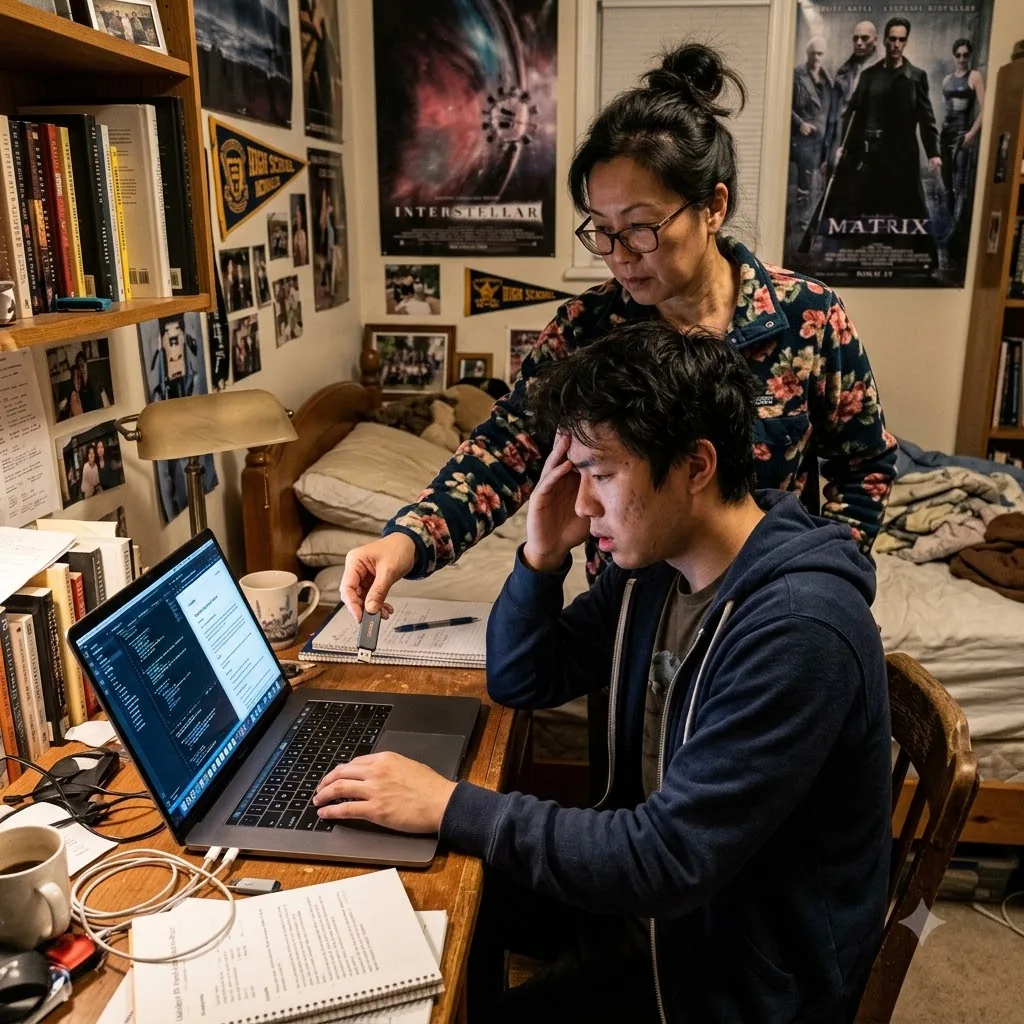
Kevin turned back to the desk. The cursor was still blinking in the code editor. The raw CSV file was still sitting open, a loaded weapon waiting to be fired. The promotional flash drive still protruded from the side of the aluminum chassis.
If he walked away right now, the data would remain. She had threatened to post it manually. Even in her current state of shock, the file existed.
Kevin reached out and gripped the edges of the laptop.
“Kevin, wait,” his mother breathed, her voice shaking. “What are you doing?”
He didn’t answer. He ripped the laptop off the desk, snapping the power cable out of its port. He raised the heavy aluminum chassis high above his head. The screen tore away from the secondary monitor’s display, flashing blindly.
With a sharp, guttural exhale, Kevin brought the machine down onto the hardwood floor with every ounce of strength he had left.
The impact sounded like a gunshot in the cramped bedroom. The aluminum frame warped and buckled. The screen shattered into a spiderweb of dead pixels and jagged glass. More importantly, the plastic flash drive jutting from the side port took the brunt of the lateral force. It snapped cleanly in half, the internal circuitry crushed against the floorboards.
Kevin didn’t stop. He lifted his heavy boot and brought it down on the center of the chassis, stomping once, twice, three times. The hinge snapped. The keyboard cracked, sending small, black plastic keys skittering across the room like loose teeth.
He destroyed the script. He destroyed the CSV file. He destroyed the thousand-dollar machine she had claimed was the foundation of his success.
When he finally stepped back, his chest heaving, the laptop was nothing but a jagged heap of ruined metal and glass.
His mother let out a small, broken sob. Her legs seemed to give out beneath her, and she collapsed onto the edge of the twin bed. She sat there, staring blankly at the wreckage on the floor, her hands trembling violently in her lap. She made no move to salvage the drive. She made no move to stop him. The iron grip she had held over him for thirty years was gone, shattered as thoroughly as the motherboard on the floor.
Kevin looked at her, expecting to feel a surge of guilt. He expected the old panic to rise, the desperate need to apologize, to fix it, to promise he would buy a new one and write the code.
Instead, he felt absolutely nothing. The hollow space in his chest remained, but it was no longer a vacuum of anxiety. It was just empty space. Room to finally breathe.
He turned away from the desk. He didn’t bother picking up the dead corporate phone. His career as an infrastructure architect was over. His six-figure salary was gone. He walked past his mother, who didn’t even lift her head as he moved toward the bedroom door.
Kevin stepped out into the hallway, his boots quiet on the carpet. He walked down the stairs, grabbed his car keys from the hook by the front door, and walked out into the cool evening air.
The sky was beginning to turn a deep, bruised purple. Kevin stood in the driveway, looking up at the early evening stars. He took a long, deep breath, pulling the crisp, clean oxygen all the way down to the bottom of his lungs. His hands were completely still. He had no job, no laptop, and he had just nuked his relationship with his only remaining family.
But as he unlocked his car, Kevin realized it was the first time in ten years he wasn’t afraid of his phone ringing. He slid into the driver’s seat, pulled up his contacts on his personal cell, and stared at the name in his favorites list. For the first time in six months, he felt like he had actually earned the right to press call.