Story code: ST-000107
Part 2: The Rally Point
The heavy canvas tarp slipped from her grip, hitting the packed dirt floor with a muffled thud that sent up a cloud of dust into the weak beam of her phone. Sarah stepped back, her breath catching in her throat as the small circle of light washed over a towering, six-wheeled armored military transport. It was painted in a flat, matte-green finish, completely stripped of any official insignia or identifying numbers. Heavy, angular steel plates were welded haphazardly over the windows, leaving only narrow viewing slits. Mounted directly to the roof of the chassis was a rotating steel turret housing a massive, dual-barreled heavy machine gun.
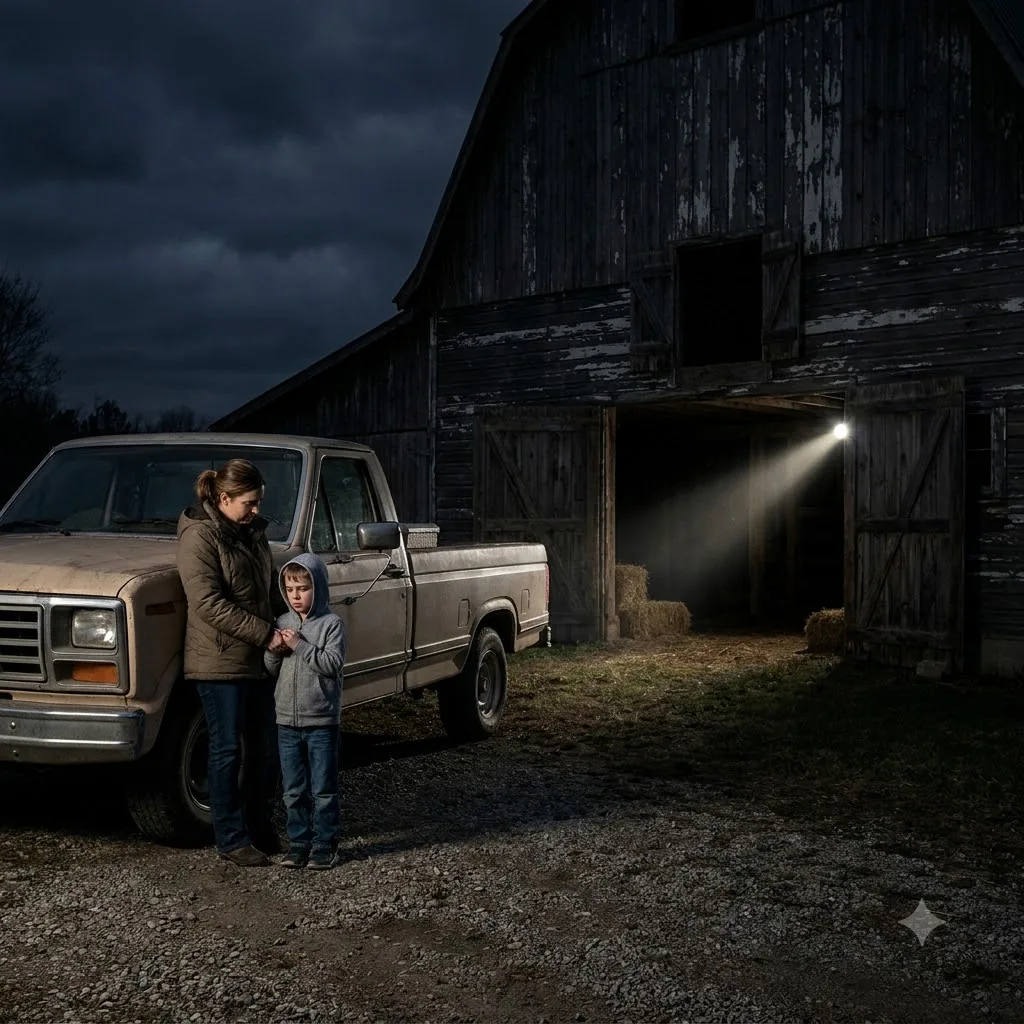
Sarah stared at it, her mind violently rejecting what she was seeing. This was her father’s calving barn. This was where she used to brush down the family’s quarter horses in the gentle, dusty light of summer afternoons. Now, the wooden walls were lined with towering pallets of olive-drab ammunition crates and rows of heavy-duty reloading presses bolted to reinforced steel workbenches.
She took an unsteady step back, her boot kicking something hard. Pointing the phone’s light downward, she illuminated a cluster of empty brass shell casings scattered near the massive tires. They weren’t standard hunting rifle casings; they were the size of small thermoses, thick and heavy enough to punch through concrete. The sharp, metallic stench of sulfur and machine oil suddenly made her deeply nauseous. The absolute, archaic safety she had desperately sought for Leo was a complete illusion. She had dragged her traumatized, mute son away from a simulated middle school lockdown directly into a fully equipped, heavily militarized staging ground. Panic, sharp and electrifying, flooded her chest. She needed to grab the wool blanket, pull Leo off that sofa, and drive back down the dirt road until they hit the interstate.
“Turn the light off, Sarah.”
The voice was deep, gravelly, and entirely stripped of surprise or warmth. Sarah spun around, dropping the phone. It clattered against the dirt, its beam illuminating a pair of scuffed, steel-toed work boots. A blindingly bright tactical flashlight clicked on from the shadows, hitting her directly in the eyes. She threw a hand up, squinting against the harsh white glare.
“Dad?” she choked out.
Her father stepped forward into the periphery of the light. He was wearing his familiar canvas work jacket, but strapped tightly over his chest was a black tactical rig, the pouches bulging with extended rifle magazines. Cradled in his right hand, the muzzle pointed safely at the ground but gripped with practiced readiness, was a customized, matte-black assault rifle. He looked older, his face lined and deeply weathered by the sun, but his eyes were wide, alert, and feverishly intense.
“I saw your headlights cross the ridge,” her father said, his voice terrifyingly calm. “You didn’t call.”
“There’s no signal,” Sarah stammered, her eyes darting between the rifle resting against his thigh and the armored vehicle looming behind her. “Dad, what is this? What are you doing out here?”
He lowered the flashlight slightly, just enough so she could see the hardened set of his jaw. “Preparing,” he said simply. “The cities are rotting from the inside out, Sarah. The government is running dry runs for martial law. You see it on the news every night. They manufacture a crisis, lock down the grid, terrify the population into compliance, and wait for people to beg for order. I won’t be caught in the pen when the slaughter starts.”
His rhetoric was a sharp, violently paranoid evolution of the bitter political arguments that had driven them apart three years ago.
“You’re building an army?” she whispered, the absurdity of the question swallowed by the terrifying reality of the heavy gun turret casting a long shadow over them.
“A coalition,” he corrected, his grip tightening on the rifle. “Neighbors. Patriots. Men who understand that when the federal convoys roll down the interstate to enforce their mandates, a bolt-action hunting rifle isn’t going to stop them.”
Sarah took a slow step backward toward the open barn door. “Dad, Leo is in the house. He had a breakdown today. A lockdown drill at his school. He’s terrified. I just wanted a quiet place for him to sleep. I just wanted to keep him safe.”
Her father’s expression barely shifted, his eyes hardening into flint. “The boy needs to learn what the real world is. Conditioning him to cower under a desk and wait for the authorities to save him is exactly what they want. Hiding him under a blanket won’t stop a bullet.”
“I’m taking him home,” Sarah said, her voice shaking but suddenly fierce. “We’re leaving right now.”
Her father shook his head slowly. “You can’t. The electronic front gates automatically deadbolted the minute your rear bumper cleared the sensors. Security protocol.”
“Open them,” Sarah demanded, her voice rising to a frantic pitch.
Before her father could answer, the heavy two-way radio clipped to his shoulder strap let out a sharp burst of static.
“Base, this is unit four,” a distorted voice crackled through the speaker. “Convoy is a mile out. We have eyes on an unknown sedan parked by the main house. Acknowledge.”
Her father pressed the transmit button, never taking his eyes off Sarah. “Copy, four. It’s family. Proceed to the rally point.”
Sarah’s blood ran completely cold. Through the gaping barn doors, she heard the low, guttural rumble of multiple heavy diesel engines echoing across the quiet prairie. A line of headlights crested the distant ridge, cutting through the pitch-black night and aiming directly for the dark ranch house, where Leo sat shivering and alone.