Story code: ST-001825
Part 2: Forbidden Access
Arthur fished the cracked smartphone from his damp jeans, his knuckles scraped and raw. The screen was spider-webbed, but the bright red notification banner burned through the fractures. It was his banking app. *URGENT: Your account ending in 4402 has been frozen pending a legal hold.*
Arthur stared at the words, the rain washing away the blood on his thumbs. He tapped the notification, but the app just spun, locking him out. A second alert popped up immediately, this one an email from his auto insurance provider. The subject line read: *Notice of Policy Cancellation and Claim Denial.*
He hadn’t even called them yet.
The sound of heavy diesel engines pulling up snapped him back to reality. Two flatbed tow trucks, identical and pristine, backed into the intersection. The drivers didn’t wear grease-stained coveralls like Arthur used to when he ran the graveyard shift. They wore crisp polos with a corporate logo: *Apex Logistics.*
Arthur limped toward the Taurus as the first driver hooked a winch to the Porsche. The second driver was already unspooling a cable toward Arthur’s crushed sedan.
“Hey,” Arthur croaked, his voice raw. He pressed his hand against his bruised ribs, fighting a wave of nausea. “That’s my car. You can’t take it yet. I need my things.”
The driver, a broad-shouldered kid barely in his twenties, didn’t stop winching the cable. “Police impound order, buddy. I can’t let you touch it. Chain of custody.”
“It’s my property,” Arthur said, taking another agonizing step forward. “My tools are in the trunk. My laptop is in the front.”
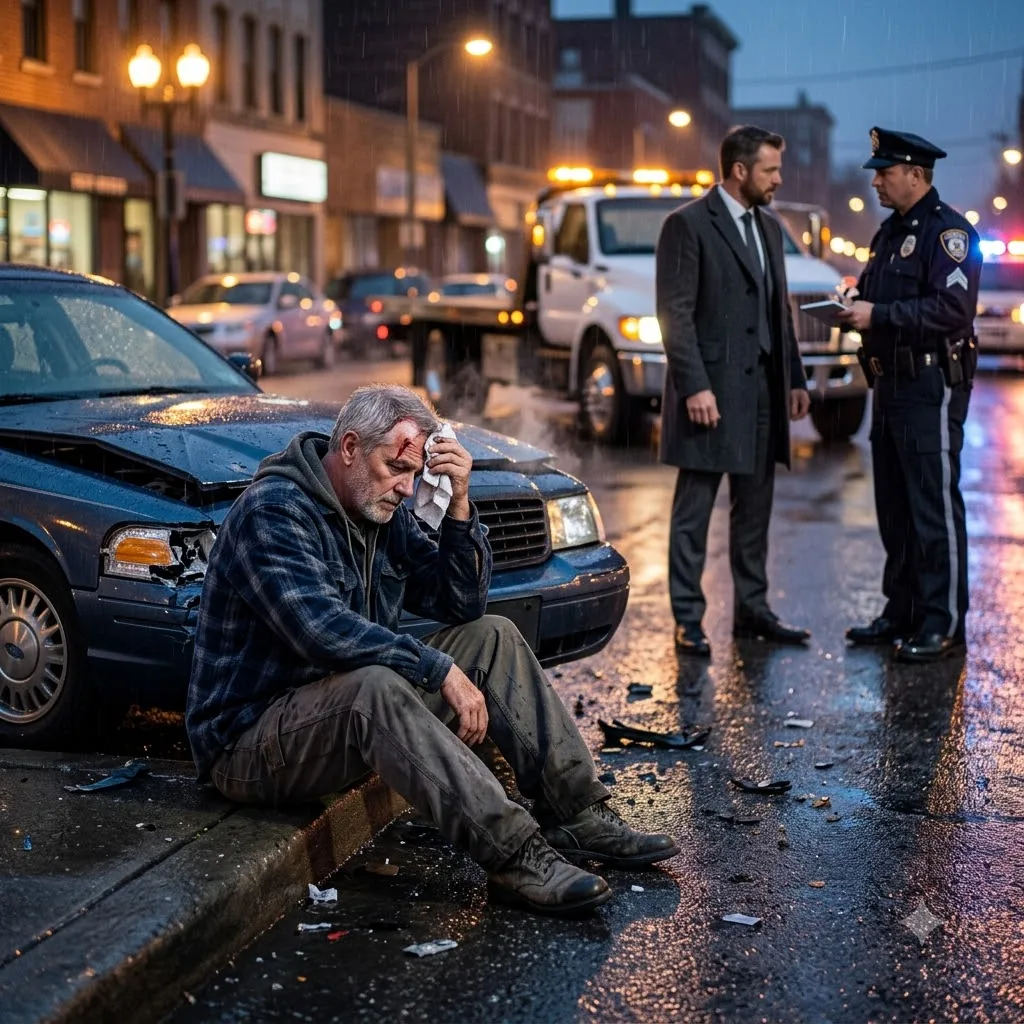
The cop, who had been lingering near his cruiser, took a menacing step toward Arthur, his hand resting casually on his duty belt. “Step back, sir. You’ve been cited. Interfere with the tow and I’ll add obstruction to your charges and take you in.”
Arthur froze. The threat wasn’t empty. If he went to a holding cell tonight, he wouldn’t be able to make bail. His frozen bank account guaranteed he would rot there until his arraignment, losing his apartment in the process. He swallowed his pride, tasting copper. “Just my laptop,” Arthur pleaded, hating how small his voice sounded over the idling diesel engines. “It’s on the passenger floorboard. It’s got my coursework. Please.”
The kid operating the winch hesitated, glancing at the cop. The officer gave a microscopic shrug. The driver popped the warped passenger door of the Taurus, reached in, and tossed a cheap, waterlogged canvas messenger bag onto the wet asphalt at Arthur’s feet.
Arthur picked it up, cradling the heavy, refurbished ThinkPad inside like an infant. He watched in silence as the winch dragged his livelihood onto the flatbed. The metal screeched against the pavement, the sound tearing through Arthur’s pounding skull. Within three minutes, the intersection was empty, leaving Arthur alone in the torrential rain with nothing but a worthless yellow citation and a damp bag.
It took him an hour to walk the two miles to a twenty-four-hour truck stop diner just off the interstate. By the time he collapsed into a corner booth, his left leg was completely numb and his work shirt was glued to his skin. The waitress, an older woman named Brenda who knew him from his delivery routes, brought him a mug of black coffee and a handful of paper towels without asking questions.
Arthur dried his face, wincing as he dabbed the deep gash above his hairline. He unzipped the canvas bag and pulled out the thick, blocky ThinkPad. It was a five-year-old machine he’d bought at a pawn shop, the hinges held together with electrical tape. He wiped the moisture from the trackpad and pressed the power button.
It whirred to life. A small, desperate mercy.
He connected to the diner’s unsecured Wi-Fi. He had spent the last eight months spending every free hour on this machine, running through free coding bootcamps, learning Python, struggling through database management, and trying to understand APIs. He wanted to build inventory software for independent garages to keep them from being swallowed by corporate chains. Now, those nascent skills were his only weapon.
Arthur opened a browser and navigated to the municipal court’s public docket system. He typed in the citation number from the wet yellow paper. The system loaded slowly, but when the page populated, Arthur felt the blood drain from his face.
The charge wasn’t just a misdemeanor traffic violation. The plaintiff listed was *Elias Thorne*, the CEO of Thorne Vanguard, a venture capital firm that bought up local real estate and automated logistics companies. But it was the attached civil filing that made Arthur stop breathing. It had been filed electronically, timestamped just twenty minutes after the crash. Thorne’s legal team was seeking $450,000 in property damage and an injunction to seize Arthur’s assets, claiming Arthur had deliberately rammed the Porsche in a “targeted act of class-motivated vandalism.”
They had already spun a narrative, weaponizing the legal system to crush him before he could even defend himself. That explained the frozen bank account. The billionaire wasn’t just walking away; he was making sure Arthur was utterly destroyed to cover his own tracks.
Arthur pulled up his command terminal. His hands shook as he typed. He opened a basic Python script he had written to scrape municipal traffic data for his delivery routes. He modified the parameters, pointing the script at the city’s traffic camera registry for the intersection where the crash occurred.
He executed the code. *Error 403: Forbidden.*
He tried again, routing it through an open proxy he’d learned to use during a web-scraping tutorial. The terminal fed back lines of data. The cameras at the intersection weren’t city property. The metadata showed they were privately owned and operated by Aegis Security-a subsidiary of Thorne Vanguard.
The footage of Thorne crossing the double yellow line existed. But it was locked behind a corporate firewall, on a private server.
Arthur rubbed his aching chest. He didn’t know how to hack a billionaire’s security grid. He only knew how to write simple loops and query databases. But as he stared at the raw JSON output in his terminal, he noticed something his instructor had mentioned in a lecture about sloppy network architecture. The camera’s data stream wasn’t going directly to a secure cloud. It was being routed through a local relay point-the glass guardhouse where Thorne had been standing out of the rain.
Arthur looked down at the citation, then at the frozen bank notification on his shattered phone. He had forty-eight hours until his arraignment. No car, no money, and the police were in Thorne’s pocket.
He closed the terminal, staring at the flashing cursor. To prove his innocence, the aging mechanic realized he couldn’t just learn to code. He was going to have to learn how to break in.