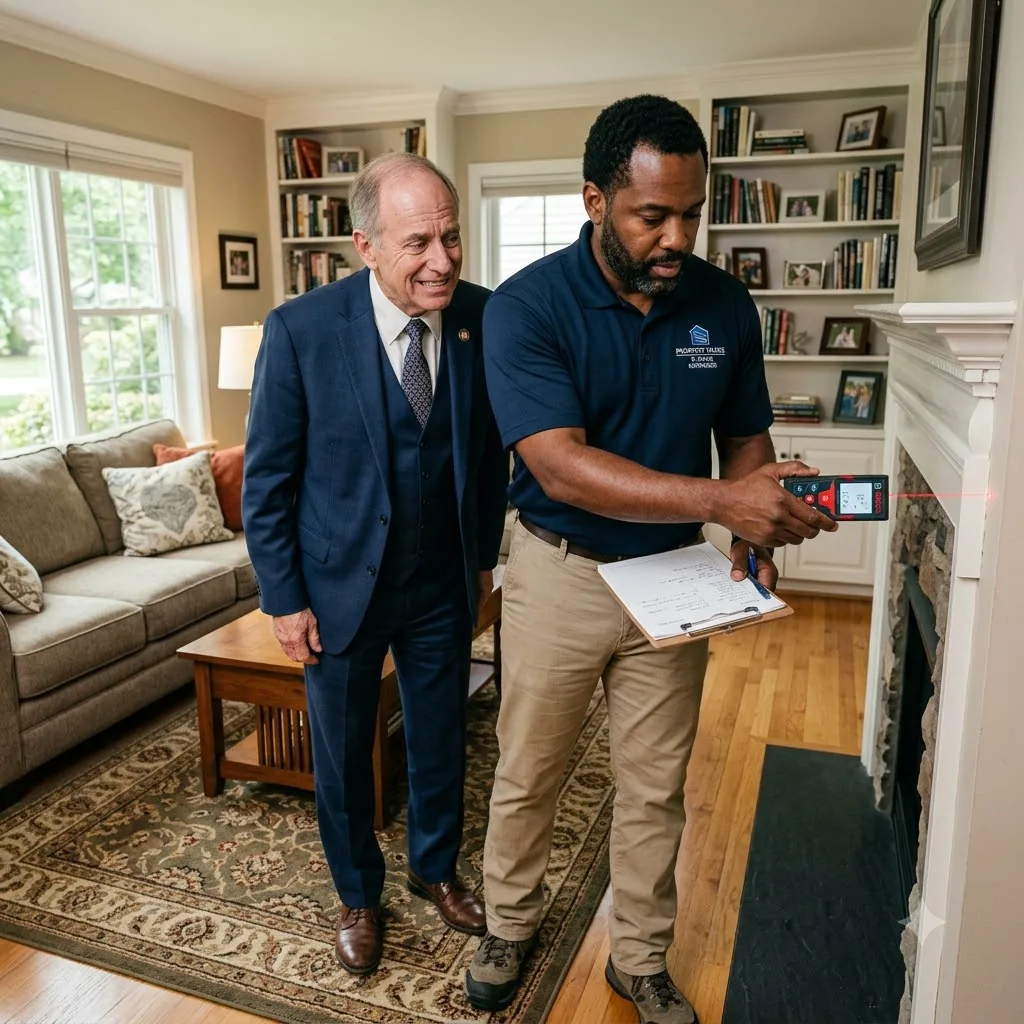
Story code: ST-000748
Part 3: Fair Market Value
The A/C blasted against Marcus’s face, but he still felt the cold sweat clinging to his collar. He sat locked in the sweltering cab of his truck, tethering his laptop to his phone’s cellular hotspot. Through the windshield, he could see Dale inside the house, casually adjusting the blinds in the front window, perfectly content to wait Marcus out.
Marcus opened the county clerk’s GIS mapping portal. If he was going to lose his license, his business, and the quiet, secular sanctuary he had spent ten grueling years building, he needed to know exactly who he was bleeding for. Dale had called the seller an “out-of-state heir.” Marcus typed the property address into the database, his fingers rigid.
The parcel data loaded, drawing a jagged blue polygon over the lot. Current Owner: The Estate of Julian Vance. Administrator: Thomas Vance, Ohio.
Marcus frowned. Julian Vance. He opened a new tab, searching the name alongside the town’s local news archives. An obituary from four months ago appeared. Julian Vance, a retired choir director, survived by his partner of twenty years, a man named Arthur. Because they hadn’t legally married before Julian’s sudden passing, and Julian left no formal will, the house had bypassed Arthur entirely. It defaulted to a distant, estranged nephew in Ohio who just wanted to liquidate the asset quickly.
But that wasn’t what made Marcus’s stomach drop. He remembered Julian. Sister Beatrice and the church elders used to actively protest Julian’s holiday concerts, handing out damnation tracts on the sidewalk and using him as a frequent, venomous example in Sunday sermons.
Marcus switched back to the county registry. His fingers flew across the keyboard, the rigid, comforting logic of data analysis taking over. He set the search parameters for the Grantee-the buyer-and typed in Providence Holdings LLC.
He expected to see two, maybe three transactions. A parsonage. A youth center.
The database churned, then spat out seventeen distinct property transfers over the past three years.
Marcus downloaded the deeds into a spreadsheet, importing the corresponding historical MLS data for each address. All seventeen properties had been listed by Dale’s brokerage. All seventeen had been sold strictly off-market or within a suspiciously short twenty-four-hour window, effectively eliminating any competing bidding wars.
But it was the names of the sellers-the Grantors-that made the breath catch in Marcus’s throat.
Parcel 402 on Elm Street. Sold by the Washingtons, a prominent Black family who had run a local bakery for decades before facing bankruptcy. Dale had listed the property at nearly forty percent below the neighborhood comps, citing “severe foundational issues” that Marcus, pulling the old inspection report from the state database, saw were completely superficial.
Parcel 119 on Maple. Sold by Elena Rostova, a transgender woman who had relocated after a year of targeted vandalism. Dale secured the listing and sold it to Providence for a fraction of its value, marking the perfectly good roof as “condemned” in the agent remarks.
Parcel after parcel. The Reynolds family in the historically Black east side. The estate of a queer couple on the north ridge.
Marcus stared at the glowing spreadsheet. The math was horrifyingly absolute. This wasn’t just about securing a cheap parsonage. Providence Holdings wasn’t merely a real estate investment arm; it was a weaponized gentrification engine. The church was using Dale to identify vulnerable, marginalized homeowners-specifically queer residents and Black families-and systematically devaluing their properties.
Dale functioned as the gatekeeper, breaching his fiduciary duty to his sellers by suppressing square footage, hiding finished renovations, and exaggerating defects to crush the appraisals. Then, Providence Holdings swooped in with lowball cash offers, stripping generational wealth from the exact demographics the church deemed “undesirable” and funneling it directly into their own tax-exempt portfolio.
It was a calculated, devastating crusade, hidden entirely behind the banal paperwork of real estate transactions.
The heavy oak front door of the house clicked shut. Dale strolled down the driveway, whistling a soft, upbeat hymn. He spun his keys around his index finger, his tailored suit immaculate in the afternoon sun.
Marcus unplugged his laptop, shoved the truck door open, and stepped out onto the blistering asphalt.
“Hey,” Dale called out, flashing that aggressively polished smile. “Glad you waited. We have an understanding, then? Raw concrete on the sketch?”
Marcus didn’t answer. He walked around the hood of his truck and turned the laptop screen toward Dale.
Dale’s smile remained, but his eyes dropped to the spreadsheet. “What is this, Marcus? I told you, I don’t care about your little math projects.”
“Seventeen properties,” Marcus said, his voice terrifyingly steady. The panic from the basement was entirely gone, burned away by the cold, hard fury of the data. “Over the last three years, you have represented seventeen sellers in this town. Every single one of them was a Black family in financial distress, a queer homeowner, or the out-of-state heir of one.”
Dale stopped spinning his keys. They hit his thigh with a sharp jingle. “I am a high-volume agent. I take on difficult listings.”
“You take on targeted marks,” Marcus corrected, tapping the screen. “You list their properties, aggressively suppress the data-like hiding a thousand square feet of premium basement-and scare off the open market so Providence Holdings can buy the land for pennies on the dollar.”
“The market dictates the price,” Dale said, though his voice had lost its theatrical projection. He took a half-step back, his eyes darting toward the street. “Estates want fast cash. It’s a service.”
“It’s a coordinated Civil Rights violation,” Marcus stepped forward, closing the distance. He kept the screen angled up, the spreadsheet glowing like a spotlight. “It is a systematic, racially and sexually targeted real estate grift. You are manipulating MLS data to orchestrate federal mortgage fraud on a multi-million-dollar scale.”
Dale swallowed, his Adam’s apple bobbing sharply against his tight collar. “You’re insane. None of that proves anything. It’s a coincidence.”
“The Federal Housing Administration doesn’t believe in coincidences,” Marcus said quietly. “And neither does the state attorney general. You threatened me with the state appraisal board, Dale? Your little congregation can write all the letters they want. I have the GIS tax records, the manipulated MLS listings, and the actual property deeds proving a RICO-level conspiracy.”
“Marcus,” Dale started, his slick veneer cracking, revealing the panicked, sweating man underneath. He raised a trembling hand, as if he could physically push the data away. “Listen to me. Sister Beatrice-”
“My mother is not on the deed,” Marcus cut him off, his voice echoing in the quiet street. “But your signature is on every single one of these fraudulent listings.”
Dale opened his mouth, but no words came out. He stared at the glowing screen, his polished smile totally shattered, completely out of ammunition.