Story code: ST-001058
Part 4: The Panopticon
The number on Mark’s glowing tablet flickered, jumping from 117 to 240 in a fraction of a second. Then, just as suddenly, the rapidly climbing number collapsed. It didn’t drop to zero. It locked at one. A single, unified administrative connection.
“This is impossible,” Mark stammered, his thick thumb hammering the glass screen in a frantic, useless rhythm. The aggressive confidence that had defined him just moments ago vanished, replaced by the pale, sweaty panic of a man watching his expensive reality unravel. “It’s a localized mesh network. It has enterprise-grade firewalls. Nobody can brute-force the master node this fast.”
Sarah did not look at Mark. She kept her eyes glued to the glowing tablet. The sleek user interface of the Panopticon-X dashboard dissolved into a raw, black-and-white developer console. Lines of code scrolled upward at dizzying speed. Then, the scrolling stopped, and a single command line pulsed in stark, undeniable white text:
TARGET ACQUIRED. OVERRIDING LOCAL ARRAY LIMITERS.
A synchronized, high-pitched mechanical whine sliced through the freezing night air. Sarah flinched, instinctively ducking her head. The sound wasn’t coming from the tablet. It was coming from the roof.
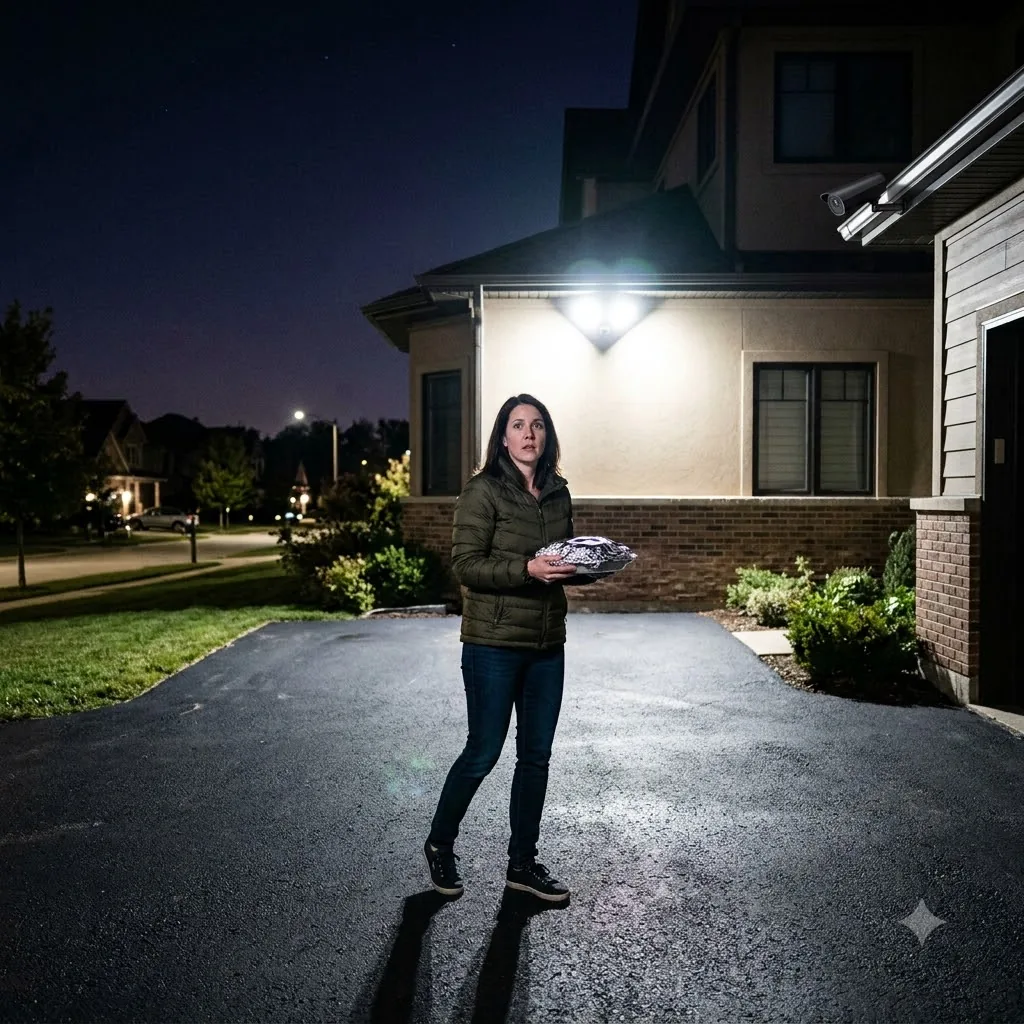
The camera directly above them, the one she had just coated in thick black enamel, remained blind. But the other four high-definition domes mounted along Mark’s pristine roofline-the ones specifically calibrated to sweep the driveway, the street, and the front porch-suddenly snapped to life. Their internal motors shrieked as they pivoted violently away from their designated sectors. They ground against their factory-set physical limiters with a sickening clicking noise, the gears forcing themselves past the intended rotation angles.
One by one, the four motorized lenses tilted sharply down, aiming directly over the six-foot wooden privacy fence. Four unblinking red LEDs burned through the darkness, forming a tight grid of digital crosshairs focused perfectly on Sarah’s chest.
“They aren’t supposed to do that,” Mark whispered, stepping away from the fence. He stared up at his own house in horror. “They’re stripping their own gears. They’re overriding the hardware locks.”
Sarah’s knees gave out. Her grip on the fence slipped, and the spray paint can tumbled from her numb fingers, hitting the damp grass with a muted thud. The heavy rare-earth magnet clamped to the bottom kept the mixing ball silent.
On the tablet, the raw code cleared, replaced by a simple text field updating the local network profile.
NODE_RENAME_COMMAND: SARAH_PRIMARY_RESIDENCE.
The cold air in Sarah’s lungs turned to ash. It was him. The man who had weaponized every legal loophole and public record for three years hadn’t just scraped a municipal database; his data aggregation firm had likely supplied the very facial recognition architecture Panopticon-X relied on. He didn’t need to hack a backdoor into Mark’s system. He owned the digital infrastructure the backdoor was built upon. He was the architect of the cloud.
“Hey!” Mark yelled at his device, panic bleeding into his voice as the screen flashed a rapid series of download confirmation bars. “It’s locking me out of the local router! It’s dumping the entire local storage cache. Every video, every thermal log, every biometric scan.”
“He has it,” Sarah said. Her voice was a hollow, weightless whisper.
“I’m cutting the mainline power!” Mark shouted, spinning around and sprinting toward his back patio. He practically threw himself up his own stairs, his tactical boots slipping on the concrete. “I’m flipping the breaker! Just stay right there!”
The heavy mahogany door slammed shut behind him, plunging his side of the fence into silence.
Sarah did not move. She remained standing on the aluminum step-stool, staring up into the four glowing red eyes tracking the subtle rise and fall of her chest. Cutting the power wouldn’t change anything. The data packets were already gone. Her exact GPS coordinates, the thermal map of her bedroom layout, the high-definition capture of her standing in the driveway-it had all been compiled, packaged, and delivered directly to his server in a matter of milliseconds.
She slowly stepped backward off the stool. As her sneakers touched the wet grass, the four motorized domes whirred in perfect, terrifying unison, their red LEDs panning smoothly to track her movement. When she stopped, the mechanical grinding stopped. When she shifted her weight to the left, the lenses tracked left.
She was no longer standing in a quiet suburban side yard. The heavy wooden privacy fence, her double-layered blackout curtains, her carefully protected phone numbers, and her meticulously constructed isolation-none of it mattered anymore. The physical walls of her sanctuary had dissolved into dust. She was standing in the dead center of a digital cage, and the lock had just clicked shut.
Sarah turned slowly toward her own dark house, feeling the immense, physical weight of his gaze pressing against her spine. The technology had done exactly what it was designed to do. It had located the anomaly. It had secured the perimeter. And she knew, with absolute, paralyzing certainty, that by sunrise, his car would be parked at the end of the cul-de-sac.